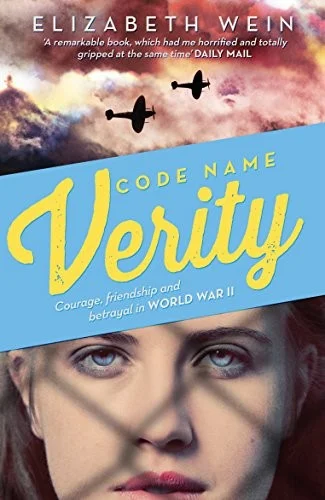
Code Name Verity
- Publication Date:
- February 26th, 2015
- Publisher:
- Egmont Books Ltd
- ISBN-13:
- 9781405278423
- ISBN-10:
- 1405278420
Why Code Name Verity Has Been Challenged
Critics of the novel have mainly taken issue with how unflinchingly it renders the cruelty of wartime captivity for a teenage readership. See more ↓
Challenged or banned in 1 state across 1 school district.
Overview
The novel opens after the fact: a British aircraft has already gone down over France in 1943, and its survivor is in the hands of the Gestapo. What follows is her account, written under duress, of how she came to be there. She is trading information for time, and the narrative she constructs is deliberately partial — shaped as much by what she withholds as by what she reveals.
At the center of her story is a friendship formed in wartime service, between women who found themselves doing dangerous, unglamorous work far from any battlefield glory. The bond between them anchors the book even as the plot moves through interrogation rooms, coded messages, and the daily improvisations required to survive occupation.
Wein builds the book around the unreliability of its own narrator, so that the reader's understanding of events shifts as new information surfaces. The structure rewards patience: details that seem incidental in the early pages take on different weight once the fuller picture emerges.
Context and Reception
Code Name Verity belongs to a small shelf of young-adult novels that treat World War II not as a backdrop for adventure but as a setting for moral pressure — the choices people make when every option carries a cost. Its interest in the Special Operations Executive and the Air Transport Auxiliary reflects a broader effort in recent historical fiction to recover the wartime contributions of women whose work went largely unrecorded at the time.
The book is also a study in narrative trust. By filtering a war story through a captive narrator writing for her captors, Wein asks readers to weigh sincerity against strategy on every page, a device that has drawn comparisons to espionage fiction as much as to conventional YA war novels. Its reputation has grown largely through word of mouth and classroom use, where its structural puzzle and its portrayal of female friendship under extremity are frequently cited as reasons for its lasting appeal.
Why Code Name Verity Has Been Challenged
The interrogation sequences at the heart of the book are frank about the mechanics of wartime captivity: psychological pressure, physical abuse, and the ever-present threat of execution are described without softening. Some readers and parents have found these passages too intense for the book's intended audience, arguing that the depiction of torture and its aftermath crosses from historical honesty into material better suited to older readers.
Objections have also centered on the novel's language and on brief scenes depicting the casual, coarser talk of servicemen and women under strain, which some reviewers have flagged as inconsistent with school reading lists. Underlying both concerns is a disagreement over how much of war's brutality belongs in a book marketed to teenagers, even one whose violence serves a clear historical and narrative purpose rather than shock value. The catalog records this title as challenged in 1 state and 1 school district.
Where to Buy



Affiliate links may generate a small commission at no extra cost to you, which helps support this site.
Banned in Schools
Banned or challenged in 1 state across 1 school district.
Wisconsin 1 district
- Elkhorn Area School District Banned pending investigation