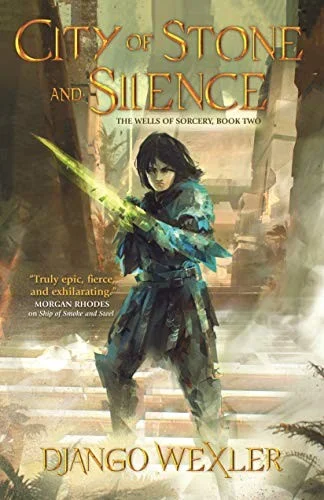
City of Stone and Silence
- Publication Date:
- January 1st, 2020
- Publisher:
- Doherty Associates, LLC, Tom
- ISBN-13:
- 9780765397270
- ISBN-10:
- 0765397277
- Pages:
- 368
Why City of Stone and Silence Has Been Challenged
Critics have taken particular issue with a fantasy adventure that treats its heroine's same-sex relationships as simply part of who she is rather than a topic requiring special framing. See more ↓
Challenged or banned in 1 state across 1 school district.
Overview
"City of Stone and Silence" continues Django Wexler's Wells of Sorcery trilogy, returning readers to a world where power is drawn from distinct magical "Wells," each granting its user a different and often dangerous ability. The novel follows Isoka, a young woman who has clawed her way to authority through combat skill and a volatile magic of her own, as she is pulled back into the factional, high-stakes politics of a city built on competing claims to sorcery and survival.
Where the first installment established Isoka's transformation from street fighter to someone entangled in forces far larger than herself, this book pushes her further into divided loyalties. She must balance the demands of the criminal world she once commanded against a covert role serving interests she does not fully trust, all while concealing the true extent of her power from allies and enemies alike.
As a middle volume in a trilogy aimed at young adult readers, the book trades some of the introductory world-building for escalating tension, deepening its cast's relationships and consequences while setting up the series' eventual resolution.
A Series Rooted in Power, Secrecy, and Divided Selves
Wexler's trilogy is built around a central tension: the gap between the self someone presents to survive and the self they actually are. Isoka's story is one of compartmentalization, since every faction she moves through believes it has a different, partial version of her, and the cost of dropping any one mask could be fatal. That dynamic gives the series its emotional core, using a fantasy magic system as a vehicle for questions about trust, performance, and belonging.
The book also sits within a broader wave of YA fantasy that foregrounds morally compromised protagonists and queer identity as integral to character rather than incidental detail. Isoka's attraction to women is part of how she relates to the people around her, and the series has been noted for folding that identity into an adventure narrative without treating it as the plot's central problem to be solved. This approach has made the trilogy a point of reference in discussions of how mainstream YA fantasy handles sexuality and heroism together.
Why City of Stone and Silence Has Been Challenged
LGBTQ+ content is the most frequently cited concern driving objections to this book, specifically the inclusion of a lesbian protagonist and same-sex attraction presented as a normal part of her character rather than a plot twist or cautionary subplot. Some challengers argue that this content is inappropriate for the younger end of the young adult audience, or that it promotes perspectives they believe schools and libraries should not make available to students.
Violence tied to the book's combat-driven plot has also drawn scrutiny, since the story's magic system is frequently used as a weapon in physical confrontations between rival factions, and some readers consider those sequences too intense for the intended age range. Within the catalog tracked here, the book has been the subject of a challenge in 1 state and 1 district, reflecting a narrower but still notable pattern of concern focused on how the novel pairs fantasy adventure with candid queer representation.
Where to Buy




Affiliate links may generate a small commission at no extra cost to you, which helps support this site.
Banned in Schools
Banned or challenged in 1 state across 1 school district.