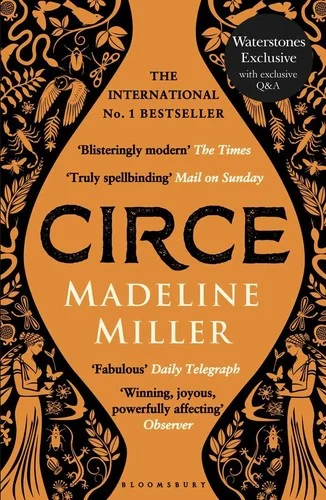
Circe
- Publication Date:
- April 4th, 2019
- Publisher:
- Bloomsbury
- ISBN-13:
- 9781526612519
- ISBN-10:
- 1526612518
- Pages:
- 336
Why Circe Has Been Challenged
Some parents and reviewers have argued that the novel's frank treatment of sex, assault, and bodily violence makes it inappropriate for teenage readers, regardless of its literary pedigree. See more ↓
Challenged or banned in 2 states across 2 school districts.
Overview
Madeline Miller's Circe reimagines a minor figure from Greek myth—daughter of the sun god Helios, aunt to monsters, footnote in the story of Odysseus—as the center of her own long and difficult life. Born without her father's radiance or her mother's cruelty, Circe is an outsider among the Titans from the start, drawn instead to the fragile, mortal world she is forbidden from touching.
When she discovers an unexpected talent for transformative magic, that gift proves dangerous enough to unsettle Zeus himself, and she is exiled to a remote island to live out her power in isolation. There she becomes a keeper of beasts and a wary host to a procession of mythic visitors, including the Minotaur's makers, a doomed inventor's son, and the cunning sailor whose stay on her shores becomes its own kind of reckoning.
What begins as banishment becomes self-invention, as Circe is forced again and again to decide what she owes to the divine family that discarded her and to the flawed, mortal world she has chosen instead.
A Goddess Rewritten from the Margins
Miller's novel belongs to a wave of contemporary fiction that returns to classical epic and asks what its silent or minor women were actually experiencing. Where Homer's Circe exists mainly as an obstacle and a temptation in someone else's journey, Miller gives her interiority, memory, and consequence, tracing how centuries of divine indifference and mortal fear might shape a single, very long life. The book sits alongside her earlier reworking of the Iliad in treating myth not as fixed scripture but as raw material for exploring power, gender, and exile.
Critical and popular reception has largely centered on the novel as a meditation on autonomy: what it costs a woman—divine or otherwise—to insist on her own competence in a world built around her father's and husband's authority. That framing has made the book a natural crossover title, read both as literary fiction and as accessible mythology for younger audiences, which in turn is part of why its more adult content has drawn scrutiny in school settings.
Why Circe Has Been Challenged
A recurring objection raised by parents and school board members is that a book marketed to teens and shelved as accessible mythology contains scenes of sexual violence and coercion that they consider too explicit for the age group encountering it in a classroom or school library. Related complaints point to depictions of rape, consensual sex between characters, and graphic violence—including transformation used as punishment and threat—as content better suited to adult readers than to the high school students who often pick it up on the strength of its mythological subject matter. Some challenges also object to its treatment of the gods' cruelty and moral ambiguity, arguing it undercuts more traditional or sanitized versions of these myths taught elsewhere in the curriculum. In this catalog, Circe has been the subject of challenges in 2 states and 2 school districts.
Where to Buy




Affiliate links may generate a small commission at no extra cost to you, which helps support this site.
Banned in Schools
Banned or challenged in 2 states across 2 school districts.
Florida 1 district
- Orange County Public Schools Banned by restriction
Tennessee 1 district
- Wilson County Schools Banned