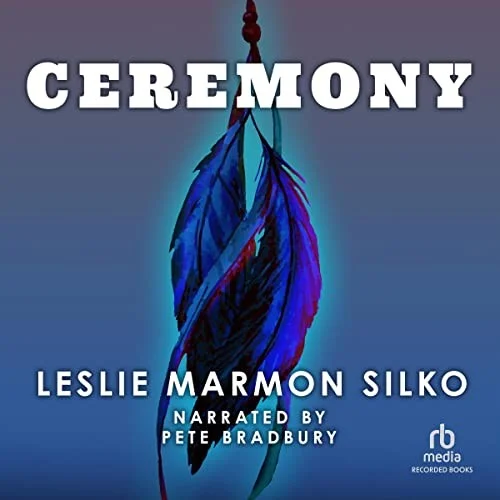
Ceremony
- Publication Date:
- June 5th, 2008
- Publisher:
- Recorded Books, Inc. and Blackstone Publishing
- ISBN-13:
- 9781664491984
- ISBN-10:
- 1664491988
- Pages:
- 1
Why Ceremony Has Been Challenged
Readers have pushed back on the novel less for its themes of war and homecoming than for the graphic honesty with which it renders sexual assault and the wreckage of addiction in a returning veteran's life. See more ↓
Challenged or banned in 1 state across 1 school district.
Overview
Tayo comes home to Laguna Pueblo broken in a way that medals and discharge papers cannot fix. Captured by Japanese forces during World War II and worn down by years of imprisonment, he arrives back on the reservation carrying a grief that has no name in the language the Army gave him for it. The world around him keeps moving as though the war ended cleanly, but Tayo cannot locate himself inside that version of events.
Where some of the men he served with settle into drinking and brawling as a way of forgetting, Tayo is pulled toward something else: the older stories and practices of his own people, half-remembered and newly urgent. His path back to himself runs through Laguna belief about sickness, imbalance, and the forces that cause harm, rather than through anything a hospital could offer him.
What follows is less a conventional plot than a slow reassembly, structured around ritual and remembrance. Silko builds the narrative out of both prose and verse, weaving traditional narrative material into Tayo's present-day search so that his healing and the old stories become versions of the same act.
A Novel Between Two Wars
Published in the mid-1970s, the novel arrived as one of the first major works of fiction by a Native American woman to reach a wide national readership, and it helped open space in American literature for Indigenous authors writing from within their own communities rather than about them. Silko draws on her Laguna heritage to build a narrative form that resists the tidy arc of Western war fiction: time loops, stories interrupt other stories, and healing is never presented as a single climactic event.
The book sits at an intersection that gives it lasting critical interest: it is a war novel, a homecoming narrative, and a work steeped in a specific tribal cosmology, all at once. Tayo's condition speaks to what would later be recognized as combat trauma, but Silko refuses to treat it purely in clinical terms, insisting instead that his damage and his cure both belong to a larger world of story, land, and ancestral obligation. That refusal has made the novel a touchstone in discussions of Native American literature, war writing, and the limits of Western medicine and psychology in addressing wounds that are also spiritual and communal.
Why Ceremony Has Been Challenged
A parent objection lodged against the novel centered on a specific scene depicting sexual violence, arguing that its inclusion in a high school curriculum exposed students to material more explicit than the educational purpose required. That complaint reflects the broader pattern behind the book's opposition: reviewers and committees have flagged its frank treatment of rape, along with its depictions of alcoholism, wartime brutality, and the violence Tayo witnesses and later confronts among his own community. Some challengers have also pointed to the novel's unflinching portrayal of racism directed at Native veterans as material they considered too harsh or unsettling for the classroom. Within the scope of this catalog, the book has drawn a single tracked challenge, spanning one state and one school district.
Where to Buy



Affiliate links may generate a small commission at no extra cost to you, which helps support this site.
Banned in Schools
Banned or challenged in 1 state across 1 school district.