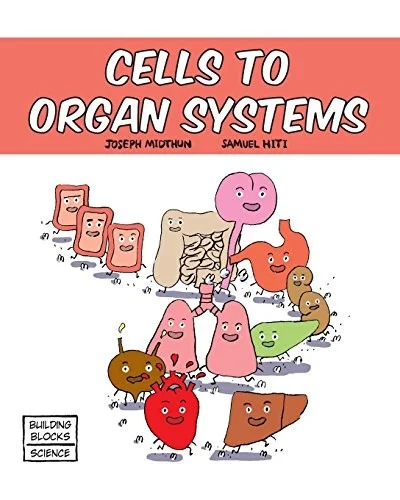
Cells to Organ Systems
- Publication Date:
- January 1st, 2014
- Publisher:
- World Book, a Scott Fetzer Company
- ISBN-13:
- 9780716618416
- ISBN-10:
- 0716618419
- Pages:
- 32
Why Cells to Organ Systems Has Been Challenged
Some parents and reviewers have objected to the book's anatomically accurate illustrations of the human body, arguing that certain diagrams are too explicit for the age of its intended readers. See more ↓
Challenged or banned in 1 state across 1 school district.
Overview
Cells to Organ Systems is a nonfiction title aimed at young readers, tracing the biological hierarchy that builds a living body: how individual cells specialize, group into tissues, form organs, and ultimately cooperate as organ systems. Joseph Midthun approaches the subject with the visual, explanatory style associated with illustrated science guides for students, breaking down abstract concepts into digestible stages.
The book moves progressively outward in scale, starting at the microscopic level before widening its lens to whole-body function. Along the way it likely touches on major systems such as circulatory, respiratory, digestive, and reproductive anatomy, since a complete account of organ systems cannot omit any of them.
As a work of children's or middle-grade science education, its purpose is descriptive rather than narrative: there is no plot to summarize, only a structured march through anatomical organization intended to build foundational literacy in biology.
Context and Reception
Books of this kind sit at an intersection that often proves contentious: they are designed for classrooms and school libraries, yet they must render the human body accurately, including systems and structures that some adults consider sensitive for younger audiences. Illustrated science titles walk a narrower line than plain-text textbooks, since diagrams and images make anatomical content more immediately visible and harder to summarize away.
Within children's science publishing, such titles are typically framed as tools for building scientific literacy early, on the premise that understanding how a body is built is inseparable from understanding health, growth, and biology more broadly. Their inclusion in school collections tends to reflect curricular alignment with life-science standards rather than any intent to provoke.
Why Cells to Organ Systems Has Been Challenged
Anatomical illustration is the recurring flashpoint for books like this one: diagrams depicting the human reproductive system, or other unclothed anatomical structures rendered for instructional purposes, are sometimes read by challengers as inappropriate imagery for the age group holding the book, even when the intent is strictly educational. This tension between clinical accuracy and perceived immodesty is a familiar pattern for science titles that must depict the whole body to be complete.
A second thread in objections concerns age-appropriateness more broadly — a concern that a child encountering detailed body diagrams outside a guided classroom lesson may be exposed to material a parent would prefer to introduce directly, rather than through independent reading. Because the book covers every organ system rather than a curated subset, it cannot avoid the more sensitive material simply by omission. In this catalog, the title has been documented as challenged in 1 state and 1 district.
Where to Buy




Affiliate links may generate a small commission at no extra cost to you, which helps support this site.
Also by Joseph Midthun
Banned in Schools
Banned or challenged in 1 state across 1 school district.