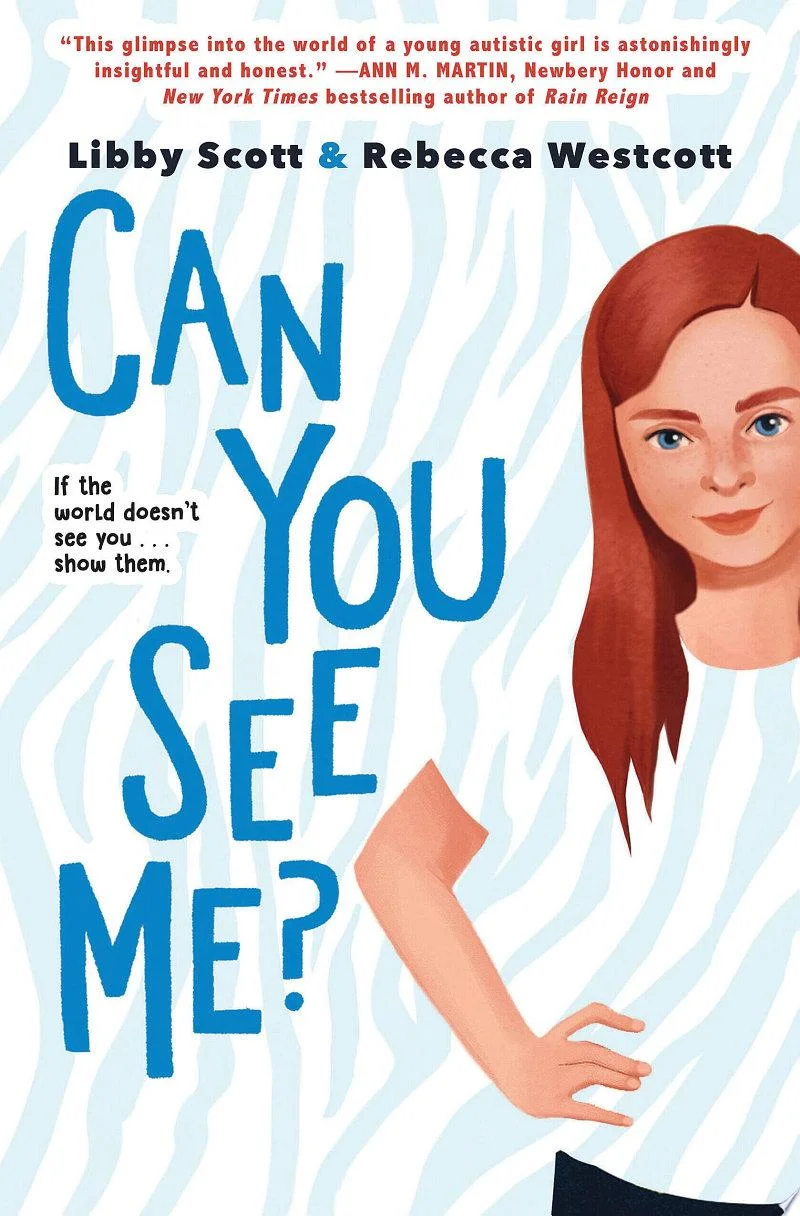
Can You See Me?
by Libby Scott
- Publication Date:
- March 3rd, 2020
- Publisher:
- Scholastic Inc.
- ISBN-13:
- 9781338608922
- ISBN-10:
- 1338608924
- Pages:
- 243
Why Can You See Me? Has Been Challenged
Some adults have questioned whether a school-set story addressing autism and social masking belongs in front of younger middle schoolers without adult framing. See more ↓
Challenged or banned in 1 state across 1 school district.
Overview
Can You See Me? follows Tally, an eleven-year-old autistic girl starting sixth grade at a new school, where a stiff uniform and unfamiliar classrooms are the least of her worries. Only her best friend Layla knows she's autistic, and Tally has decided to keep it that way, treating her diagnosis less as a fact of her life and more as a secret to be managed.
The novel traces what happens when that secrecy starts to cost her. Layla's attention drifts toward other friends, new social codes prove harder to read than old ones, and the effort of performing "normal" begins to wear Tally down in ways her classmates don't see. Small humiliations and quiet victories accumulate alongside each other, giving the story its emotional texture.
Co-written with a young autistic author drawing on her own school experience, the book renders Tally's inner life in close, specific detail rather than treating autism as an outside observer might. The result reads less like an issue book and more like a document of one particular girl's year.
A Story of Masking and Belonging
What distinguishes Can You See Me? from many school-set novels is its interest in the labor of concealment itself — the calculations Tally makes about when to speak, how to sit, what to let slip, and what to bury. That labor, often called masking in discussions of autism, is rarely dramatized from the inside in fiction aimed at this age group, and the book's authorship gives it a credibility that secondhand accounts can't match.
The novel also sits comfortably alongside other contemporary middle-grade fiction about difference and social belonging, sharing that genre's basic premise: that a young reader's understanding of a classmate unlike themselves can be built through story rather than explanation. Its reception has largely tracked that comparison, with the book frequently recommended to readers of similarly themed novels about kids navigating school while visibly or invisibly different from their peers.
Where the book pushes further is in refusing a tidy resolution to the question of disclosure. Tally's arc is less about being accepted once her secret comes out than about reconsidering, for herself, what "fitting in" is actually worth.
Why Can You See Me? Has Been Challenged
Disagreement over this book has tended to center on whether its treatment of disability and social pressure is suited to the shelves and classrooms where it's placed, rather than on any single scene or line. Because the story is told through the close perspective of a young autistic narrator working through anxiety, sensory discomfort, and the fear of exposure, some readers have questioned whether that intensity is appropriate for the age group the book is marketed to, or whether it needs more adult guidance around it than a library setting typically provides.
Other objections have focused on the broader appropriateness of centering neurodivergence so directly in school reading collections at all, reflecting wider disputes about how much say students and families should have over exposure to material dealing with disability and difference. In the catalog tracked here, the book has drawn a single challenge, recorded in one state and one district, placing it among the more narrowly contested titles in this collection rather than among those facing widespread action.
Where to Buy




Affiliate links may generate a small commission at no extra cost to you, which helps support this site.
Banned in Schools
Banned or challenged in 1 state across 1 school district.