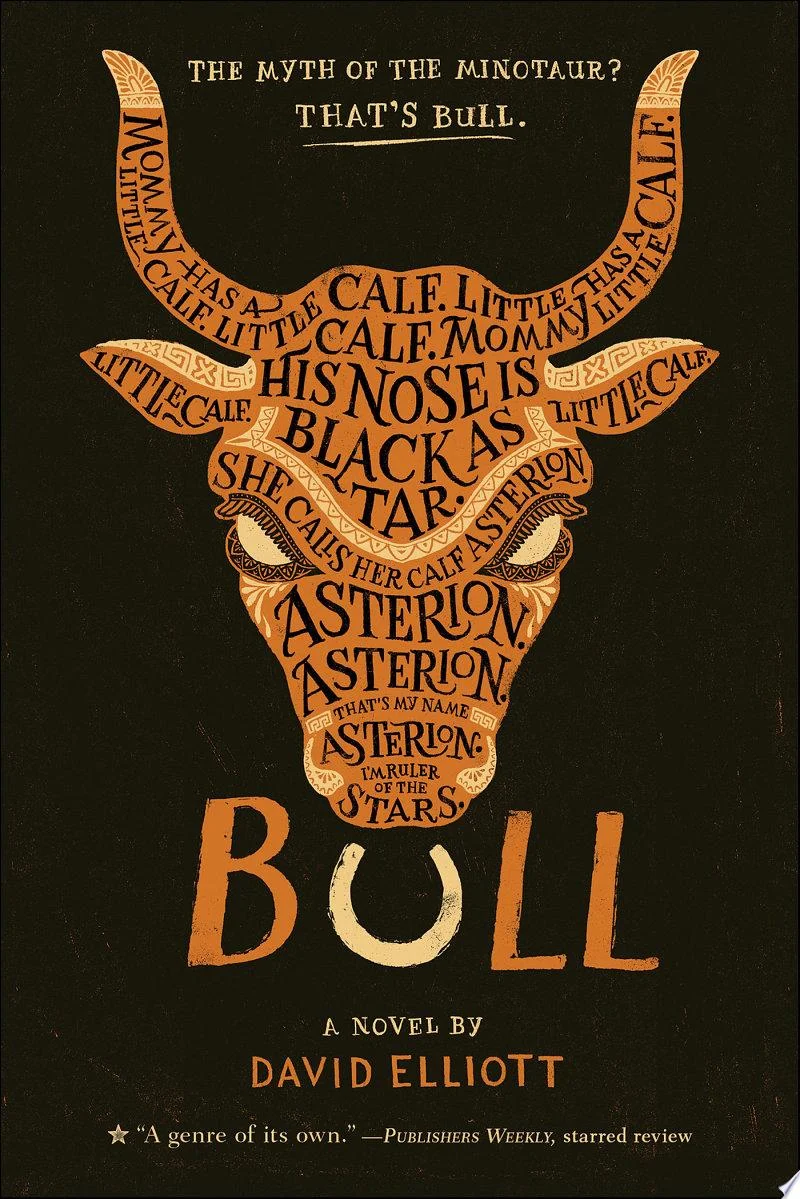
Bull
- Publication Date:
- March 28th, 2017
- Publisher:
- HarperCollins
- ISBN-13:
- 9781328698933
- ISBN-10:
- 1328698939
- Pages:
- 205
Why Bull Has Been Challenged
Critics of this verse retelling have taken issue with its blunt, often profane dialogue and the way the ancient myth's sexual origin story comes through even in stylized form. See more ↓
Challenged or banned in 1 state across 1 school district.
Overview
David Elliott's Bull retells the Greek myth of Theseus and the Minotaur as a novel in verse, letting gods, monsters, and mortals speak in their own voices across the length of the book. Poseidon opens the story with a grudge, Pasiphae and Minos carry its guilt, and the Minotaur himself eventually gets to describe what it is like to be born a monster and treated as one before anyone asks what he wants.
The form shifts poem to poem, moving between blunt, contemporary slang and more lyrical passages depending on who is speaking, which gives the book a jagged, theatrical energy rather than a single narrative voice. Elliott uses that structure to needle at the myth's cruelty: a king's arrogance, a curse turned into a birth, a child hidden underground because he is inconvenient.
NPR described the result as "beautifully clever," a nod to how the retelling manages to be funny and cutting at once while still landing the myth's darker beats.
A Classic Told Slant
Bull belongs to a small tradition of writers taking canonical stories and restaging them in a different register to expose what the original glosses over, in the way a musical like Hamilton recast a founding-era biography through a modern lens. Here, that means giving voice to figures usually reduced to background scenery in the Theseus legend: a vengeful sea god, a queen forced into a monstrous circumstance not of her choosing, and a creature defined entirely by what he looks like rather than who he is.
By letting the Minotaur speak for himself, Elliott pushes readers to reconsider a figure mythology has always treated as pure threat, asking what culpability belongs to the humans who created his circumstances rather than to the "monster" left to live them. The verse format, increasingly common in young adult fiction, also lets the book move quickly between registers, from crude comic asides to something closer to grief.
Why Bull Has Been Challenged
The poems voiced by Poseidon and other Olympians lean into coarse, contemporary language and blunt sexual innuendo, and the myth itself hinges on Pasiphae's coupling with a bull, the act that produces the Minotaur. Readers who have objected to the book point to that combination: profanity presented without softening, and a plot built around a sexual act between a queen and an animal, even though the retelling handles it through implication and metaphor rather than explicit description. The core complaint is less about any single passage than about a young adult book leaning on crude, adult-register language and a myth with sexual origins that some consider unsuitable for the intended teen audience. In the catalog tracked here, that objection has led to a challenge recorded in one state and one district.
Where to Buy




Affiliate links may generate a small commission at no extra cost to you, which helps support this site.
Banned in Schools
Banned or challenged in 1 state across 1 school district.
Florida 1 district
- Escambia County Public Schools Banned pending investigation