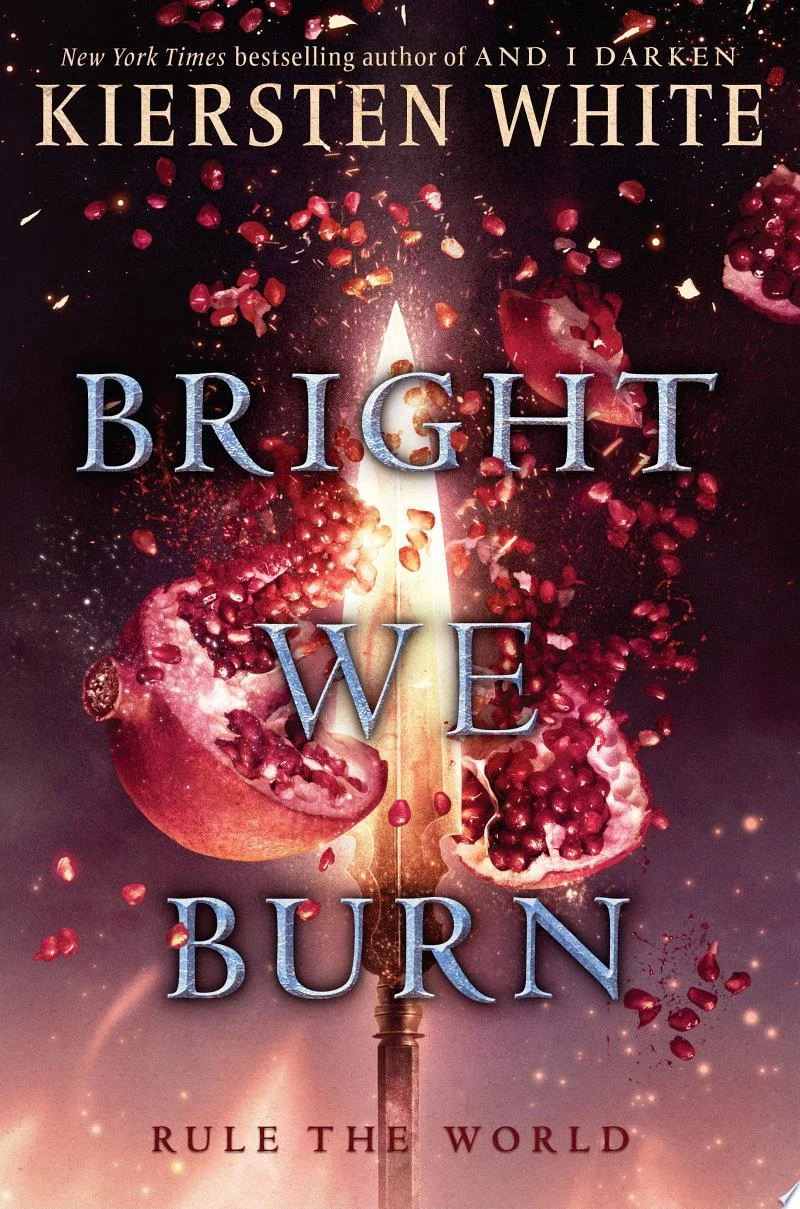
Bright We Burn
- Publication Date:
- May 7th, 2019
- Publisher:
- Ember
- ISBN-13:
- 9780553522426
- ISBN-10:
- 0553522426
- Pages:
- 434
Why Bright We Burn Has Been Challenged
Objections to this installment largely trace back to its unflinching battlefield cruelty and its matter-of-fact portrayal of a male character's longing for another man. See more ↓
Challenged or banned in 1 state across 1 school district.
Overview
Bright We Burn closes out Kiersten White's reimagining of Vlad the Impaler as Lada, a fifteenth-century noblewoman who has clawed her way to rule over Wallachia through sheer will and violence. By this final volume, her country is orderly and crime-free, but that order rests entirely on fear, and Lada is unwilling to let anyone, including the Ottoman Empire, test the borders she has drawn in blood.
Her brother Radu, meanwhile, has returned to the new Ottoman capital still unsettled by what became of people he loved, and finds himself drawn back into the orbit of Mehmed, the sultan he has quietly adored for years. Mehmed is now consolidating an empire of his own, and the isolation that comes with absolute power leaves him reconsidering what, and who, he is willing to risk.
When Lada provokes Mehmed past the point of diplomacy, the three are pulled into open war, and the novel spends its final stretch asking what each of them is actually willing to sacrifice, loyalty, love, or each other, to become the ruler history remembers.
A Trilogy's Reckoning With Power
Across the Conqueror's Saga, White has used an alternate, gender-swapped version of the Vlad the Impaler legend to interrogate what ambition costs a woman specifically, and what it costs the people around her. Bright We Burn pushes that question to its limit: Lada's success as a ruler is inseparable from her brutality, and the book refuses to resolve that tension with a tidy redemption. Her single-mindedness is framed as both her strength and the thing that isolates her from everyone who has loved her.
The novel also completes a quieter arc running underneath the war narrative, Radu's unrequited feelings for Mehmed and his search for a sense of belonging that doesn't depend on his sister's shadow. Reviewers praised the series for its emotional complexity, with Kirkus Reviews calling the finale an "intense, engrossing read that never loses sight of its passionate characters' humanity, especially when they're at their worst," and Booklist describing it as a "worthy end to a powerful saga." The trilogy sits alongside White's other historical reworkings, including her later novel reimagining Mary Shelley's circle, as part of a broader interest in rewriting familiar history through overlooked or inverted perspectives.
Why Bright We Burn Has Been Challenged
The same qualities that drew critical praise, its willingness to sit inside violence and desire without flinching, are what have drawn objections in schools. Rather than disputing the book's literary ambition, challenges have focused on specific content parents and administrators considered inappropriate for the age group reading it.
The most frequently cited concern is the book's graphic violence: Lada's rule is enforced through executions, mutilation, and the aftermath of battle, rendered in detail consistent with the historical atrocities attributed to Vlad the Impaler. Challengers have also pointed to sexual content involving the main characters, and to Radu's romantic feelings for another man, which some objectors framed as content unsuitable for a school library's younger readers rather than as a flaw in the writing itself. In the one state and one school district where this title has been formally challenged within this catalog, these concerns were raised together as grounds for restricting or removing the book from shelves.
Where to Buy




Affiliate links may generate a small commission at no extra cost to you, which helps support this site.
Also by Kiersten White
Banned in Schools
Banned or challenged in 1 state across 1 school district.