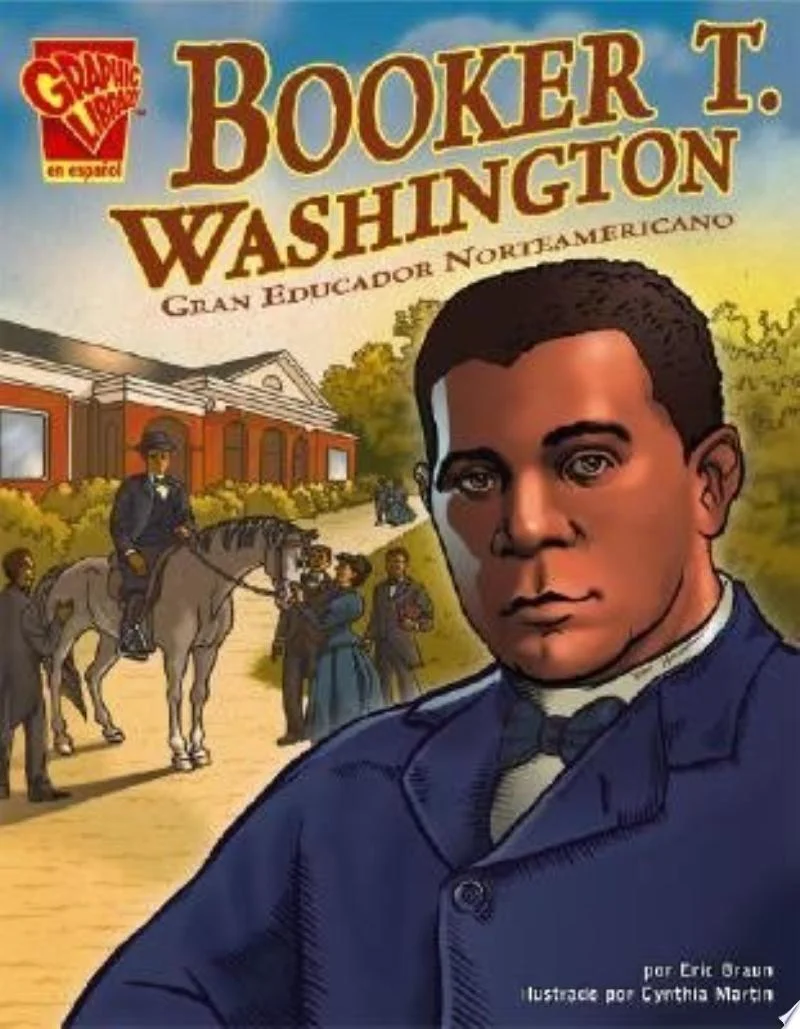
Booker T. Washington
by Eric Braun
- Publication Date:
- September 1st, 2006
- Publisher:
- Capstone
- ISBN-13:
- 9780736865999
- ISBN-10:
- 0736865993
- Pages:
- 36
Why Booker T. Washington Has Been Challenged
Some reviewers have questioned not Washington's story itself but whether a young readership should encounter the hard realities of slavery and segregation it depicts, even in illustrated form. See more ↓
Challenged or banned in 1 state across 1 school district.
Overview
This graphic novel biography traces the life of Booker T. Washington, the educator and institution-builder whose work shaped the trajectory of Black education in the decades following the Civil War. Rendered in sequential art rather than straight prose, the book follows Washington from the constraints of his early life into his emergence as a founder of schools and a national voice on how formerly enslaved people and their descendants might gain footing in American civic and economic life.
The comics format places this account alongside a growing shelf of illustrated nonfiction aimed at making history more immediate for young readers. Panels and captions substitute for dense paragraphs, compressing a complicated life into a sequence of visual scenes meant to hold a middle-grade or early-teen reader's attention while still conveying real historical stakes.
As a biography rather than a work of fiction, the book is bound to the facts of its subject's life: the limited schooling available to Black children in the post-war South, the uphill effort of building institutions from almost nothing, and the broader climate of racial restriction Washington worked within and around.
Washington's Place in the Story of American Education
Washington occupies a contested spot in American memory. He is remembered both as a pragmatic builder who expanded access to vocational and industrial education for Black Americans at a moment when options were scarce, and as a figure whose gradualist public positions drew sharp criticism from contemporaries who wanted more immediate demands for civil and political equality. A biography aimed at younger readers has to hold both threads at once: the genuine scale of what Washington built, and the debates his strategy provoked then and still provokes among historians.
That tension is part of what makes his story useful in classrooms. It offers an entry point into Reconstruction and the Jim Crow era not through abstract summary but through one person's choices under real constraint, inviting readers to weigh the costs and payoffs of incremental change versus confrontation. The graphic novel format, with its reliance on visual shorthand, necessarily simplifies some of that nuance, which is itself often a point of discussion when the book is used alongside other sources.
Why Booker T. Washington Has Been Challenged
Most objections to this title are less about whether Washington belongs in a school library than about where on the shelf, and at what age, his story should be encountered. Because the book renders its history visually for younger readers, some challenges center on whether the graphic novel format is equipped to handle material involving slavery and entrenched racial discrimination without flattening or oversimplifying it.
Underneath that placement question sits a more substantive objection: discomfort with exposing younger readers to the realities of slavery and legalized racism at all, even in a biography focused on uplift and achievement. Because an honest account of Washington's life cannot avoid describing the segregation and violence of the era he navigated, some reviewers have treated the book as part of a broader category of race-history titles drawing scrutiny in recent years, rather than objecting to anything specific to Washington's own story. The book has been challenged in one state and one district tracked in this catalog, reflecting a narrow but real dispute over how directly younger readers should encounter this chapter of American history.
Where to Buy




Affiliate links may generate a small commission at no extra cost to you, which helps support this site.
Banned in Schools
Banned or challenged in 1 state across 1 school district.