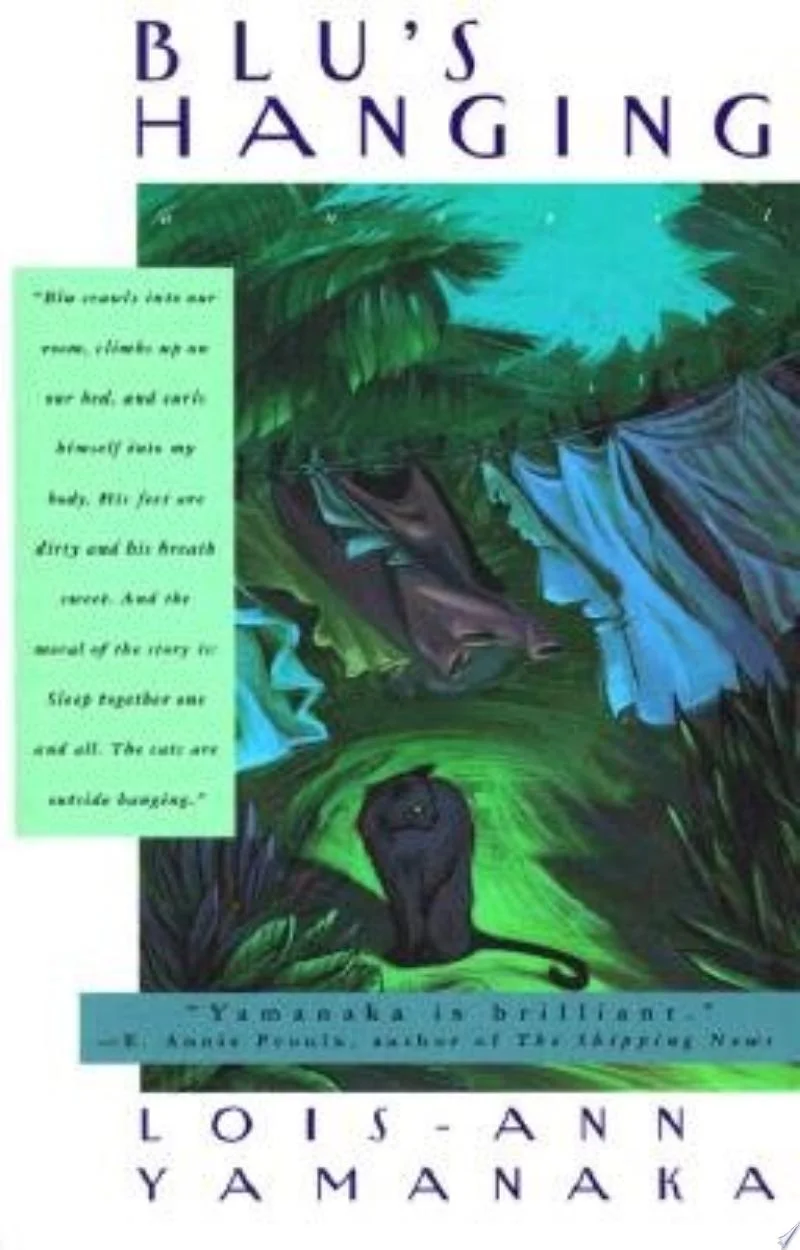
Blu's Hanging
- Publication Date:
- July 1st, 1998
- Publisher:
- Harper Collins
- ISBN-13:
- 9780380731398
- ISBN-10:
- 0380731398
- Pages:
- 276
Why Blu's Hanging Has Been Challenged
Critics have taken particular issue with the novel's willingness to put scenes of abuse and cruelty directly in front of young readers rather than keeping them off the page. See more ↓
Challenged or banned in 1 state across 1 school district.
Overview
Lois-Ann Yamanaka's novel follows three siblings on the Hawaiian island of Moloka'i after a family tragedy strips them of both parents in all but name. Their mother is gone, and their father, undone by grief, withdraws into himself, leaving the children to navigate school, friendship, and daily survival largely on their own. The narrative centers on the eldest child's attempts to hold the family together while still being a kid herself.
Told in a voice shaped by Hawaiian Pidgin and local idiom, the book renders working-class island life with specificity and immediacy. Yamanaka resists sentimentalizing the children's circumstances; moments of humor, cruelty, and tenderness sit side by side, reflecting how young people actually process loss rather than how adult narratives often imagine they should.
The result is a coming-of-age story grounded in a particular place and culture, one that treats childhood grief as messy and unresolved rather than as a tidy arc toward healing.
Voice, Place, and the Texture of Grief
Much of the book's critical attention centers on its commitment to vernacular voice. By writing in Pidgin rather than standard English, Yamanaka asserts the legitimacy of a regional and working-class idiom often excluded from literary fiction, situating the novel within a broader body of Hawaiian literature concerned with identity, authenticity, and who gets to narrate island life on its own terms.
That same unsentimental approach extends to how the book handles trauma. Rather than softening the children's experience for the reader's comfort, the novel allows ugliness, confusion, and dark humor to coexist with genuine affection among the siblings. This refusal to resolve grief neatly is part of what distinguishes the book within coming-of-age fiction, but it is also the quality most likely to unsettle readers expecting a more conventional, redemptive arc.
Why Blu's Hanging Has Been Challenged
Most objections to the novel cite its suitability for high school readers, arguing that its frank content exceeds what is appropriate for teenage audiences even at the upper grade levels. Critics raising these concerns point to the book's graphic treatment of sexual abuse and its unvarnished depictions of neglect, bullying, and childhood cruelty, arguing that the material is too disturbing to assign without extensive guidance or warning. Some have also objected to the novel's frank language and sexual content more broadly, as well as to scenes depicting animal cruelty, finding them gratuitous rather than essential to the story being told. Supporters of the book counter that these same elements are what give the novel its honesty, allowing it to portray the real aftermath of parental loss without flinching away from the hardest parts of children's inner lives. The book has been the subject of documented challenges in 1 state and 1 school district tracked in this catalog.
Where to Buy




Affiliate links may generate a small commission at no extra cost to you, which helps support this site.
Banned in Schools
Banned or challenged in 1 state across 1 school district.
Florida 1 district
- Orange County Public Schools Banned by restriction