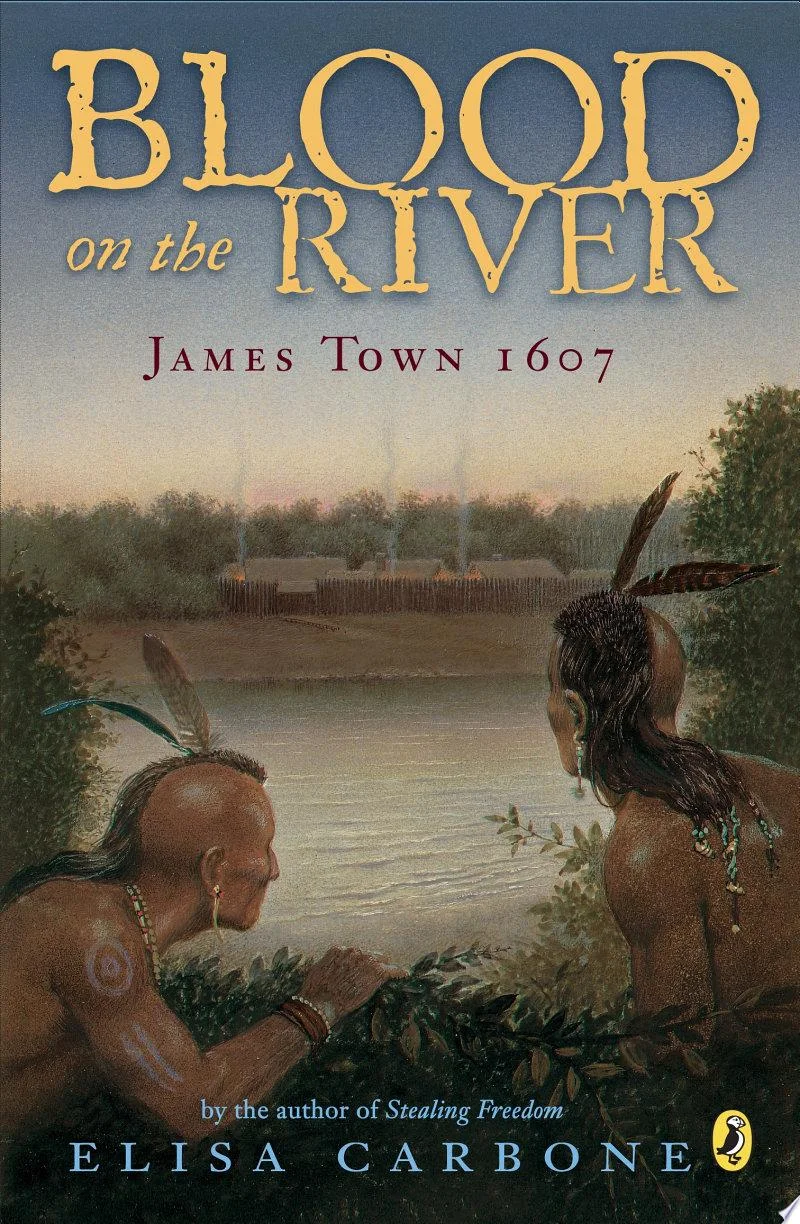
Blood on the River
- Publication Date:
- September 20th, 2007
- Publisher:
- Penguin
- ISBN-13:
- 9781440684388
- ISBN-10:
- 1440684383
- Pages:
- 260
Why Blood on the River Has Been Challenged
Some readers have pushed back on the book for confronting young audiences with the era's real violence and the fraught, often exploitative dynamics between English settlers and the Algonquian people rather than softening them. See more ↓
Challenged or banned in 1 state across 1 school district.
Overview
Elisa Carbone's novel follows Samuel Collier, a poor boy from London's streets who lands an unlikely position as page to Captain John Smith. When Smith boards the Susan Constant bound for Virginia, Samuel goes with him, drawn by tales of a New World where fortune supposedly lies waiting on the beaches.
The crossing itself disabuses him of easy expectations, and the settlement that follows at James Town proves far more complicated than the stories promised. The land is at once striking and unforgiving, and the settlers' relationship with the Algonquian people who already live there resists any simple sorting into allies and enemies.
As Samuel picks up the Algonquian language and watches Smith navigate the delicate, high-stakes business of diplomacy, he starts to grasp that his identity in this place isn't fixed by the rank he held back in London. The New World, whatever else it is, gives him room to become someone else.
A Boy's-Eye View of Colonial Encounter
Carbone works within a well-established tradition of historical fiction that puts a young, socially marginal protagonist at the center of a documented historical episode. Samuel's low status in England is the hinge of the story: it's precisely because he has so little standing at home that the New World's uncertainty reads to him as opportunity rather than only danger. That framing lets the novel explore Jamestown's early, precarious months through eyes attuned to survival and possibility rather than through the perspective of the colony's commanders or chroniclers.
The book also sits inside the ongoing project of retelling the Jamestown story with more attention to the Algonquian perspective than older, more triumphalist accounts allowed. By having Samuel actually learn the language and observe cross-cultural negotiation up close, Carbone signals an interest in complicating the settler narrative, even while keeping a young English boy as her point-of-view character.
Why Blood on the River Has Been Challenged
The novel's depiction of contact between the English colonists and the Algonquian people, along with its unvarnished picture of the hardship, violence, and moral ambiguity of the Jamestown settlement, has drawn the scrutiny behind its challenges. Some objections center on how the book portrays Native people and colonial violence, with concerns that the material is too intense or too frank about the era's brutality for the age group likely to encounter it in a classroom or library setting. Others reflect broader discomfort with how the founding of an English colony is framed for young readers when the story includes conflict, deception, and the deaths of both colonists and Algonquians rather than a tidier version of events. In the catalog tracked here, the book has been challenged in 1 state and 1 school district.
Where to Buy




Affiliate links may generate a small commission at no extra cost to you, which helps support this site.
Banned in Schools
Banned or challenged in 1 state across 1 school district.
Florida 1 district
- School District of Manatee County Banned by Restriction