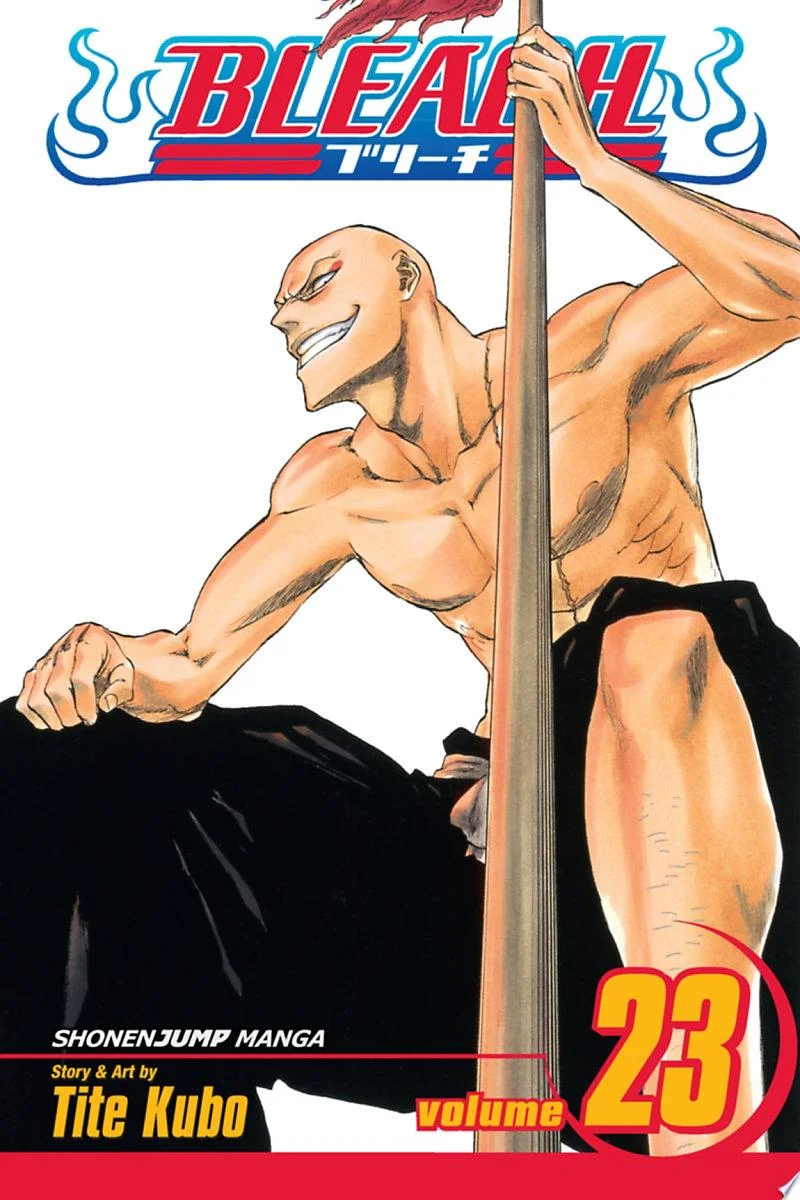
Bleach, Vol. 23
by Tite Kubo
- Publication Date:
- September 12th, 2011
- Publisher:
- VIZ Media LLC
- ISBN-13:
- 9781421548142
- ISBN-10:
- 1421548143
- Pages:
- 202
Why Bleach, Vol. 23 Has Been Challenged
Reviewers have flagged this volume primarily for the visceral intensity of its illustrated battle sequences and the danger extended to civilian bystanders. See more ↓
Challenged or banned in 1 state across 1 school district.
Overview
Bleach, Vol. 23 continues Tite Kubo's long-running manga saga with the Arrancars' invasion of Karakura Town. These Hollows-turned-soldiers, who have clawed their way into possessing Soul Reaper-caliber abilities, arrive under the command of Grimmjow Jaegerjaques with a single mandate: eliminate anything capable of resisting them.
The volume widens the series' stakes beyond its core cast. Rather than confining the danger to Ichigo and his fellow Soul Reapers, the Arrancars cast a wide net, targeting any resident of Karakura Town who registers even a faint trace of spiritual power. That shift transforms an ordinary neighborhood into contested ground and forces the story's heroes to defend people who never asked to be part of the fight.
As a mid-series installment, this volume functions as connective tissue in a much longer arc, escalating tension and raising the cost of confrontation while setting pieces in motion for the battles that follow.
A Long Arc of Escalating Threats
By this point in the series, Bleach had settled into a rhythm familiar to long-form shonen manga: each new antagonist faction arrives more powerful than the last, and each volume adds another layer to an increasingly intricate cosmology of souls, Hollows, and the afterlife bureaucracy that governs them. The Arrancars occupy a distinct narrative niche within that cosmology, as beings who have crossed from monstrous Hollow into something closer to the heroes who are meant to oppose them.
That blurring of categories is part of what sustains reader interest across dozens of volumes. Grimmjow and his companions are not simple villains; they embody a world where power is acquired rather than granted, and where the line separating protector from predator keeps shifting. The decision to endanger ordinary townspeople, rather than only trained combatants, also reflects a broader pattern in the series of raising emotional stakes by widening the circle of who can be hurt.
Why Bleach, Vol. 23 Has Been Challenged
Graphic combat imagery is the primary concern raised about this volume, as is common for action-driven manga aimed at older teen readers. The Arrancars' campaign against Karakura Town is depicted through Kubo's characteristically intense battle sequences, and objections have centered on the visual intensity of that violence, including injury and the threat posed to civilian characters, rather than on language or thematic content.
Some objections also reflect broader unease about manga as a format in school and library collections, where illustrated violence can read as more viscerally immediate than its prose equivalents, prompting questions about age-appropriate shelving and audience. In the catalog tracked here, this volume has drawn a formal challenge in 1 state and 1 district, a narrow but notable instance of the scrutiny manga titles have faced in collection reviews.
Where to Buy




Affiliate links may generate a small commission at no extra cost to you, which helps support this site.
Also by Tite Kubo


Banned in Schools
Banned or challenged in 1 state across 1 school district.