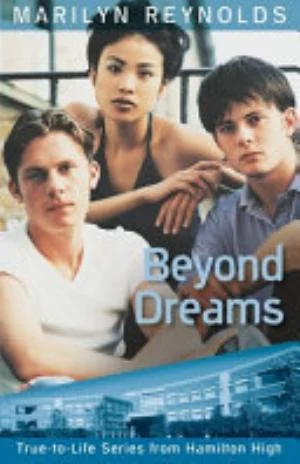
Beyond Dreams
- Publication Date:
- August 15th, 2014
- ISBN-13:
- 9781929777020
- ISBN-10:
- 1929777027
- Pages:
- 193
Why Beyond Dreams Has Been Challenged
Some parents and educators have argued that teenagers shouldn't encounter frank depictions of abuse, addiction, and sexuality in school-assigned reading, regardless of the book's cautionary intent. See more ↓
Challenged or banned in 1 state across 2 school districts.
Overview
Beyond Dreams gathers six short stories, each centered on a teenager navigating a moment of personal upheaval. The narrators alternate between young men and young women, giving the collection a kind of call-and-response structure as it moves through different households, friend groups, and emotional states.
The crises at the heart of each story are drawn from ordinary adolescent life pushed to its breaking point: a car accident involving alcohol, an unplanned pregnancy, a relationship that has turned controlling, a classroom failure that threatens a larger future, a family member whose decline reshapes a household, and the quiet, corrosive presence of racism. None of these threads is treated as exceptional or sensational; instead, each is presented as the kind of ordinary hardship that arrives without warning and forces a reckoning.
Reynolds keeps the focus tight on interior experience rather than plot mechanics, favoring voice and emotional honesty over resolution. The result is less a single narrative than a mosaic of adolescence under strain, in which the stories accumulate meaning by proximity to one another.
A Collection Built on Empathy and Consequence
Reynolds has built a body of work around young adult fiction that treats difficult circumstances as material for empathy rather than spectacle, and Beyond Dreams fits that pattern by compressing her longer-form concerns into short fiction. The format itself does some of the thematic work: by giving each crisis its own compact story rather than folding every issue into one plot, the collection suggests that these experiences are common and varied rather than rare or isolated.
The alternating narration between male and female teenagers is a deliberate structural choice, resisting the assumption that stories about pregnancy, abuse, or caregiving belong only to one gender's perspective. Read together, the six stories function as a kind of survey of what adolescence can demand of a person, and of how young people process fear, shame, and responsibility when adults are often absent, distracted, or part of the problem.
Within discussions of bibliotherapy and realistic YA fiction, the book is often positioned as a tool for classrooms and counseling settings, meant to give students language and context for situations they or their peers may already be living through, rather than as an introduction to ideas they would otherwise be unaware of.
Why Beyond Dreams Has Been Challenged
Much of the friction around Beyond Dreams centers less on whether its subjects are worth discussing than on whether a short-story collection assigned or shelved for teen readers is the right venue for discussing them so directly. Critics have questioned whether the book's compressed format, moving quickly between weighty topics, gives young readers enough context to process what they encounter, and some have pushed for the collection to be restricted to older students or removed from general circulation entirely.
The specific objections cluster around a handful of recurring concerns: depictions of drunk driving and its aftermath, abortion and teen pregnancy, physical and emotional abuse within a dating relationship, and school failure intertwined with family caregiving burdens. Some challengers have also objected to the collection's treatment of racism, arguing that its presentation is too blunt for a classroom setting, while others have focused on the abuse and pregnancy storylines as inappropriate for the age group likely to encounter the book in a school library.
In the catalog tracked here, Beyond Dreams has drawn a challenge in 1 state and 2 districts. The disputes tend to reflect a broader disagreement about whether realistic fiction that mirrors teenagers' actual struggles belongs in school settings, or whether its frankness outweighs its value as a resource for young readers facing similar circumstances.
Where to Buy




Affiliate links may generate a small commission at no extra cost to you, which helps support this site.
Banned in Schools
Banned or challenged in 1 state across 2 school districts.
Florida 2 districts
- Citrus County School District Banned
- Collier County Public Schools Banned