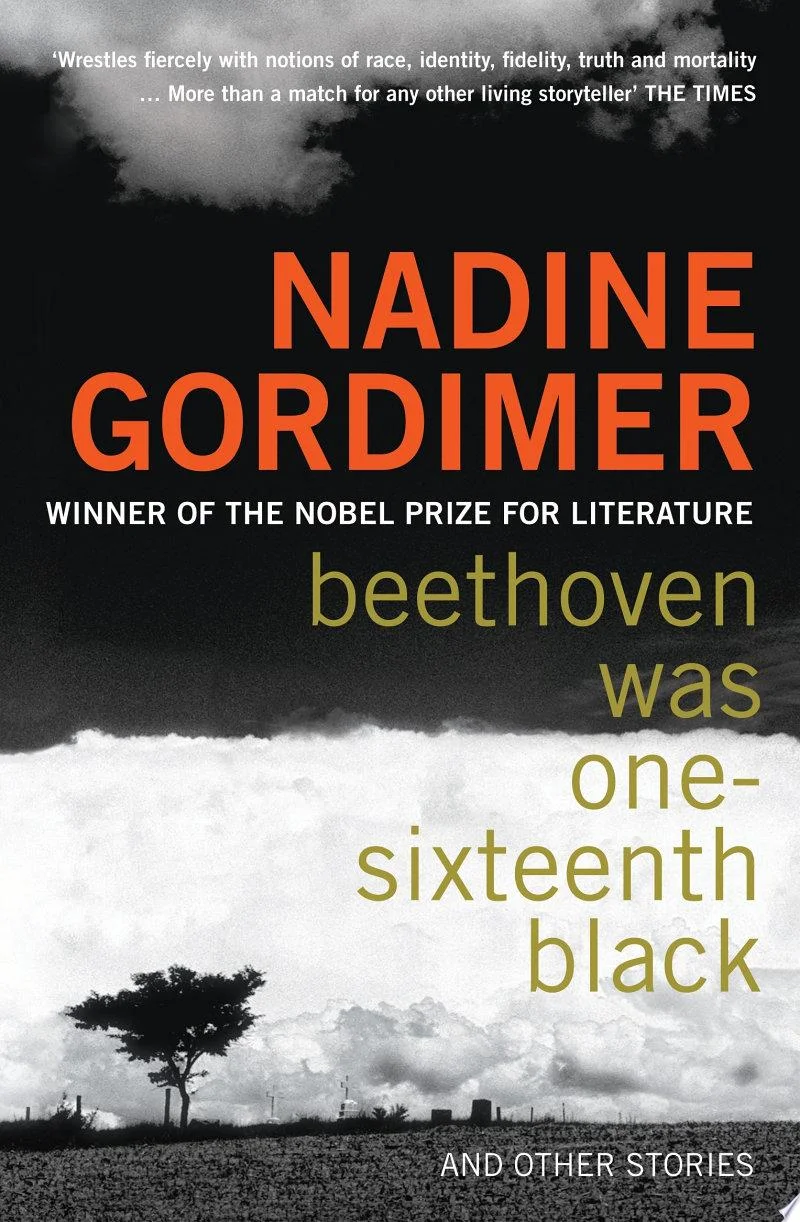
Beethoven Was One-sixteenth Black
- Publication Date:
- March 15th, 2012
- Publisher:
- A&C Black
- ISBN-13:
- 9781408832981
- ISBN-10:
- 1408832984
- Pages:
- 184
Why Beethoven Was One-sixteenth Black Has Been Challenged
Objectors have taken issue less with any single scene than with the collection's willingness to write about racial identity and mixed ancestry in frank, unresolved terms. See more ↓
Challenged or banned in 1 state across 1 school district.
Overview
Gathered late in a career that spanned the whole arc of apartheid and its aftermath, this collection brings together short fiction by Nadine Gordimer, whose work had already earned her both the Nobel Prize in Literature and the Booker Prize before this book's release. The stories carry her characteristic attention to the small domestic and social frictions through which larger political histories become visible.
Rather than offering a single sustained narrative, the collection moves between characters and situations, using the compressed form of the short story to isolate moments where personal identity, inherited history, and social expectation collide. Its title story takes its premise from a claimed fragment of ancestry to probe how people narrate lineage and belonging to themselves and others.
Readers familiar with Gordimer's novels will recognize her spare, observant prose and her refusal to resolve tension neatly; those new to her work will find the stories a compact entry point into the concerns that defined her fiction.
Gordimer's Late Style and Its Concerns
By the time this collection appeared, Gordimer had spent decades writing from inside a country reckoning with the legacy of legally enforced racial separation, and her later fiction increasingly turned that same unflinching eye toward the messier, less codified forms race and memory take in ordinary life after formal segregation ends. The stories here are less interested in dramatic confrontation than in the quiet, often uncomfortable moments where a family history, a chance remark, or an assumed fact about ancestry forces a character to reconsider what they thought they knew about themselves or someone close to them.
This places the collection within a broader trajectory in Gordimer's work: a movement from the overt political urgency of her apartheid-era novels toward a more interior, ambiguous exploration of how identity persists, mutates, and gets misremembered once the structures that once defined it have officially fallen away. Critics have generally read the book as a continuation of her lifelong insistence that fiction's job is to notice what official histories leave out, applied here to the intimate scale of personal and family memory rather than to national events.
Why Beethoven Was One-Sixteenth Black Has Been Challenged
Objections to this collection have tended to center less on whether younger readers should encounter it at all and more on where in a library or curriculum it properly belongs, given that its themes and prose style are aimed at an adult literary audience rather than a general or youth readership. Within that framing, the substantive complaints focus on the book's direct engagement with race, ancestry, and the social fictions surrounding both. Some challenges have objected to the frankness with which the stories examine racial classification and mixed heritage, treating the subject matter itself as inappropriate for certain shelves or collections rather than disputing any particular scene or passage. Others have raised concerns tied to language and adult content found in individual stories, which some readers felt made the collection unsuitable for open or unrestricted access. Notably, the collection has drawn a formal challenge or removal attempt in exactly one state and one school district tracked in this catalog, a narrow footprint that reflects its status as adult literary fiction rather than a title routinely assigned to younger students, but one still worth recording as part of the broader pattern of scrutiny applied to work that treats race and identity without euphemism.
Where to Buy




Affiliate links may generate a small commission at no extra cost to you, which helps support this site.
Banned in Schools
Banned or challenged in 1 state across 1 school district.