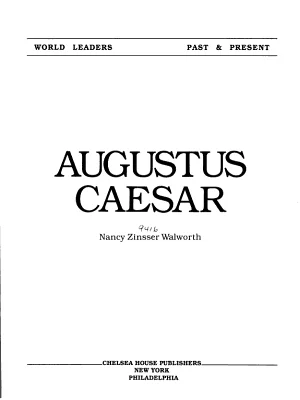
Augustus Caesar
- Publication Date:
- January 1st, 1989
- Publisher:
- Chelsea House
- ISBN-13:
- 9781555468040
- ISBN-10:
- 1555468047
- Pages:
- 116
Why Augustus Caesar Has Been Challenged
A parent's objection to this title questioned whether a young reader's shelf was the right place for a story built around political betrayal and the seizure of imperial power. See more ↓
Challenged or banned in 1 state across 1 school district.
Overview
Nancy Zinsser Walworth's biography follows the life of Octavian, later known as Augustus, from his unlikely position as the grand-nephew and adopted heir of Julius Caesar to his emergence as the founder of the Roman Empire. The narrative traces how a comparatively untested young man outmaneuvered seasoned rivals in the chaos following Caesar's assassination.
The book then turns to Augustus's decades-long consolidation of authority, describing how he transformed a fractured republic wracked by civil war into a stable imperial system while carefully preserving the outward forms of republican governance.
Walworth also considers the cultural flourishing that took shape under Augustus's rule, presenting his reign as a turning point in which Rome's political structures and public life were permanently reordered.
Historical Context and Significance
The book sits within a tradition of biographical writing aimed at younger readers that treats ancient political figures as case studies in ambition, strategy, and the exercise of power. Rather than simply cataloguing dates and battles, it invites readers to consider how one man's calculated maneuvering permanently altered a centuries-old system of government.
Augustus himself is a notoriously difficult subject for biography: he was a master of political image-making who left behind a carefully curated account of his own achievements, and later historians have long debated how much of his reputation for restraint and civic virtue was genuine versus constructed. A book aimed at student readers must navigate this tension between the historical record and the propaganda Augustus generated about himself, making choices about how critically to treat its subject. Its place in classroom and library collections reflects an enduring interest in classical antiquity as a lens for examining leadership, the fragility of republican institutions, and the mechanics of consolidating power.
Why Augustus Caesar Has Been Challenged
A complaint lodged against the book centered on whether a biography of a Roman emperor belonged on shelves intended for younger students at all, with the objecting parent arguing that its dense historical and political content was better suited to older readers or a different course of study. The concern was less about any single passage than about the book's overall fit for its intended audience and grade level.
Underlying such objections is a broader unease sometimes expressed about classical history titles: that they present political violence, assassination, and the ruthless pursuit of power as ordinary features of a leader's rise, without enough framing to guide younger readers in interpreting those events. This title has drawn a single tracked challenge, spanning one state and one school district, reflecting how infrequently a straightforward historical biography attracts sustained objection compared to works dealing with more contemporary or explicitly controversial subject matter.
Where to Buy




Affiliate links may generate a small commission at no extra cost to you, which helps support this site.
Banned in Schools
Banned or challenged in 1 state across 1 school district.
Florida 1 district
- Escambia County Public Schools Banned pending investigation