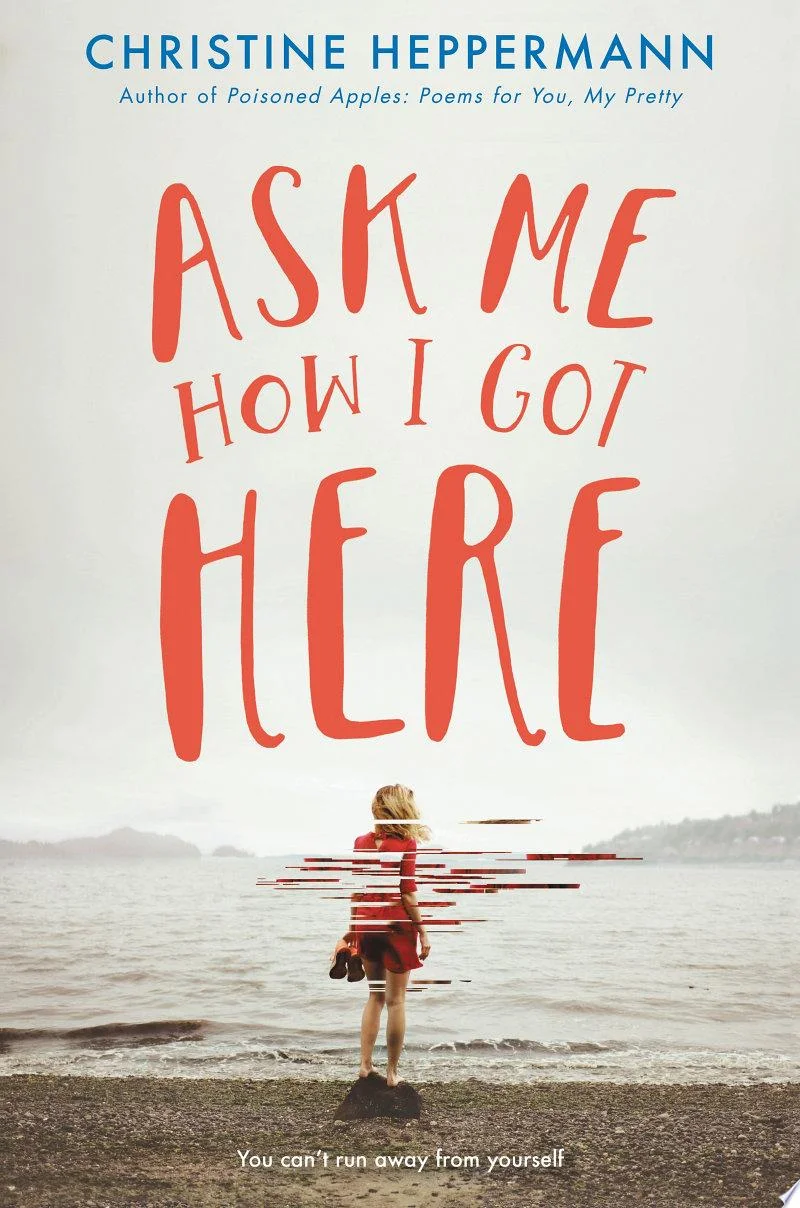
Ask Me How I Got Here
- Publication Date:
- May 3rd, 2016
- Publisher:
- HarperCollins
- ISBN-13:
- 9780062387974
- ISBN-10:
- 0062387979
- Pages:
- 218
Why Ask Me How I Got Here Has Been Challenged
Opponents have pushed back against a young-adult book that walks a teenage character through an abortion without presenting it as a mistake she must atone for. See more ↓
Challenged or banned in 1 state across 1 school district.
Overview
Christine Heppermann's Ask Me How I Got Here is a novel told entirely in free verse, centered on Addie, a disciplined cross-country runner at an all-girls Catholic school who has always measured herself by forward motion — in races, in faith, in her relationship with an attentive, well-meaning boyfriend. That sense of direction collapses after one unplanned night leads to a pregnancy she did not intend and a decision she makes with care: to end it.
The book is less interested in the decision itself than in what follows. Addie doesn't regret choosing abortion, but she also can't return to who she was before it. She pulls away from running, from enthusiasm, from the people around her who don't know what happened, carrying a private weight in a world that offers her no script for processing it. Her slow reconnection with Juliana, a former teammate quietly struggling with her own hard circumstances, becomes the book's most tender thread — two young women recognizing in each other a grief that neither can fully name aloud.
As the follow-up to Heppermann's Poisoned Apples, the book continues her interest in writing about girlhood without softening it, using spare, image-driven poems to trace interior states that prose might otherwise flatten into explanation.
A Story About What Comes After
Much of young-adult literature that touches on teen pregnancy treats the pregnancy itself as the climax — the crisis to be resolved. Heppermann's book is unusual in treating the abortion as a beginning rather than an ending: the real subject is the strange, unacknowledged mourning that follows a choice Addie stands by, and the loneliness of carrying a significant experience that she feels she cannot share with her community, her teammates, or even her own sense of who she's supposed to be.
That focus places the novel alongside work by writers like Laurie Halse Anderson and Ellen Hopkins, who use unflinching first-person narration and verse to render adolescent interiority — shame, resilience, desire, and recovery — without tidy moralizing. The Catholic school setting sharpens the tension further, placing Addie's private choice against an institutional backdrop that would condemn it, without the book itself delivering condemnation. Critics of Heppermann's work have noted her recurring attention to the gap between how girls are expected to feel about their bodies and choices and how they actually feel, a gap this book renders through silence, omission, and the things Addie can't bring herself to say out loud.
Why Ask Me How I Got Here Has Been Challenged
A formal challenge brought against the book has centered on its portrayal of a teenage character obtaining an abortion and continuing afterward to view it as the right choice, with the complaint arguing that the novel fails to present adequate consequence or regret and is therefore unsuitable for a school library's younger readers. This book has been challenged or banned in 1 state and 1 district tracked in this catalog, reflecting how isolated but pointed this objection has been rather than widespread.
Underlying the complaint is discomfort with the book's refusal to frame abortion as a moral failing requiring punishment or redemption arc. Because Addie's grief is about identity and belonging rather than remorse over the decision itself, some readers have found the book to normalize a choice they believe young-adult literature should treat more cautiously. The frank verse treatment of teenage sexuality, and the setting of a Catholic school where such a choice would be doctrinally forbidden, have compounded objections from those who view the material as inconsistent with religious or community values, even as the book's defenders point to its restrained, non-graphic handling and its focus on emotional honesty over explicit content.
Where to Buy



Affiliate links may generate a small commission at no extra cost to you, which helps support this site.
Banned in Schools
Banned or challenged in 1 state across 1 school district.