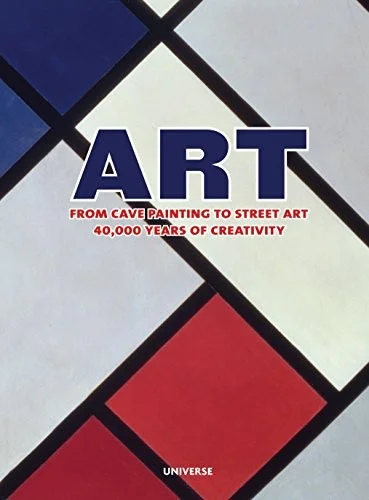
Art: From Cave Painting to Street Art- 40,000 Years of Creativity
- Publication Date:
- September 28th, 2010
- Publisher:
- Universe
- ISBN-13:
- 9780789318336
- ISBN-10:
- 0789318334
- Pages:
- 576
Why Art: From Cave Painting to Street Art- 40,000 Years of Creativity Has Been Challenged
Reviewers have taken issue less with any single artwork than with the cumulative effect of placing nudity, religious imagery, and unsanctioned street art side by side for young readers without curatorial filtering. See more ↓
Challenged or banned in 1 state across 1 school district.
Overview
Stephen Farthing's survey takes on an enormous span of time, moving from the ochre-and-charcoal paintings left on cave walls by prehistoric hands to the spray-painted murals that appear overnight on city streets today. Rather than treating these as separate subjects, the book presents them as points along one continuous line: humans making images to record, worship, provoke, or simply mark that they were there.
Structured as a chronological survey, the book moves through major eras and movements, pairing reproductions of artworks with commentary that situates each piece within its historical moment. The approach favors breadth over depth, functioning less as a specialist's argument and more as a guided walk through the history of visual culture, aimed at readers encountering much of this material for the first time.
Because the book covers so much ground, it necessarily draws on art from every era and every register, from sacred icons and royal portraiture to the anonymous, unsanctioned work of contemporary street artists. That range is the book's organizing idea: creativity as a constant of human life, expressed differently by the tools, materials, and social conditions available in a given century.
A Single Impulse Across Millennia
What the book is really arguing for is continuity. It treats the person who painted a bison on a cave wall forty millennia ago and the person who painted a mural on a highway underpass last year as participants in the same basic human activity, separated by time and technique but not by intent. That framing pushes back against the instinct to treat "art history" and "street art" as belonging to different worlds, one solemn and museum-bound, the other transient and unauthorized.
This is also a book about legitimacy: which images get preserved in institutions and which are painted over, which artists are named and which remain anonymous. By placing graffiti and street art at the same table as classical painting and sculpture, the survey implicitly asks readers to reconsider where the line between "high art" and vandalism has historically been drawn, and by whom.
Why Art: From Cave Painting to Street Art Has Been Challenged
As a broad survey intended to introduce readers to the sweep of art history, the book has generally been received as an accessible reference rather than a provocation. Its inclusion in library and classroom collections has nonetheless drawn objections, reflecting a familiar tension around illustrated art history books aimed at younger audiences. Reported concerns center on the reproduced artworks themselves: a survey spanning tens of thousands of years inevitably includes nude and semi-nude figures, religious imagery, and works tied to political or social movements, any of which can be read by some parents and reviewers as unsuitable for the age group likely to encounter the book on a library shelf.
A related strand of objection concerns the street art content specifically, since some readers regard the inclusion of graffiti and unauthorized public art as implicitly endorsing illegal activity rather than simply documenting a contemporary art form. Taken together, these objections are less about any single image or passage and more about the discomfort of placing centuries of unfiltered artistic expression in front of young readers without curatorial softening. In the catalog tracked here, that discomfort has translated into a challenge recorded in 1 state and 1 district.
Where to Buy




Affiliate links may generate a small commission at no extra cost to you, which helps support this site.
Banned in Schools
Banned or challenged in 1 state across 1 school district.