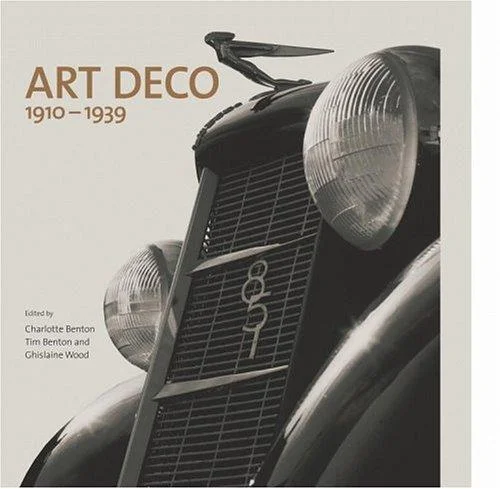
Art deco 1910-1939
- Publication Date:
- January 1st, 2003
- Publisher:
- Bulfinch Press/AOL Time Warner Book Group
- ISBN-13:
- 9780821228340
- ISBN-10:
- 082122834X
- Pages:
- 464
Why Art deco 1910-1939 Has Been Challenged
Some readers have taken issue with the book's photographic plates of period sculpture and fashion, which include stylized depictions of the unclothed human form typical of Deco-era art. See more ↓
Challenged or banned in 1 state across 1 school district.
Overview
Charlotte Benton's survey treats Art Deco as a single visual language that swept through remarkably different corners of design during the interwar decades. The book anchors its account in the 1925 Paris exposition that gave the movement its public debut and, eventually, its name, using that event as a hinge between the style's roots and its rapid international spread.
From there the study fans outward, tracing how a shared vocabulary of geometric ornament, stylized natural forms, and machine-age gloss migrated across disciplines. Buildings, clothing, glazed ceramics, printed lettering, and mass-produced household goods all receive attention, with the argument that Art Deco was less a fixed set of motifs than an adaptable sensibility that designers reshaped to fit each medium.
Nearly 450 images accompany the text, giving the book the character of a visual reference as much as a narrative history. The result is a wide-lens introduction meant to show how a single aesthetic moment could look so different depending on whether it was expressed in a skyscraper facade or a perfume bottle.
An Aesthetic Between Two Wars
What makes this survey more than a catalog of pretty objects is its interest in Art Deco as a symptom of its historical moment. The style emerged from a tangle of influences — archaeological discoveries, colonial-era imports, industrial materials newly available for design — and the book is attentive to how those sources were absorbed and, at times, appropriated by Western designers eager for novelty. That tension between borrowing and originality runs quietly beneath the surface of the more celebratory passages.
The book also sits within a broader tradition of design history that treats decorative and applied arts as worthy of the same scrutiny long reserved for painting and sculpture. By giving equal weight to a ceramic vase and a civic building, Benton's approach pushes back against hierarchies that once separated "fine" art from commercial and domestic design. This inclusiveness is part of what has made the volume a durable reference for students and collectors rather than a niche architectural text.
Why Art Deco 1910-1939 Has Been Challenged
Because the book documents fashion, sculpture, and decorative arts of the period through photographic plates, some of its illustrations depict the human form, including figures rendered in the stylized, sometimes unclothed manner favored by Deco-era sculptors and poster artists. Reviewers in school and library settings have occasionally flagged these images as inappropriate for younger readers, treating a design-history reference the same way they might a work of fiction with mature content, despite the images serving an art-historical rather than narrative purpose. The book has been the subject of exactly 1 challenge tracked in this catalog, spanning 1 state and 1 school district, reflecting a narrow but real pattern of objections to nudity in illustrated art books shelved in youth-accessible collections.
Where to Buy




Affiliate links may generate a small commission at no extra cost to you, which helps support this site.
Banned in Schools
Banned or challenged in 1 state across 1 school district.