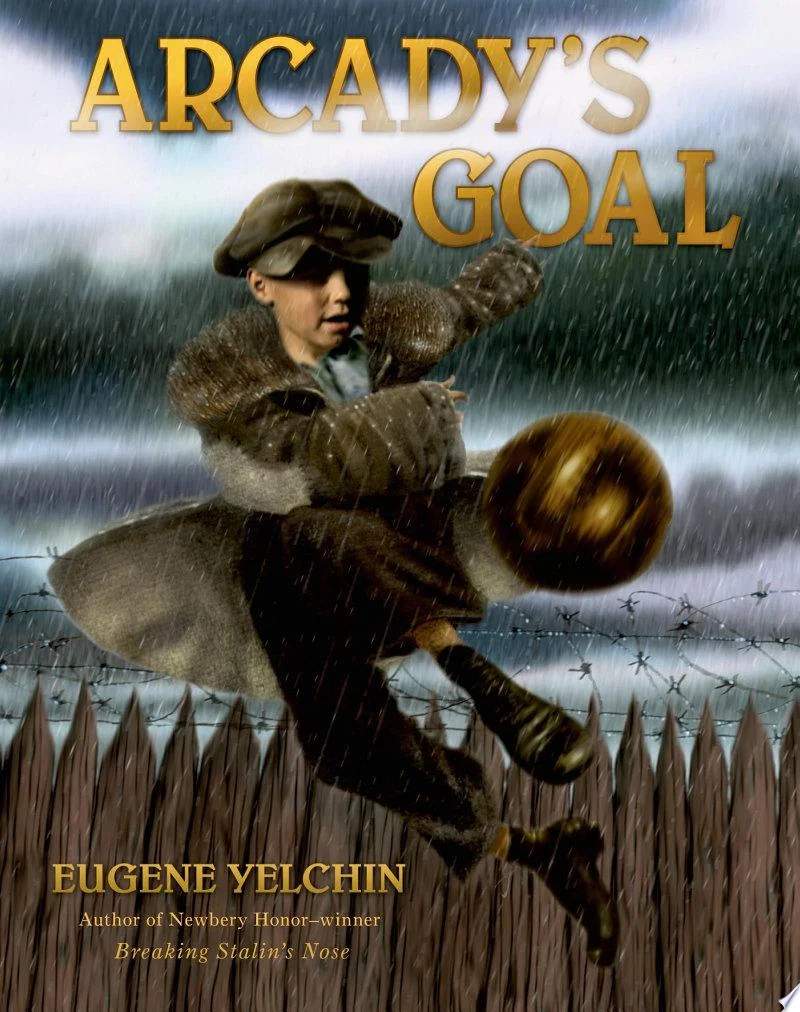
Arcady's Goal
- Publication Date:
- October 14th, 2014
- Publisher:
- Macmillan
- ISBN-13:
- 9780805098440
- ISBN-10:
- 0805098445
- Pages:
- 241
Why Arcady's Goal Has Been Challenged
Some readers have balked at how plainly the novel depicts a child's fear and deprivation under an authoritarian system, arguing the realism outpaces what young audiences are ready to absorb. See more ↓
Challenged or banned in 1 state across 1 school district.
Overview
Eugene Yelchin's novel follows Arcady, a boy thrown into a state-run children's home after his parents are branded enemies of the Soviet government. Stripped of family and status in a single stroke, he finds himself among other children similarly discarded by the system, all of them learning to survive on wit, toughness, and whatever small leverage they can find.
For Arcady, that leverage turns out to be soccer. His talent on the field becomes currency: it buys him food, earns him grudging respect from the other boys, and offers a measure of protection in an environment where none is guaranteed. But the game is also a narrow opening toward something larger than survival.
The harder transformation in the story is emotional rather than physical. Arcady has to decide whether he can let himself depend on another person after the state has already shown him how quickly people and loyalties can be taken away, and whether he can extend himself any belief in his own worth beyond what he produces on the field.
A Child's-Eye View of a Police State
Yelchin, who grew up in the Soviet Union before emigrating, writes institutional cruelty from ground level rather than from the vantage of history. The children's home in the novel is not an abstraction of totalitarianism but a daily, physical reality: scarce rations, shifting alliances, adults who hold total power with little accountability. Arcady's soccer skill matters so much precisely because almost nothing else in his circumstances is within his control.
The book sits within a body of children's and middle-grade literature that uses a young protagonist to dramatize how authoritarian systems reach into private life, turning family status into a liability and forcing children to calculate risk and trust at an age when they should be spared it. Its particular contribution is showing how a seemingly neutral pursuit, a sport, becomes entangled with power, scarcity, and self-worth. The emotional arc, Arcady's slow, wary movement toward trusting someone again, gives the historical setting a human center rather than leaving it as backdrop.
Why Arcady's Goal Has Been Challenged
Reviewers have generally praised the novel for rendering a grim chapter of twentieth-century history in terms accessible and affecting for young readers, yet in the handful of settings where it has drawn formal objections, that same unflinching approach is what reviewers and parents have pointed to. The book has been challenged or restricted in one state and one school district tracked in this catalog, and the concerns raised center on how directly it portrays state violence against families and the psychological toll of institutional life on a child.
Objecting readers have pointed to the bleakness of the setting, the separation of a child from his parents under government accusation, and the harshness of life inside the children's home as material some consider too heavy or frightening for the intended age group. Because the story does not soften the mechanics of political persecution or the precariousness of the children's daily existence, some have argued it belongs with older readers or should come with additional context, even as others view that same honesty as the book's core strength in teaching history through a child's experience.
Where to Buy




Affiliate links may generate a small commission at no extra cost to you, which helps support this site.
Banned in Schools
Banned or challenged in 1 state across 1 school district.
Texas 1 district
- North East Independent School District Banned by Restriction