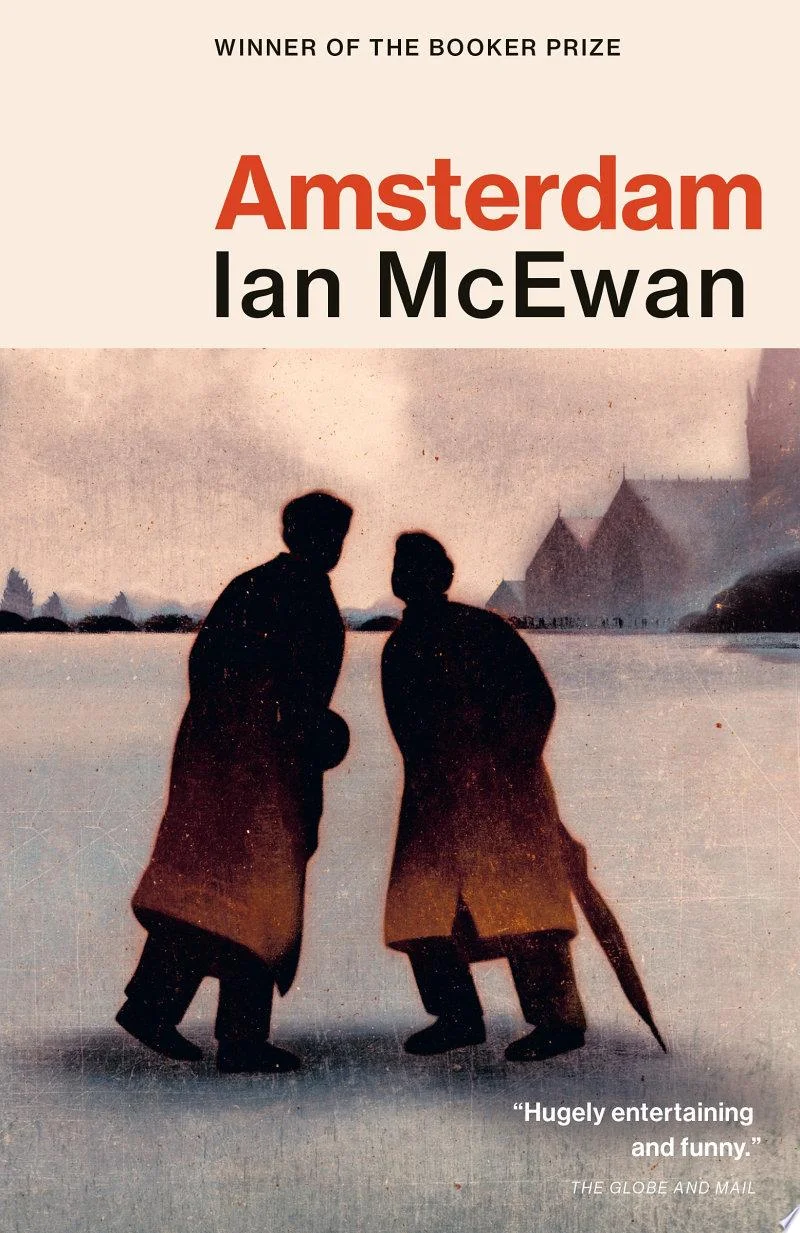
Amsterdam
by Ian McEwan
- Publication Date:
- July 20th, 2010
- Publisher:
- Vintage Canada
- ISBN-13:
- 9780307366986
- ISBN-10:
- 0307366987
- Pages:
- 162
Why Amsterdam Has Been Challenged
A quietly struck agreement between two old friends to end their own lives under Amsterdam's lenient euthanasia laws has unsettled some readers, who see the novel's detachment from that choice as an endorsement rather than an observation. See more ↓
Challenged or banned in 1 state across 1 school district.
Overview
Ian McEwan's Amsterdam opens at a funeral, the kind of gathering that forces old intimacies back into the light. Clive Linley, now celebrated as one of Britain's foremost composers, and Vernon Halliday, editor of a respected national newspaper, come together to mourn Molly Lane, a woman both men once loved before their careers eclipsed everything else in their lives.
What follows is less an elegy than a slow unraveling. Freed from Molly's gaze and newly aware of their own mortality, Clive and Vernon each face a test of character disguised as an ordinary professional decision. Neither passes cleanly. Their choices, made under pressure and self-justified in the moment, tangle their fates together in ways that neither man anticipates.
McEwan frames the novel as a comedy of manners even as it tightens into something closer to tragedy, following its two protagonists toward an agreement struck in a moment of crisis—one that carries them, by the book's end, to the city that gives the novel its title.
A Satirist's Eye on Ambition and Legacy
Amsterdam arrived as a pivot in McEwan's career, a brisker and more mordantly funny book than the densely emotional Atonement that would follow it. Where that later novel examines guilt across a lifetime, Amsterdam compresses its moral reckoning into a few weeks, using the rhythms of farce to ask serious questions about vanity, legacy, and the stories successful men tell themselves to avoid looking too closely at their own behavior.
The novel's targets are the institutions its characters inhabit: the symphony hall, the newsroom, the circles of influence that surround public life in Britain. Both men are, in their own estimation, principled. McEwan's quiet skill is in showing how easily principle bends to preserve a reputation, a commission, or a sense of being the smarter man in the room. The book won the Booker Prize, and much of its critical reception turned on this balance—a novel light enough to be read quickly, but constructed with enough precision that its characters' self-deceptions feel inevitable rather than contrived.
Why Amsterdam Has Been Challenged
The pact Clive and Vernon strike partway through the novel—an agreement to help one another die rather than face incapacity—sits at the center of most objections to the book. Because the arrangement is carried out with the clinical ease afforded by Amsterdam's permissive laws on assisted death, some readers have viewed the novel as treating euthanasia too casually, or as presenting a morally fraught act without sufficient condemnation. The frank adult relationships referenced throughout the book, along with its unsentimental view of sex, ambition, and institutional self-interest, have added to concerns from readers who consider the material inappropriate for younger or school-assigned audiences.
In the catalog tracked here, Amsterdam has been the subject of a challenge in one state and one school district. The objections reflect a broader discomfort with literary fiction that declines to moralize openly—McEwan lets his characters' decisions speak for themselves, trusting readers to supply the judgment the narrative withholds.
Where to Buy




Affiliate links may generate a small commission at no extra cost to you, which helps support this site.
Banned in Schools
Banned or challenged in 1 state across 1 school district.
Florida 1 district
- Orange County Public Schools Banned by restriction