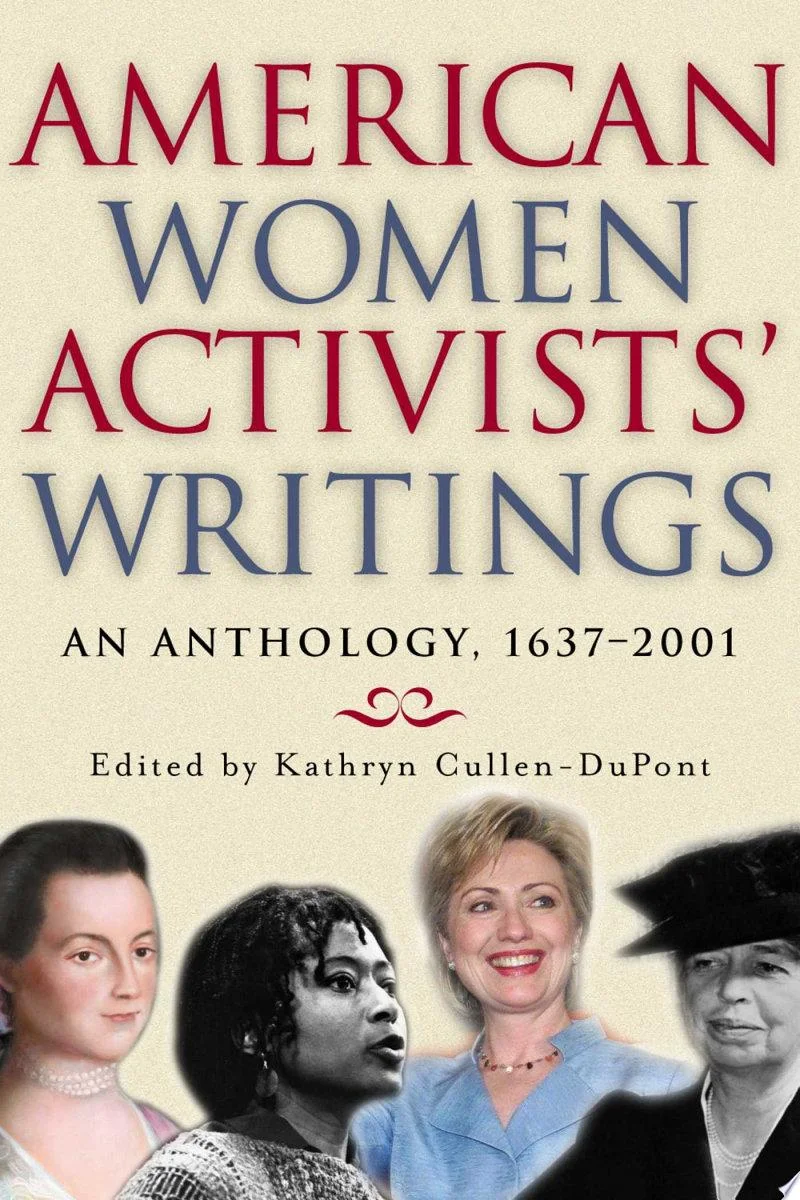
American Women Activists' Writings
- Publication Date:
- February 11th, 2002
- Publisher:
- Simon and Schuster
- ISBN-13:
- 9781461698746
- ISBN-10:
- 146169874X
- Pages:
- 657
Why American Women Activists' Writings Has Been Challenged
Complaints against this collection have focused less on its history of activism than on the frankness with which several of its selected voices discuss sexuality and bodily experience. See more ↓
Challenged or banned in 1 state across 1 school district.
Overview
This anthology, compiled by Kathryn Cullen-DuPont, gathers firsthand writing from American women who pushed against the boundaries placed on their speech, their bodies, and their citizenship. Rather than offering a single narrative, it assembles primary documents — letters, diary pages, speeches, and memoir excerpts — so that readers encounter activism in the activists' own words.
The collection opens in the colonial period with Anne Hutchinson, who was formally silenced for speaking to gatherings that included men, and traces a line forward into the organized push for women's legal and political standing. From there it moves through testimony from women confronting slavery, including Sojourner Truth's account of her own escape, and continues into more recent decades with Alice Walker's reflections on campaigning against female genital mutilation and Margarethe Cammermeyer's account of fighting her discharge from the military for being a lesbian.
Spanning roughly three centuries, the book treats activism as a continuous, evolving project rather than a series of isolated episodes, inviting readers to trace how the language and targets of women's dissent changed over time even as the underlying demand for voice and recognition did not.
A Chronicle of Dissent and Its Costs
What distinguishes this anthology from a conventional historical survey is its insistence on the document itself — the letter, the sworn testimony, the diary entry — as the unit of history. Cullen-DuPont's arrangement suggests that women's political voice has always had to contend with restrictions on who was allowed to speak, where, and to whom, starting with Hutchinson's literal prohibition from addressing mixed audiences. That throughline connects seemingly disparate causes: abolition, suffrage, labor, reproductive and bodily autonomy, and LGBTQ military service all appear here as variations on the same contest over whose testimony counts as legitimate public speech.
The book also resists treating activism as settled history. By including figures like Walker and Cammermeyer alongside nineteenth-century voices, it frames the anthology's own publication moment as another chapter in an unfinished story, implicitly arguing that each generation of women has had to reassert claims their predecessors already made.
Why American Women Activists' Writings Has Been Challenged
A parent raising concerns with a district review committee objected to the book's inclusion of material on female genital mutilation and military discharge policy tied to homosexuality, arguing that these topics exposed students to graphic bodily content and sexual-orientation discussion without adequate framing or parental notice. The complaint characterized the anthology as unsuitable for the age group assigned it, contending that primary-source testimony on these subjects should be reserved for older students or removed from required reading altogether.
Other objections raised in review discussions have centered on the book's treatment of slavery-era violence and its unfiltered inclusion of activists' personal accounts of bodily harm and sexuality, with critics arguing that compiling such material without extensive contextual commentary risks presenting difficult subjects too starkly for a classroom setting. Across the single state and single district where this title has been formally challenged in the catalog's records, the recurring thread has been discomfort with primary-source candor on sexuality and bodily autonomy rather than disagreement with the historical record itself.
Where to Buy




Affiliate links may generate a small commission at no extra cost to you, which helps support this site.
Also by Kathryn Cullen-DuPont
Banned in Schools
Banned or challenged in 1 state across 1 school district.
Georgia 1 district
- Cobb County School District Banned pending investigation