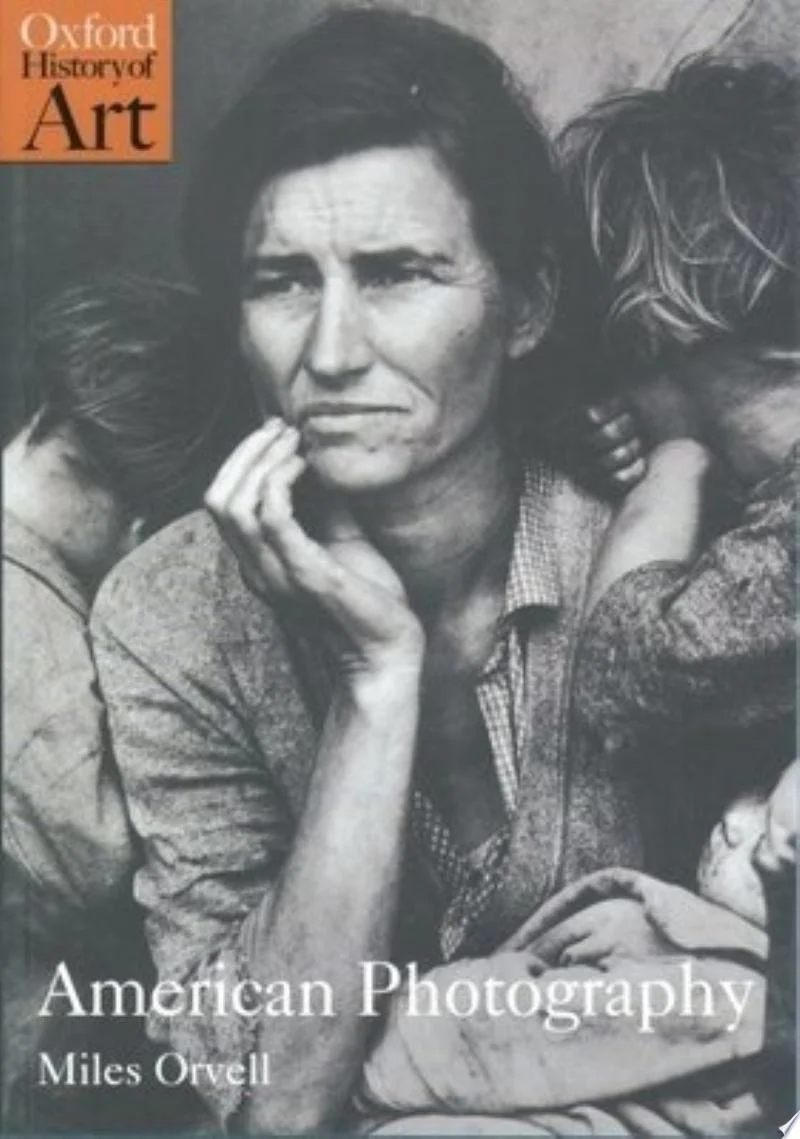
American Photography
by Miles Orvell
- Publication Date:
- January 1st, 2003
- ISBN-13:
- 9780192842718
- ISBN-10:
- 0192842714
- Pages:
- 262
Why American Photography Has Been Challenged
Some readers have balked at the book's willingness to reproduce photographs depicting suffering and exploitation, arguing that a few images included for scholarly analysis are too disturbing to belong on certain shelves. See more ↓
Challenged or banned in 1 state across 1 school district.
Overview
Miles Orvell's "American Photography" surveys roughly 150 years of picture-making in the United States, setting the medium within the broader social and cultural currents that shaped it. Rather than treating photographs as isolated artifacts, Orvell reads them as evidence of how Americans have understood themselves and their surroundings over time.
The book moves across a wide spectrum of photographic practice, from formal portraiture to landscape work, and from the vernacular tradition of the family album to the more self-conscious experiments of art photography. Orvell draws on both canonical images and lesser-known examples, using the two in tandem to complicate any simple narrative of progress or decline in the field.
Throughout, the author pairs a chronological account of shifting photographic styles and technologies with a set of recurring conceptual threads, building toward what he frames as a unified history of the form rather than a loose collection of case studies.
A Camera Trained on the National Character
Orvell's organizing claim is that photography did not merely record American life but helped constitute a particular, recognizably national habit of looking. He traces how documentary impulses, commercial pressures, and artistic ambition intertwined across successive generations of photographers, producing images that doubled as cultural self-portraits. The family album and the formal landscape, in his telling, are not opposite poles of amateur versus professional work but related expressions of the same drive to fix memory and place within a frame.
The book also sits within a longer scholarly effort to treat photography as a serious object of cultural history rather than a supplement to painting or a neutral technical record. By weighing questions such as the ethics of depicting vulnerable subjects, the role of manipulation and experimentation in shaping meaning, and photography's capacity to provoke strong reactions, Orvell engages debates that have followed the medium since its invention. He is careful, too, to question whether a single visual chronicle can ever stand in for history itself, leaving that tension unresolved rather than offering easy reassurance.
Why American Photography Has Been Challenged
Objections to the book have centered on its visual content, specifically the inclusion of photographs depicting exploitation, suffering, or imagery considered disturbing to some readers. Because Orvell's project requires confronting the camera's more unsettling uses, the book does not limit itself to decorous or celebratory images; it includes pictures chosen precisely for their capacity to unsettle or provoke, which some have found inappropriate for certain readers or shelves. This catalog records one state and one school district where the title has been formally challenged.
The underlying dispute often turns less on any single image than on the broader question of whether a scholarly survey should reproduce difficult material at all in order to analyze it honestly. Orvell's inclusion of photography's darker and more exploitative episodes is integral to his argument about the medium's power, a point that distinguishes this challenge from objections to more narrative or explicit content found in other frequently banned titles.
Where to Buy




Affiliate links may generate a small commission at no extra cost to you, which helps support this site.
Banned in Schools
Banned or challenged in 1 state across 1 school district.
Florida 1 district
- Escambia County Public Schools Banned pending investigation