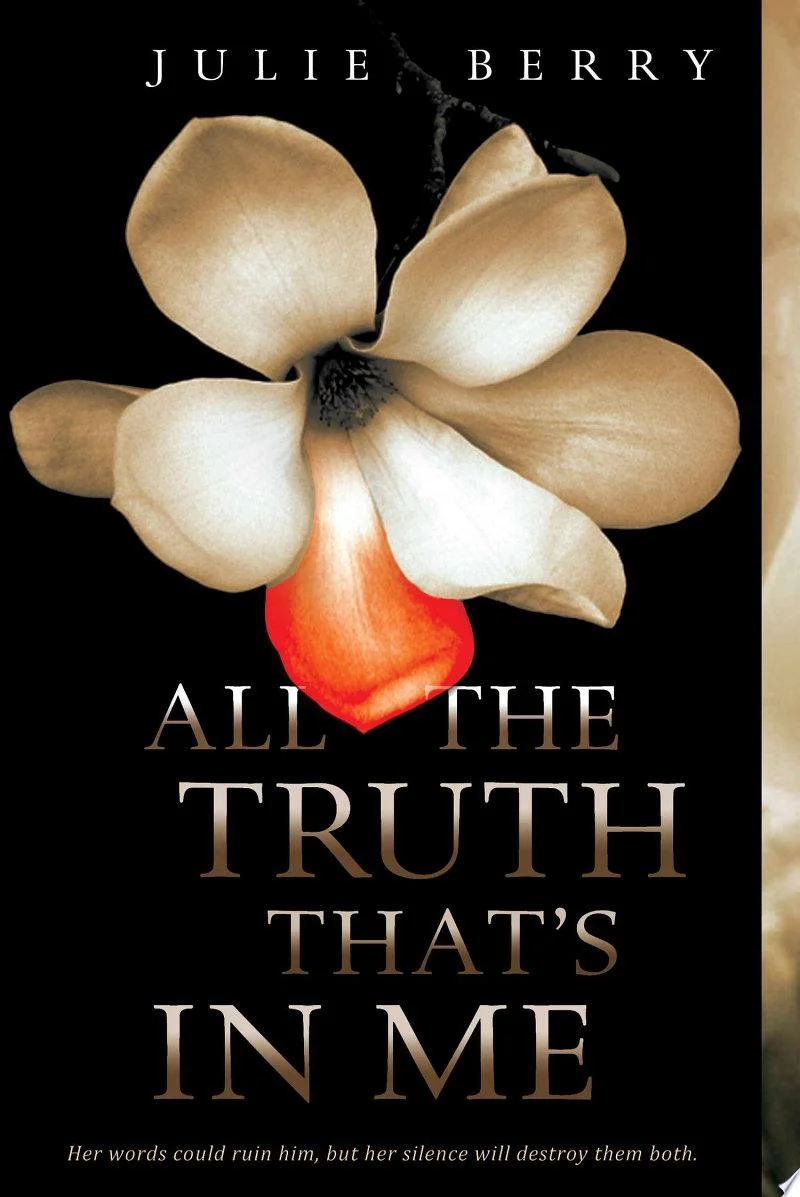
All the Truth That's In Me
by Julie Berry
- Publication Date:
- September 26th, 2013
- Publisher:
- Penguin
- ISBN-13:
- 9781101611296
- ISBN-10:
- 1101611294
- Pages:
- 209
Why All the Truth That's In Me Has Been Challenged
Critics of the novel have taken issue with its unflinching depiction of the violence behind Judith's muteness, arguing the material is too graphic for the shelves where it's been placed. See more ↓
Challenged or banned in 1 state across 2 school districts.
Overview
Julie Berry's "All the Truth That's In Me" opens on an absence already resolved into tragedy: Judith disappeared from Roswell Station alongside her closest friend, and only Judith came back, two years later, bearing injuries that have left her unable to speak. The novel is narrated in a fractured, second-person address to Lucas, the boyhood companion Judith has loved in silence, and this choice turns an ordinary small-town mystery into something closer to an extended, unspoken confession.
Much of the book unfolds through what Judith cannot say aloud — to her mother, her neighbors, or the community that now regards her with a mixture of pity and suspicion. Berry withholds the particulars of what happened to Judith for most of the narrative, letting the reader piece together fragments alongside a protagonist who has been rendered mute both literally and socially.
When violence reaches Roswell Station again, Judith's silence becomes untenable. The plot turns on whether she will reclaim her voice, and what that reclamation will cost the people who have spent years comfortable with her wordlessness.
A Voice Withheld and Reclaimed
The novel's formal choices are inseparable from its themes. By addressing the narrative to Lucas in second person, Berry mirrors Judith's condition on the page: a story told entirely in the mode of things unsaid, directed at someone who doesn't yet know he is being addressed. The structure asks what it costs a young woman to be disbelieved, overlooked, or defined by an injury rather than by her own account of it, and what it means for a community to prefer a victim's silence to the discomfort of her testimony.
That preoccupation places the book within a recognizable strand of young adult fiction concerned with trauma, bodily harm, and the mechanics of speaking out, while its historical-sounding, unnamed setting gives the story a fable-like remove from any single time or place. Critics noted the book's recognition, including a shortlisting for the Carnegie Medal and placement on YALSA's Best Fiction for Young Adults list, as evidence that its handling of difficult material rewarded careful, literary treatment rather than sensationalism.
Why All the Truth That's In Me Has Been Challenged
Disputes over this book have generally centered on whether its content is appropriate for the age groups that encounter it on school shelves, rather than on its literary merit. The novel's central mystery involves the sexual violence and captivity that left Judith injured and silenced, and objectors have pointed to the explicitness with which that history is eventually revealed as unsuitable for younger or more sensitive readers.
Related concerns have focused on the broader atmosphere of the story, including scenes of violence and the psychological toll depicted on its protagonist, which some have argued require more guidance or context than a typical classroom or library setting provides. Others have questioned whether a narrative built around unspoken trauma risks normalizing a victim's isolation rather than illuminating it. In the catalog tracked here, the book has drawn a single formal challenge, recorded across one state and two districts.
Where to Buy




Affiliate links may generate a small commission at no extra cost to you, which helps support this site.
Also by Julie Berry

Banned in Schools
Banned or challenged in 1 state across 2 school districts.
Florida 2 districts
- Clay County School District Banned
- Escambia County Public Schools Banned pending investigation