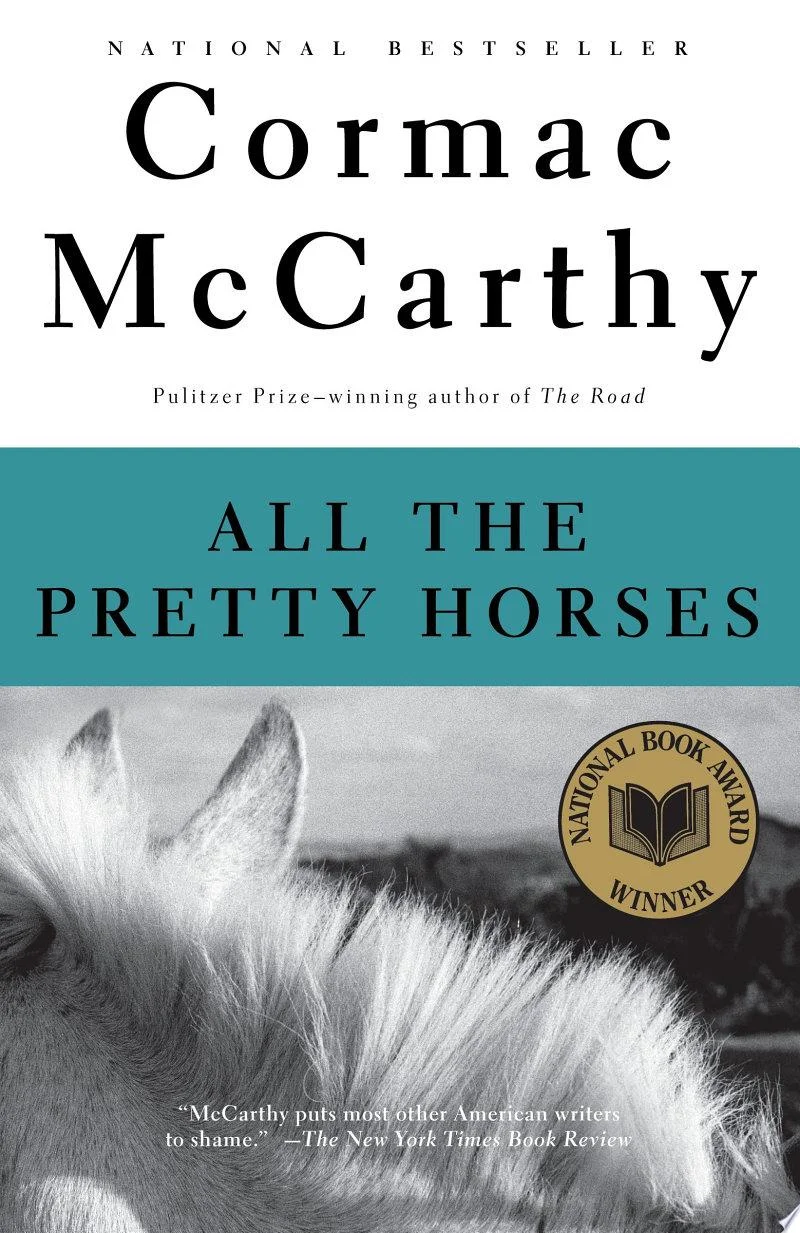
All the Pretty Horses
- Publication Date:
- June 29th, 1993
- Publisher:
- Vintage
- ISBN-13:
- 9780679744399
- ISBN-10:
- 0679744398
- Pages:
- 322
Why All the Pretty Horses Has Been Challenged
Some readers have pushed back on the novel's unflinching violence and frank sexuality, arguing the material is too mature for the classroom shelves where it sometimes appears. See more ↓
Challenged or banned in 1 state across 2 school districts.
Overview
John Grady Cole is sixteen when the family ranch he expected to inherit is sold out from under him, severing his tie to a way of life he assumed would always be his. Rather than remain in a Texas that no longer has room for him, he rides south into Mexico with his friend Lacey Rawlins, and later a third, more volatile companion named Jimmy Blevins.
What follows is a journey that shifts registers constantly: long stretches of open-country beauty and easy companionship give way to sudden legal trouble, a doomed romance with a ranch owner's daughter, and violence that arrives without warning. McCarthy renders the landscape itself as almost a character, indifferent to the men crossing it.
The novel resists a tidy coming-of-age arc. John Grady's education is less about growing into adulthood than about discovering how little control he has over the forces that shape his fate, even as he clings to a code of honor and craft — particularly with horses — that the world around him no longer rewards.
A Vanishing West and the Limits of Self-Reliance
As the opening volume of the Border Trilogy, the novel sets up a preoccupation that runs through McCarthy's later work: the erosion of a mythic American West and the question of what remains of individual honor once its old structures collapse. John Grady Cole believes in a set of values — competence, loyalty, plain dealing — inherited from a ranching culture that is already disappearing around him, and the book quietly tests whether those values can survive contact with a modern, indifferent, and often brutal world.
That tension has made the novel a touchstone in discussions of American literary style as well as theme. McCarthy's prose, stripped of quotation marks and much punctuation, alternates between plainspoken dialogue and passages of dense, almost biblical description, a combination that has drawn both acclaim and imitation. The book's stature as a National Book Award winner and the opening chapter of a trilogy that McCarthy would develop across two further novels has cemented its place as a pivot point in his career, bridging the gothic violence of his early Southern fiction and the starker, more expansive concerns of his later work.
Why All the Pretty Horses Has Been Challenged
The novel does not shy away from depicting bloodshed, including a prison stabbing and other violent encounters John Grady survives during his time in Mexico, rendered with the same unadorned clarity McCarthy brings to a sunset or a horse being broken. It also includes a sexual relationship between John Grady and an older rancher's daughter, described candidly enough to draw objections from readers who feel the content is unsuited to younger students. Some challenges have centered on the accumulation of coarse language throughout the book, arguing that its frequency, rather than any single passage, makes it inappropriate for required reading. Taken together, these concerns reflect a broader disagreement over whether a demanding, adult-oriented literary novel belongs in high school curricula at all, a dispute that has produced 1 state and 2 district challenges in the catalog tracked here.
Where to Buy




Affiliate links may generate a small commission at no extra cost to you, which helps support this site.
Banned in Schools
Banned or challenged in 1 state across 2 school districts.
Florida 2 districts
- Clay County School District Banned by Restriction
- Orange County Public Schools Banned by restriction