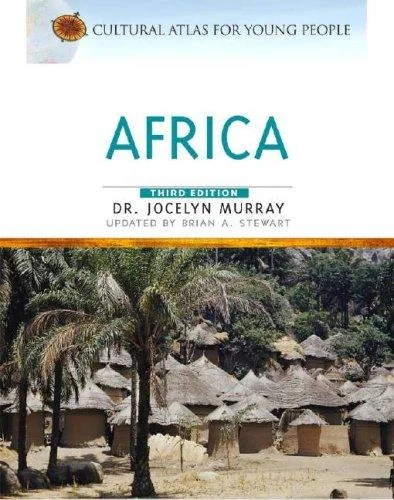
Africa (Cultural Atlas for Young People)
- Publication Date:
- June 30th, 2007
- Publisher:
- Chelsea House Publications
- ISBN-13:
- 9780816068265
- ISBN-10:
- 0816068267
- Pages:
- 96
Why Africa (Cultural Atlas for Young People) Has Been Challenged
A reference book meant to introduce children to a continent's diversity has instead drawn fire over how that diversity is pictured and framed on the page. See more ↓
Challenged or banned in 1 state across 1 school district.
Overview
Africa is a reference volume in the Cultural Atlas for Young People series, designed to give school-age readers a working introduction to the continent's geography, peoples, and history. Rather than telling a single story, it moves region by region, pairing maps and photographs with short essays on climate, economies, languages, and daily life.
Jocelyn Murray structures the book the way a classroom atlas typically does: broad orientation first, then closer looks at particular nations, ethnic groups, and historical periods, from precolonial kingdoms through the colonial era and into independence movements. The format favors breadth over depth, aiming to give young readers a mental map they can build on rather than a comprehensive history of any one country.
Like other entries in its series, the book leans heavily on visual material — photographs, charts, and timelines — to make unfamiliar geography and history accessible to a young audience without assuming prior background knowledge.
An Atlas's Balancing Act
Books that attempt to summarize an entire continent for children face an inherent tension: condensing thousands of distinct peoples, languages, and histories into a single volume risks flattening the very diversity it sets out to explain. Cultural atlases in this vein have long been used as supplementary classroom material, prized for making world regions feel less abstract to students, but also scrutinized for whether their brevity does justice to the complexity underneath.
Part of what makes this book notable within its genre is the difficulty of illustrating everyday life across dozens of distinct societies without leaning on generalization. Reference works like this one sit at the intersection of geography education and cultural representation, and their reception often says as much about shifting expectations for how children's materials should depict non-Western cultures as it does about the books themselves.
Why Africa Has Been Challenged
A parent reviewing the book for a school library raised concern over photographs of traditional dress and ceremonial attire, arguing that images showing partial nudity as part of ethnographic depiction were inappropriate for the age group with access to the shelf, regardless of their documentary intent. The complaint centered less on the book's text than on specific images selected to illustrate cultural practices, with the objection framed around what was visually depicted rather than any accompanying narrative.
Related concerns raised in review discussions have touched on the book's treatment of traditional religions and colonial history, with some questioning whether brief, simplified explanations of indigenous belief systems and the legacy of European rule were suited to a young audience without more context. Taken together, the objections reflect a broader debate over how illustrated reference works should balance authentic cultural representation against the sensitivities of an elementary or middle-grade readership. This title has been documented in this catalog as challenged in 1 state and 1 school district.
Where to Buy



Affiliate links may generate a small commission at no extra cost to you, which helps support this site.
Banned in Schools
Banned or challenged in 1 state across 1 school district.
Florida 1 district
- Escambia County Public Schools Banned pending investigation