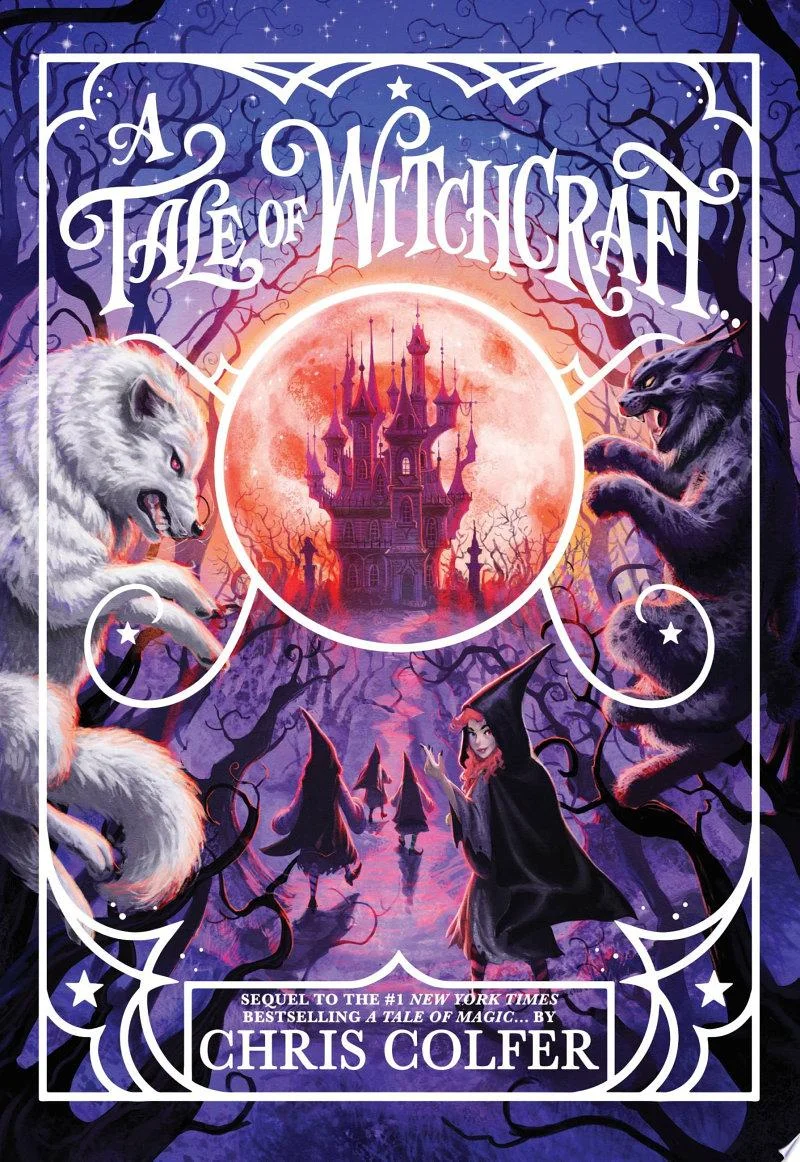
A Tale of Witchcraft...
by Chris Colfer
- Publication Date:
- September 29th, 2020
- Publisher:
- Little, Brown Books for Young Readers
- ISBN-13:
- 9780316523530
- ISBN-10:
- 0316523534
- Pages:
- 283
Why A Tale of Witchcraft... Has Been Challenged
A parent objection zeroed in on the book's sympathetic treatment of witchcraft and spellcasting as something young readers might find appealing rather than frightening. See more ↓
Challenged or banned in 1 state across 1 school district.
Overview
Chris Colfer continues the story he began with A Tale of Magic... by returning readers to a kingdom where magic has only recently become legal, and where that legality is already fraying. Brystal Evergreen, now settled among her fellow students and instructors, watches a new arrival unsettle the academy's fragile order: a witch whose charm masks an agenda to pull faeries away into a competing school built on darker principles.
As that rivalry deepens, Brystal's close friend Lucy is drawn into a scheme that threatens more than the academy's reputation. Colfer widens the frame beyond the school grounds to show a kingdom-wide backlash against magic's new legal status, with resentment building among people who never accepted the change.
That resentment culminates in the reemergence of a secretive, long-dormant faction bent on eliminating magical beings altogether, with Brystal identified as its first target. The novel balances the intimate stakes of friendship and loyalty against a larger conflict over whether magic has any place in the world at all.
A Series Wrestling With Tolerance and Backlash
Colfer's Tale of Magic series has consistently used its fairy-tale scaffolding to examine how societies respond to difference, and this installment pushes that theme further by dramatizing organized resistance to a minority group's newly won rights. The Righteous Brotherhood functions less as a fantasy villain than as an allegory for real historical patterns of persecution, giving the story a weight that extends past its academy setting and rivalries.
The book also complicates its own moral geography by introducing a witch whose recruitment of faeries isn't simple villainy but a response to exclusion, echoing the series' broader interest in how fear and marginalization can curdle into extremism on more than one side. For readers who followed Brystal from the first book, this sequel deepens her arc from an outsider seeking acceptance into someone who must decide what she is willing to risk to defend a fragile peace.
Why A Tale of Witchcraft... Has Been Challenged
A recorded complaint argued that the book normalizes witchcraft for young readers by depicting spellcasting and magical schooling in an appealing, aspirational light rather than treating it as clearly fictional or cautionary. Objections of this kind typically stem from concern that fantasy magic in books marketed to children could be read as endorsing real-world occult practice, a worry long directed at witch-centered fiction generally.
Related discomfort has focused on the novel's darker material, including a militant group organized around exterminating an entire class of characters, which some reviewers felt introduced violent and ideological themes heavier than expected for the book's younger readership. Within the catalog tracked here, the title has drawn a single formal challenge, recorded in one state and one school district.
Where to Buy




Affiliate links may generate a small commission at no extra cost to you, which helps support this site.
Also by Chris Colfer
Banned in Schools
Banned or challenged in 1 state across 1 school district.
Iowa 1 district
- Clear Creek-Amana Community School District Banned pending investigation