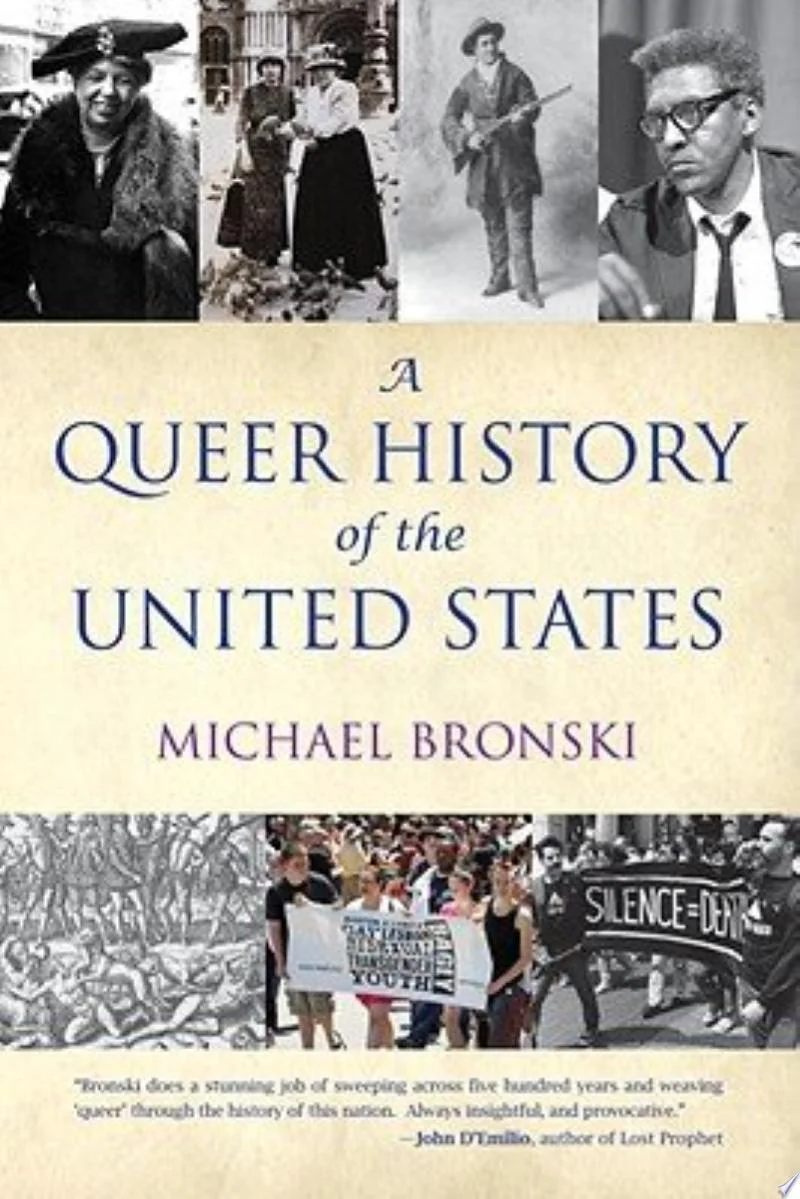
A Queer History of the United States
- Publication Date:
- January 1st, 2011
- Publisher:
- Beacon Press
- ISBN-13:
- 9780807044391
- ISBN-10:
- 0807044393
- Pages:
- 313
Why A Queer History of the United States Has Been Challenged
Some parents and administrators have argued that a full national history of queer identity belongs in adult or specialized collections rather than in general-access school libraries. See more ↓
Challenged or banned in 2 states across 2 school districts.
Overview
Michael Bronski's sweeping survey sets out to do something no single volume had attempted before it: trace the presence of lesbian, gay, bisexual, and transgender life across the entire span of what would become the United States, beginning in the centuries before European colonization and continuing into the contemporary moment. Rather than treating queer history as a twentieth-century phenomenon confined to the years after Stonewall, Bronski insists on a much longer timeline, one that reframes familiar chapters of American history through the lens of gender and sexual nonconformity.
The book moves chronologically but resists a simple march-of-progress narrative. Bronski is as interested in moments of repression, erasure, and contradiction as he is in visibility and advancement, and he draws connections between queer experience and broader currents in American life, including religion, law, medicine, and popular culture. The result is less a catalog of notable figures than an argument about how thoroughly questions of sexuality and gender identity are woven into the national story.
Written for a general audience, the book aims to make an academically grounded subject accessible without flattening its complexity, offering readers a framework for understanding queer history as inseparable from, rather than parallel to, the larger American narrative.
A Different Lens on a Familiar Story
What makes Bronski's project distinctive is less the individual stories it recovers than the interpretive stance it takes: that American history cannot be fully understood without accounting for the ways sexuality and gender have been policed, negotiated, and expressed across four centuries. This positions the book as both a work of historical synthesis and a piece of advocacy scholarship, written in the tradition of social historians who argue that marginalized experiences are not footnotes to the "real" story but constitutive of it.
The book arrived at a moment when LGBTQ history was gaining institutional legitimacy as a field of academic study, and it has been read both as a classroom resource and as an entry point for general readers seeking context beyond contemporary political debates. Its ambition invites comparison to other single-volume attempts at comprehensive social history, and its reception has largely tracked the broader cultural divide over how much weight queer experience should carry in the telling of American history itself.
Why A Queer History of the United States Has Been Challenged
Much of the friction around this book centers on where it belongs on a shelf and who should be able to reach for it, with critics arguing that a comprehensive history of queer identity and sexuality is better suited to adult or specialized collections than to general-circulation school or public libraries. Beneath that placement question sits a more substantive disagreement about content: some objectors point to the book's frank discussion of sexual practices and identities across history, treating passages on intimacy and the body as inappropriate for younger readers regardless of their historical framing. Others object to the book's core premise, viewing its argument that queer experience is central to American history as a politicized claim rather than neutral scholarship, and resist its presence in curricula or collections on those ideological grounds. Still others frame their concern around parental authority, arguing that decisions about introducing children to this material should rest with families rather than schools or libraries. Within the scope of this catalog, the title has been the subject of 2 state-level and 2 district-level challenges, reflecting a recurring tension between the book's value as historical scholarship and discomfort with its subject matter in shared public spaces.
Where to Buy




Affiliate links may generate a small commission at no extra cost to you, which helps support this site.
Banned in Schools
Banned or challenged in 2 states across 2 school districts.
Iowa 1 district
- Alta-Aurelia Community Schools Banned pending investigation