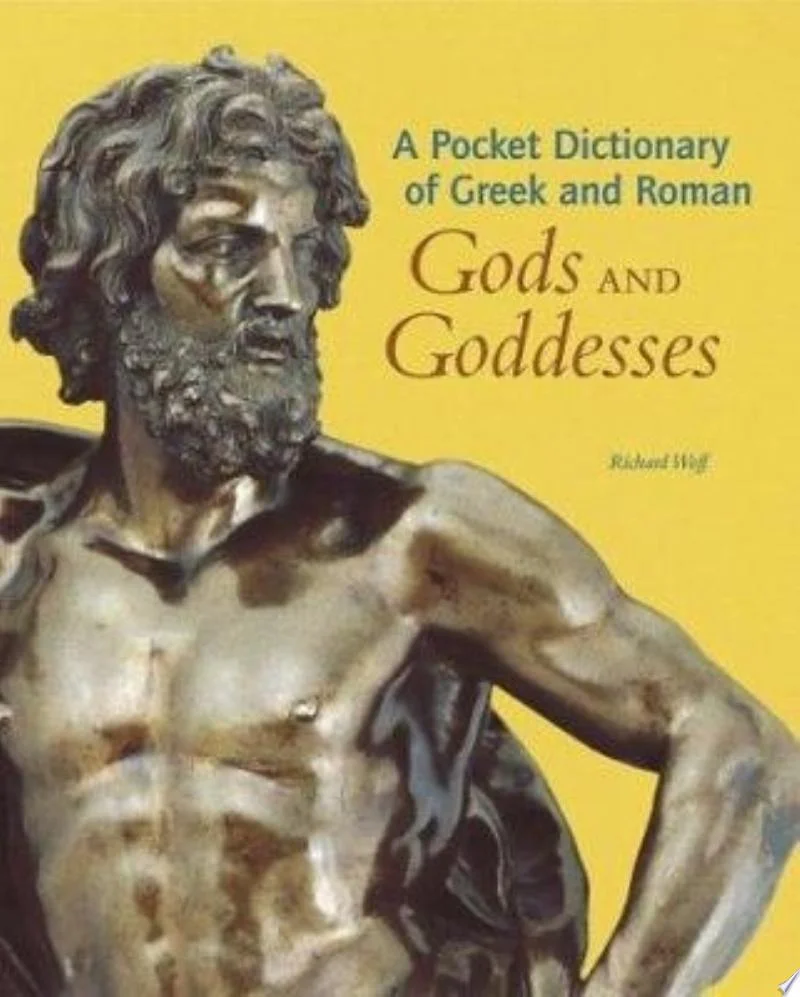
A Pocket Dictionary of Greek and Roman Gods and Goddesses
by Richard Woff
- Publication Date:
- January 1st, 2003
- Publisher:
- Getty Publications
- ISBN-13:
- 9780892367061
- ISBN-10:
- 0892367067
- Pages:
- 52
Why A Pocket Dictionary of Greek and Roman Gods and Goddesses Has Been Challenged
Some reviewers have balked not at how this reference presents its material but at the underlying myths themselves, which include violence and sexual content inherent to the ancient stories being catalogued. See more ↓
Challenged or banned in 2 states across 2 school districts.
Overview
Richard Woff's compact reference introduces readers to the major figures of Greek mythology — Zeus, Hera, Athena, Poseidon, and the wider cast of Olympians, along with lesser gods and mythic creatures who populate ancient stories. Rather than retelling myths at length, the book works more like a field guide, sketching each figure's domain, symbols, and relationships to the others.
Its organizing idea is that these figures never really stayed confined to antiquity. The book repeatedly draws lines from a god's ancient attributes to places that character or symbol shows up centuries later, whether in a painting hanging in a museum, a statue, or a modern film. That throughline gives young readers a reason to care about names and emblems that might otherwise feel remote.
Structured for browsing rather than cover-to-cover reading, entries are short and visually oriented, making the book better suited to looking something up — who Hermes is, what Medusa represents — than to sustained narrative reading.
Myth as a Living Reference
What the book is really doing is arguing for mythology's continued relevance as cultural shorthand. Greek gods persist not because ancient religion demands it, but because their stories became a visual and symbolic vocabulary that Western art, architecture, and storytelling have drawn on ever since. A dictionary format suits that argument: it treats the gods less as characters in a continuous story and more as a set of reusable figures, each with a recognizable identity that later artists and writers could borrow, adapt, or reinterpret.
This kind of reference sits within a long tradition of introducing mythology to children as literature and cultural history rather than devotional material, distinct from religious instruction. Its place in that tradition is largely functional: it exists to be consulted, not to make an argument about the meaning of any particular myth, leaving interpretation of the stories' more difficult content to a teacher, parent, or the reader's own further reading.
Why A Pocket Dictionary of Greek and Roman Gods and Goddesses Has Been Challenged
A book generally praised for its accessibility and its usefulness as a classroom or library reference has nonetheless drawn objections, tracked in this catalog across 2 states and 2 districts. The tension is less about how the book is written than about what it is: a straightforward presentation of figures and stories that some reviewing adults consider unsuitable for young readers regardless of tone.
The recurring objection concerns mythological content itself — deities and stories involving violence, deception, and sexual encounters that are simply part of the source material being summarized. Because a reference work cannot omit a god's defining stories without becoming inaccurate, challenges have centered on the presence of this content in a book aimed at children, rather than on any embellishment or editorializing by the author. Some challenges also reflect discomfort with presenting polytheistic religious material to young readers at all, treating the mythological subject matter as inappropriate independent of how factually or plainly it is conveyed.
Where to Buy




Affiliate links may generate a small commission at no extra cost to you, which helps support this site.
Banned in Schools
Banned or challenged in 2 states across 2 school districts.
Tennessee 1 district
- Oak Ridge Schools Banned