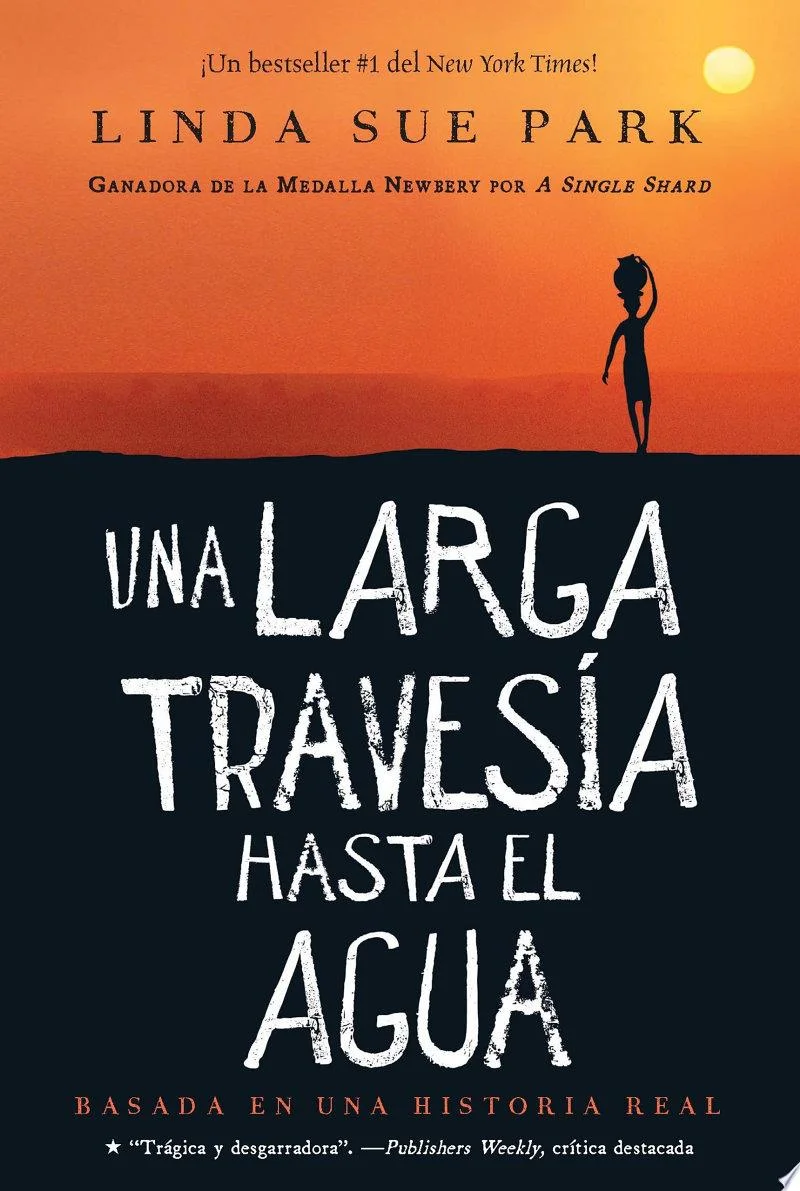
A Long Walk to Water
- Publication Date:
- January 1st, 2010
- Publisher:
- Houghton Mifflin Harcourt
- ISBN-13:
- 9780547251271
- ISBN-10:
- 0547251270
- Pages:
- 145
Why A Long Walk to Water Has Been Challenged
Some reviewers have questioned whether young readers are prepared for a story that treats war, displacement, and death as matter-of-fact realities rather than distant abstractions. See more ↓
Challenged or banned in 1 state across 1 school district.
Overview
Linda Sue Park structures her novel as two interwoven timelines separated by more than two decades but bound by the same landscape. In 2008, eleven-year-old Nya spends her days walking to and from a distant pond, carrying water home for her family in southern Sudan. In 1985, a boy named Salva, also eleven, is separated from his family when gunfire scatters his village school, forcing him into a life on the run.
Salva's chapters trace an arduous journey across the continent alongside other displaced children, encountering hunger, exhaustion, and constant danger as they search for safety and for the families they left behind. Nya's chapters, by contrast, unfold in the rhythm of a single grueling routine repeated day after day. Park lets the two threads run in parallel for most of the book before drawing them together in a final turn that reframes everything the reader has followed to that point.
The novel's spare, plainspoken prose suits its dual purpose: it works as an accessible entry point for younger readers while still conveying the weight of what its characters endure.
Two Sudans, One Thread
Part of what makes the novel distinctive is its refusal to treat its two protagonists' hardships as equivalent in kind, even as it insists they are connected. Salva's ordeal is the stuff of open conflict — sudden violence, dispersal, the constant improvisation required to survive without a fixed home. Nya's is quieter and cyclical, an unglamorous, repetitive labor that nonetheless consumes her childhood as thoroughly as war consumes Salva's. By pairing them, Park suggests that scarcity and conflict are not separate crises but different faces of the same one, each shaping a child's life in ways adults elsewhere might never see.
The book also sits within a broader body of youth literature that uses realistic, lightly fictionalized narrative to introduce readers to contemporary global history rather than relying on textbook summary. Its brevity and structure have made it a frequent classroom choice for units on perseverance, geography, or global citizenship, and its ending — where the two storylines meet — is often cited as the reason the book resonates with readers who might otherwise find the subject matter remote.
Why A Long Walk to Water Has Been Challenged
Most objections to this title center less on whether the book belongs in a library at all than on where and to whom it should be handed — specifically, whether its subject matter is suited to the younger end of the middle-grade audience that often encounters it in classrooms. Because the novel is frequently assigned in elementary and early middle school settings, some parents and reviewers have argued that its depictions of armed conflict, the death of children, and the physical dangers Salva faces during his journey are more intense than students at that age are prepared to process without additional guidance.
The concerns raised tend to focus on specific content elements — scenes of violence connected to civil war, the deaths of characters known to the protagonists, and unsettling encounters during Salva's trek — rather than on the book's themes or intentions, which are broadly framed around endurance and hope. In the catalog tracked here, the title has drawn a single formal challenge, recorded in one state and one district, reflecting a narrow but real disagreement over grade-level placement rather than a broader campaign against the book.
Where to Buy




Affiliate links may generate a small commission at no extra cost to you, which helps support this site.
Also by Linda Sue Park
Banned in Schools
Banned or challenged in 1 state across 1 school district.