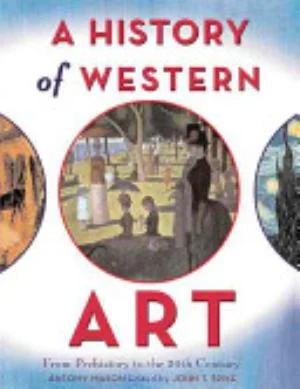
A History of Western Art
by Antony Mason
- Publication Date:
- January 1st, 2008
- Publisher:
- Abrams Books for Young Readers
- ISBN-13:
- 9780810994218
- ISBN-10:
- 0810994216
- Pages:
- 128
Why A History of Western Art Has Been Challenged
Complaints about this book center on whether centuries-old artworks depicting the nude human form belong within easy reach of younger readers, not on any flaw in its scholarship. See more ↓
Challenged or banned in 1 state across 1 school district.
Overview
Antony Mason's survey moves chronologically through the long arc of Western art, opening with the earliest known cave paintings and closing somewhere in the vicinity of Andy Warhol and the pop-art era. Along the way it stops at the familiar waypoints of the standard art-historical narrative: the Renaissance workshops that produced Leonardo da Vinci, the shifting styles of successive centuries, and the movements that eventually broke from tradition altogether.
What distinguishes the book from a straight prose history is its visual density. More than 250 full-color reproductions accompany the text, ranging from complete paintings to close-up details, photographs of sculpture and architecture, and facsimiles of historical documents. The images are treated as evidence as much as illustration, meant to let readers see the stylistic shifts the narrative describes rather than simply take them on faith.
As a reference-style overview rather than a specialist monograph, the book is pitched at readers encountering the sweep of Western art for the first time, offering a map of the territory before any deeper study of a single period or artist.
A Reference Point in a Contested Canon
Books that attempt to summarize "Western art history" in a single volume inevitably make choices about what counts as art worth including, and those choices have become more visible to scrutiny over time. A survey built around the traditional canon, running from prehistoric imagery through named European masters to twentieth-century movements, reflects a particular way of organizing art history that has itself been debated within the field: which cultures are centered, which are treated as peripheral, and which periods receive the most illustrative weight.
The book's reliance on reproduction rather than description also places it in a specific tradition of art education, one that assumes visual literacy is best built through direct exposure to images rather than through text alone. That approach carries its own set of considerations, since reproducing centuries of art means reproducing whatever those centuries considered acceptable to depict, including works that reflect the artistic conventions, subject matter, and social norms of their own eras rather than the present one.
Why A History of Western Art Has Been Challenged
Much of the friction around this title concerns where it belongs on a shelf and at what age a reader should encounter it, rather than any dispute about its value as a reference work. Because the book reproduces artworks spanning thousands of years without filtering them for a young audience, some of the included reproductions depict nudity or other imagery drawn from classical, religious, or historical art traditions, and objectors have argued that this content is better suited to older students or a different section of a library than the one in which it was placed. The concern raised is typically less about the book's educational intent than about whether its illustrations are appropriate for the shelf, classroom, or age group where a young reader might encounter them unsupervised. Records reviewed for this catalog show the book challenged in one state and one district.
Where to Buy




Affiliate links may generate a small commission at no extra cost to you, which helps support this site.
Banned in Schools
Banned or challenged in 1 state across 1 school district.