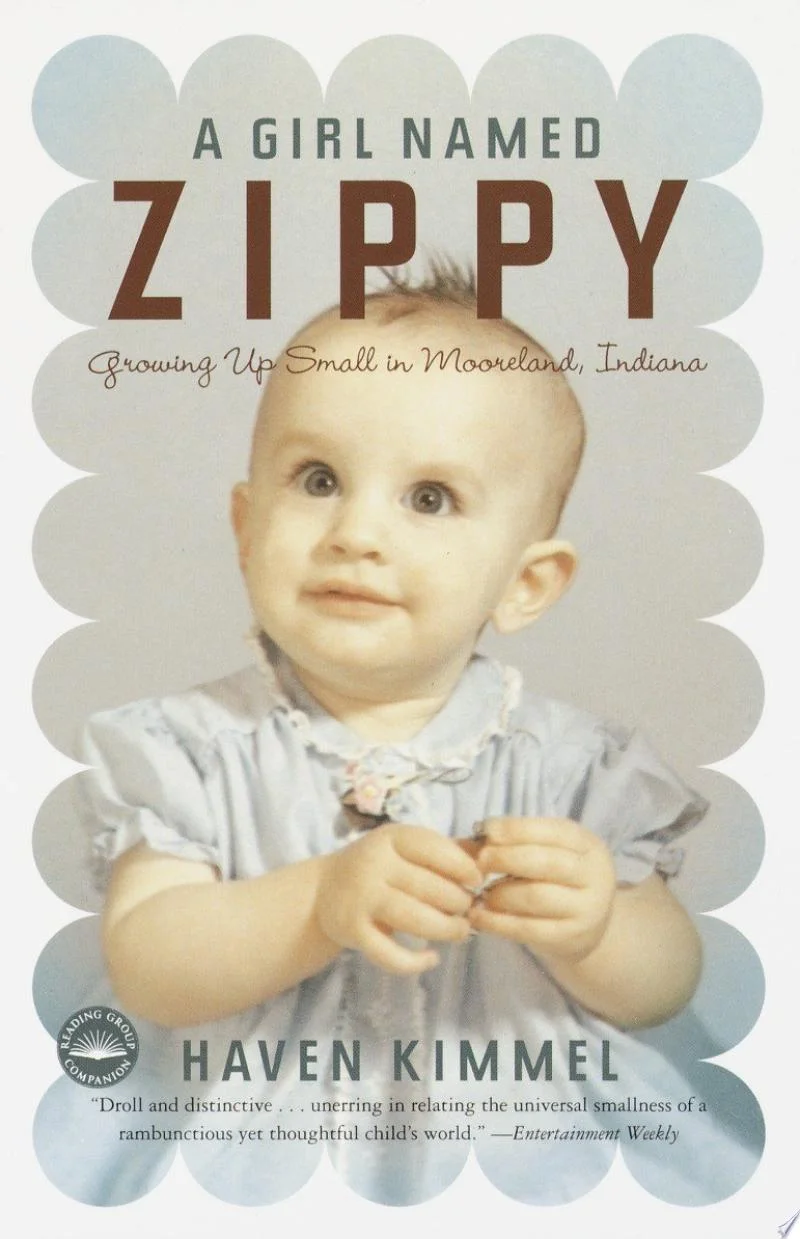
A Girl Named Zippy
by Haven Kimmel
- Publication Date:
- September 3rd, 2002
- Publisher:
- Crown
- ISBN-13:
- 9780767915052
- ISBN-10:
- 0767915054
- Pages:
- 306
Why A Girl Named Zippy Has Been Challenged
Some readers have objected that a memoir dressed in nostalgic, small-town charm turns out to speak just as plainly about sex, bodily realities, and family strain as it does about chickens and church suppers. See more ↓
Challenged or banned in 1 state across 1 school district.
Overview
Haven Kimmel's memoir returns to Mooreland, Indiana, the tiny farm town where she was born in 1965 and where, as a child prone to sudden bursts of motion, she earned the nickname "Zippy." Written by the author of The Solace of Leaving Early, the book reconstructs a childhood that unfolded at the tail end of an era when small towns still ran on familiarity: neighbors kept an eye on one another's kids, Sunday mornings meant church, and a backyard might just as easily hold chickens as a swing set.
Rather than a linear coming-of-age story, the memoir moves in loosely connected episodes, each filtered through young Zippy's outsized curiosity and her habit of taking the adult world at face value, only to arrive at conclusions that are funnier, and occasionally sharper, than the grown-ups intended. The result is less a chronicle of events than a portrait of a sensibility: watchful, unsentimental, and prone to finding the absurd in the ordinary.
Reviewers and readers responded to the book's voice as much as its subject matter, and it became a commercial success on the strength of that voice. Kimmel's willingness to let her younger self be odd, stubborn, and a little bit sly, rather than merely charming, gives the memoir a texture that distinguishes it from more sentimental accounts of small-town Americana.
A Child's-Eye View of a Vanishing World
A Girl Named Zippy belongs to a lineage of American memoirs that treat childhood not as innocence to be preserved but as a vantage point from which adult institutions look strange, arbitrary, or quietly absurd. Kimmel's Mooreland is presented with evident affection, but the memoir resists turning that affection into nostalgia for its own sake; the town's insularity, its rituals, and its unspoken rules are observed with the same clear-eyed attention as its warmth.
Part of the book's appeal lies in this doubleness. It can be read as a loving elegy for a postwar rural community that has largely disappeared, and at the same time as a subtly subversive account of what that community actually asked of its members, particularly its women and girls. That tension between comfort and critique, delivered in a voice that is by turns wry and unguarded, is a large part of why the memoir found an audience well beyond readers with any personal connection to Indiana.
Why A Girl Named Zippy Has Been Challenged
Frank language and candid references to bodily and sexual matters are the primary source of objection to this memoir. Because the narrator is a young girl, some readers have balked at passages where adult topics, sex, bodily functions, and family friction among them, are described plainly rather than softened for a younger audience, even though the book was published and marketed for adult readers rather than children or teens. Objectors have also pointed to the memoir's unvarnished depiction of a household with real strain beneath its folksy surface, arguing that its inclusion in school or library settings exposes younger readers to material misaligned with the book's nostalgic packaging. The catalog records this title as challenged in one state and one district.
Where to Buy



Affiliate links may generate a small commission at no extra cost to you, which helps support this site.
Banned in Schools
Banned or challenged in 1 state across 1 school district.
Wisconsin 1 district
- Elkhorn Area School District Banned pending investigation