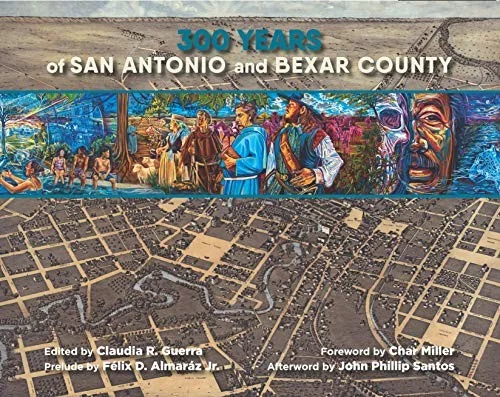
300 Years of San Antonio and Bexar County
- Publication Date:
- January 1st, 2019
- Publisher:
- Maverick Books
- ISBN-13:
- 9781595348937
- ISBN-10:
- 159534893X
- Pages:
- 280
Why 300 Years of San Antonio and Bexar County Has Been Challenged
Critics have pushed back on a local-history title that weighs the costs of colonization and segregation as heavily as the achievements typically celebrated in anniversary accounts of the city. See more ↓
Challenged or banned in 1 state across 1 school district.
Overview
"300 Years of San Antonio and Bexar County" is a commemorative history assembled by local historian and archivist Claudia R. Guerra, tracing the region from its founding as a Spanish colonial outpost through its growth into one of Texas's largest metropolitan areas. Built around the milestone of the city's tricentennial, the book moves chronologically through missions, Mexican independence, the Texas Republic, statehood, and the twentieth century, using archival photographs, maps, and documents to anchor each period.
Rather than a single narrative thread, the book reads as a layered civic portrait, letting institutions, neighborhoods, and public figures stand in for the larger sweep of change. It gives particular attention to the people and communities whose labor and presence shaped the city's built environment and culture, even when their contributions were not always centered in earlier popular histories of the region.
As a work of local history rather than narrative nonfiction, it functions as much as a reference and visual record as a continuous story, intended for readers with a civic or genealogical interest in the area as much as general readers.
A City's Self-Portrait at 300
Books produced around municipal anniversaries occupy an unusual space: they are celebratory by design, yet the century-spanning scope of a project like this one makes it difficult to avoid harder chapters of the past. San Antonio's three hundred years encompass colonization of Indigenous land, a shifting border and shifting national allegiances, and the long, uneven process by which Mexican American, Indigenous, and Black residents gained recognition and civic standing alongside the Anglo institutions that came to dominate the city's official history.
Guerra's background in archival and library work is evident in the book's method: it treats the historical record itself, who was photographed, whose buildings were preserved, whose stories were written down, as part of the story. That approach situates the book within a broader, ongoing effort in local and regional history publishing to widen whose experience counts as "the city's" history, rather than simply adding new anecdotes to an unchanged frame.
Why 300 Years of San Antonio and Bexar County Has Been Challenged
Because the book covers Spanish colonization, the mission system, slavery, segregation, and the marginalization of Mexican American and Indigenous communities as part of the region's ordinary civic history, some readers have objected to the way it frames these episodes, viewing the attention paid to discrimination and inequity as overly critical of the city's founding institutions and of the settlers and civic leaders traditionally celebrated in local history. The concern in these objections is less about any single passage than about tone and emphasis: whether a history written for a broad audience, including students, should foreground the costs borne by displaced and disenfranchised groups alongside the achievements more commonly highlighted in commemorative accounts. The book has been challenged in 1 state and 1 school district tracked in this catalog on those grounds.
Where to Buy




Affiliate links may generate a small commission at no extra cost to you, which helps support this site.
Banned in Schools
Banned or challenged in 1 state across 1 school district.