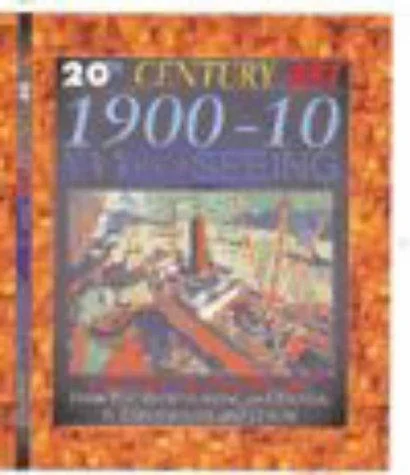
1900-10 New Ways of Seeing (20th Century Art)
by Jackie Gaff
- Publication Date:
- September 28th, 2000
- Publisher:
- Heinemann Library
- ISBN-13:
- 9780431116006
- ISBN-10:
- 0431116008
- Pages:
- 32
Why 1900-10 New Ways of Seeing (20th Century Art) Has Been Challenged
Reproductions of period paintings featuring nude and partially clothed figures have drawn concern from some parents and reviewers who consider such imagery unsuited to the book's intended young-reader audience. See more ↓
Challenged or banned in 1 state across 1 school district.
Overview
"1900-10 New Ways of Seeing" surveys one of the most compressed and consequential decades in the history of Western art. Written for younger readers, the book walks through the opening years of the twentieth century, a period when painters began to abandon the careful realism that had dominated art for generations in favor of bolder color, flattened perspective, and fractured form.
Jackie Gaff structures the book around the artists and movements that emerged in rapid succession during this decade, introducing readers to figures who were testing what painting could do once it stopped trying to simply record the visible world. Reproductions of period artwork anchor each chapter, paired with accessible explanations of technique and historical context aimed at giving young readers a visual vocabulary for modern art.
As part of a broader series on art history, the book is designed less as a narrow biography of any single artist and more as an introduction to a moment of collective experimentation, presenting the decade as a hinge between nineteenth-century tradition and the more radical abstraction that would follow.
Art History as a Story of Rupture
What the book is really exploring is the idea that artistic revolutions rarely happen in isolation. The early 1900s saw painters across Europe reacting against the same inherited conventions at roughly the same time, producing overlapping and sometimes competing movements rather than a single unified style. By presenting this decade as a connected story rather than a list of isolated masterpieces, the book invites young readers to think about how artistic change actually happens: through argument, imitation, and rejection among artists who were often aware of, and responding to, one another's work.
This framing also situates the book within a familiar genre of illustrated art-history primers for children, where reproductions of canonical paintings do much of the pedagogical work. That reliance on primary images, rather than on text alone, is part of what has made this kind of survey occasionally contentious in school settings, since the same reproductions considered standard in an art museum or textbook can read differently once they appear in a book shelved among general nonfiction for young readers.
Why 1900-10 New Ways of Seeing Has Been Challenged
Most objections to this book have centered less on its text than on where it belongs on a shelf and who should encounter it unsupervised, since the dispute is fundamentally about age-appropriateness rather than about any argument the book itself makes. Because the volume reproduces real paintings from the period it covers, some of that artwork includes nude and partially clothed figures, a convention common in early modern art but one that some parents and reviewers consider unsuitable for the younger audience the book otherwise targets. The concern raised has generally not been about accuracy or intent, but about exposure: whether reproductions acceptable in a museum catalog or adult art history text are appropriate in a volume aimed at children and shelved in school or public library collections for that age group. In the catalog tracked here, this book has been the subject of a challenge in 1 state and 1 district, reflecting a localized dispute over placement and audience rather than a widespread rejection of its content or educational value.
Where to Buy




Affiliate links may generate a small commission at no extra cost to you, which helps support this site.
Banned in Schools
Banned or challenged in 1 state across 1 school district.