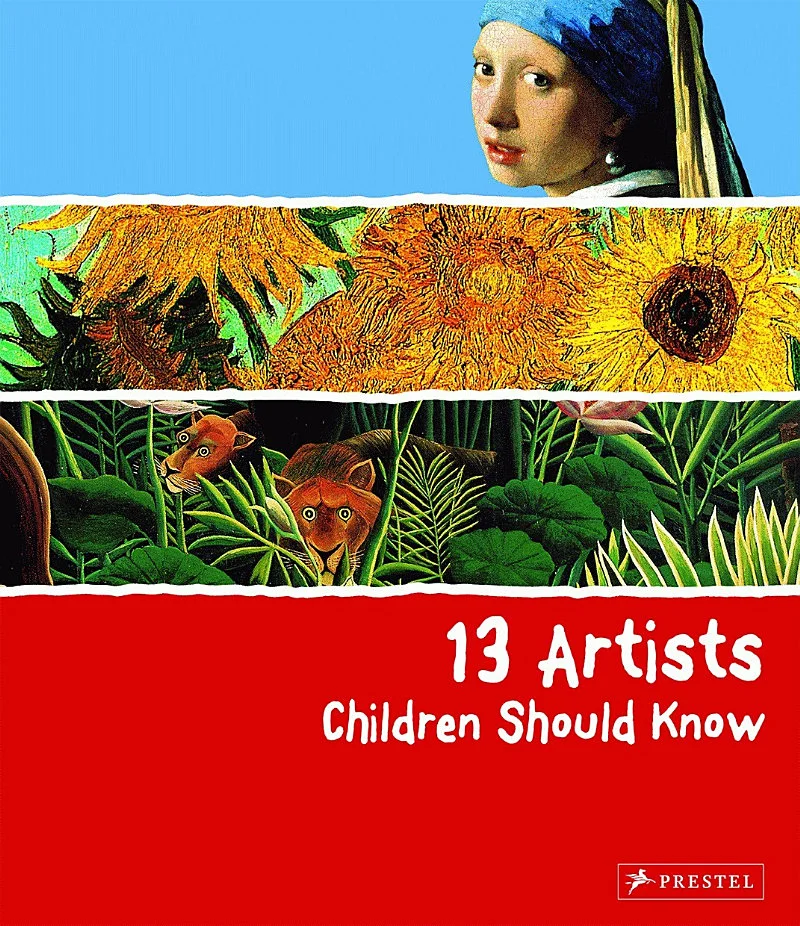
13 Artists Children Should Know
- Publication Date:
- April 12th, 2009
- Publisher:
- National Geographic Books
- ISBN-13:
- 9783791341736
- ISBN-10:
- 3791341731
Why 13 Artists Children Should Know Has Been Challenged
Objectors have taken issue with reproductions of nude and partially nude figures drawn from classical and modern painting appearing in a book intended for young readers. See more ↓
Challenged or banned in 1 state across 1 school district.
Overview
Angela Wenzel's introduction to art history moves through thirteen painters in chronological order, using a timeline to anchor each figure in the broader sweep of Western art. Readers move from the quiet enigma of Leonardo da Vinci's portraiture through the luminous domestic scenes of Vermeer, the restless energy of Van Gogh's brushwork, and finally to the pared-down joy of Matisse's paper cutouts.
Each artist receives a compact biography, a generous selection of reproduced works, and prose pitched directly at a young audience rather than at their parents or teachers. The tone favors curiosity over lecture, treating each painter as a personality to get to know rather than a name to memorize.
Supplementary material extends the book past the page: quizzes and small activities invite readers to test what they've absorbed, while lists of museums and further reading point toward the original works and deeper study. The result is less a survey than an invitation, structured so a child can dip into one artist's chapter at a time.
A Child's Doorway Into Art History
Books like this one occupy a particular niche in art education: they are neither exhaustive references nor simplified picture books, but structured introductions meant to build a working vocabulary before formal instruction begins. The chronological arrangement does real work here, letting a young reader notice, even implicitly, how one painter's innovations set up the next — how the naturalism prized by early masters eventually gives way to the abstraction and formal play of the twentieth century.
The choice of thirteen artists is itself a kind of argument about what belongs in a foundational art education, spanning centuries and national traditions while still fitting into a single approachable volume. Its inclusion of activities and museum guidance reflects a pedagogical philosophy common to this genre of art book: that looking at reproductions is a starting point, and that real engagement continues in a gallery or a sketchbook, not just on the page.
Why 13 Artists Children Should Know Has Been Challenged
A book praised for making fine art legible to children runs into trouble over the very reproductions that make it work: the same canvases celebrated in museums for centuries have drawn objection when placed in front of young readers without the surrounding context an adult viewer brings. The friction is not over the book's accuracy or its intentions, which go unquestioned, but over whether reproductions of nude or partially nude figures in classical and modern paintings belong in a volume aimed at children, regardless of the artistic canon they come from.
The objections track a recurring tension in art education generally, in which works long regarded as cornerstones of Western painting are judged differently once removed from a museum wall and placed into a children's book. Critics have focused less on any single artist than on the presence of the human form as it appears across multiple painters featured in the collection, treating the images as unsuitable for young viewers even when they are standard inclusions in any survey of major artworks. The book has been formally challenged in 1 state and 1 school district within the districts tracked in this catalog, a reflection of how differently reproduced fine art can be received once it enters a school library rather than a museum catalog.
Where to Buy



Affiliate links may generate a small commission at no extra cost to you, which helps support this site.
Banned in Schools
Banned or challenged in 1 state across 1 school district.