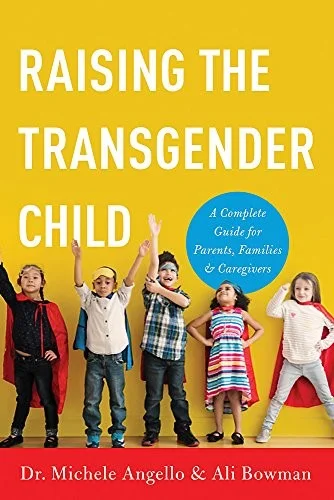
Raising the Transgender Child: A Complete Guide for Parents, Families, and Caregivers
- Publication Date:
- November 22nd, 2016
- Publisher:
- Seal Press
- ISBN-13:
- 9781580056359
- ISBN-10:
- 1580056350
- Pages:
- 288
Why Raising the Transgender Child: A Complete Guide for Parents, Families, and Caregivers Has Been Challenged
Critics have targeted this parenting guide not for any passage in particular but for its core premise, treating practical support for a transgender child as a position too contested to belong on library shelves. See more ↓
Challenged or banned in 1 state across 1 school district.
Overview
Michele Angello's guide is written less as a narrative than as a resource shelf: a comprehensive reference for parents, grandparents, teachers, and clinicians navigating the practical and emotional terrain of raising a transgender or gender-expansive child. Drawing on her background in psychology and gender-specialty counseling, Angello organizes the book around the questions families actually ask — how to respond to a child's first disclosure, how to work with schools and doctors, how to talk to extended family, and how to handle the uncertainty that comes with watching a child's identity unfold over time.
Rather than advancing a single theory of gender development, the book functions as a toolkit, moving between developmental psychology, medical basics, and everyday logistics. It acknowledges that families arrive with different levels of familiarity and comfort, and it tries to meet readers wherever they start, translating clinical language into guidance that can be applied at the kitchen table.
The result is a book aimed squarely at utility. It does not ask readers to accept a worldview so much as to solve a series of concrete problems — what to say, whom to contact, what to expect — that arise when a child's gender identity diverges from assumptions made at birth.
A Guide Born of Clinical Practice
Angello's work sits within a broader shift in how gender nonconformity in children has been discussed in recent decades, moving away from frameworks that treated it primarily as a psychiatric problem to be corrected and toward frameworks centered on support and reduction of family conflict. The book reflects the vantage point of someone who has worked directly with families in crisis or confusion, and its tone is oriented toward de-escalation: helping parents manage their own fear or grief so that it does not become an obstacle for the child.
Because it is explicitly a how-to guide rather than a memoir or work of advocacy journalism, it occupies a different space in the broader literature on transgender youth than first-person accounts or academic studies. Its value, and its vulnerability as a target for challenge, both stem from the same fact: it is designed to be put into practice, not merely read and considered.
Why Raising the Transgender Child Has Been Challenged
Clinicians and parent communities have generally cited the book as a clear, accessible entry point for families with few other resources, while critics outside that audience have treated its presence on library shelves as itself the problem, independent of how it reads to the parents it was written for. The objections that have followed it are rooted less in any single passage than in the subject matter as a whole: a guide that treats a child's transgender identity as something to be supported runs counter to the position, held by some challengers, that gender identity at odds with sex assigned at birth should be discouraged or treated as a phase rather than accommodated.
Specific lines of objection include discomfort with the book's inclusion of information on medical and social transition steps for minors, concern that its placement in general-collection or parenting sections implicitly endorses a particular approach to child-rearing, and broader unease among some challengers about any material that normalizes transgender identity for a young audience or their caregivers. Because the book is a reference work rather than a story, challenges to it tend to focus on its underlying premise — that supporting a transgender child is a reasonable parenting goal — rather than on individual scenes or statements, making it a proxy for a larger disagreement about how gender identity should be discussed in public institutions. It has been challenged in 1 state and 1 district tracked in this catalog.
Where to Buy




Affiliate links may generate a small commission at no extra cost to you, which helps support this site.
Banned in Schools
Banned or challenged in 1 state across 1 school district.