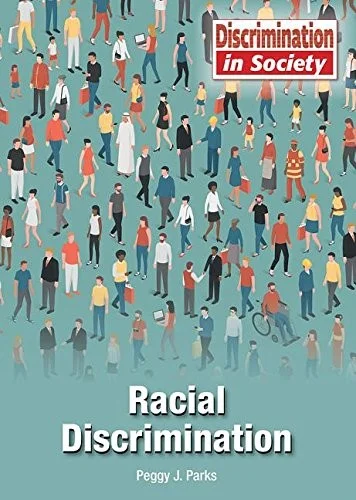
Racial Discrimination
- Publication Date:
- August 1st, 2018
- Publisher:
- Referencepoint Pr Inc
- ISBN-13:
- 9781682823859
- ISBN-10:
- 1682823857
- Pages:
- 80
Why Racial Discrimination Has Been Challenged
At the heart of the pushback is a disagreement over whether teaching students that racial bias persists as a structural force, rather than a closed historical chapter, belongs in the classroom at all. See more ↓
Challenged or banned in 1 state across 1 school district.
Overview
Racial Discrimination by Peggy J. Parks is a work of educational nonfiction written for students encountering the subject in a classroom or library setting. Rather than following a single narrative arc, the book functions as a structured survey, moving from the basic vocabulary of prejudice and bias toward the larger social and legal machinery that has enforced racial hierarchy over time.
Parks builds her account in layers, first establishing historical grounding and then widening the lens to show how discriminatory practices have persisted, adapted, or been challenged in more recent decades. The tone is explanatory rather than argumentative, aimed at giving young readers a factual scaffold rather than steering them toward a predetermined conclusion.
Like much of Parks's output for student audiences, the book favors clarity and accessibility over stylistic flourish, presenting a difficult and often uncomfortable subject in language calibrated for readers who may be encountering it formally for the first time.
Context and Purpose
The book sits within a broader tradition of issue-oriented nonfiction produced for school and library markets, where a single volume is expected to summarize a complex social problem, situate it historically, and gesture toward ongoing debate without resolving it. Its value to educators lies less in original argument than in its function as a reference point, something that can anchor classroom discussion or research assignments on civil rights and social justice topics.
Within Parks's larger body of work, which spans science, health, and social-issue titles alike, this book reflects a consistent authorial approach: reduce a large, contested subject to its essential components so that students can build their own understanding from a shared factual base. That approach is precisely what makes the book useful in some settings and contentious in others, since summarizing racial discrimination inevitably requires choices about which history and which present-day examples to foreground.
Why Racial Discrimination Has Been Challenged
Discussions of race and systemic bias are the specific content category driving objections to this book, reflecting a wider and ongoing dispute over how American schools should teach the history and persistence of racial inequality. Some challengers have argued that presenting discrimination as an enduring structural feature of American life, rather than as a series of resolved historical episodes, amounts to a political framing rather than neutral instruction.
Other objections center on age-appropriateness, with concerns that the material asks younger students to grapple with concepts of institutional bias and inherited disadvantage before they have the context to evaluate competing interpretations. These challenges echo a familiar tension in curriculum debates: whether a book that names racial discrimination as a continuing problem is delivering necessary education or advancing a particular viewpoint. In this catalog, the title has been documented as challenged in one state and one district, a modest but notable footprint for a book whose subject matter continues to generate disagreement wherever it is assigned.
Where to Buy




Affiliate links may generate a small commission at no extra cost to you, which helps support this site.
Banned in Schools
Banned or challenged in 1 state across 1 school district.