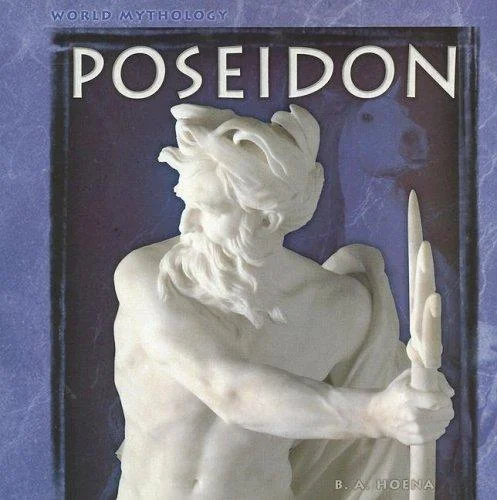
Poseidon
by B. A. Hoena
- Publication Date:
- October 1st, 2006
- Publisher:
- Capstone Press
- ISBN-13:
- 9780736896382
- ISBN-10:
- 0736896384
- Pages:
- 24
Why Poseidon Has Been Challenged
Some reviewers have questioned whether a children's book built around an ancient god's exploits belongs in elementary collections, citing worries over religious framing and unsettling mythological content alike. See more ↓
Challenged or banned in 1 state across 1 school district.
Overview
"Poseidon" belongs to the tradition of illustrated nonfiction that introduces classical mythology to young readers in digestible form. B. A. Hoena, an author known for producing approachable, visually driven books for elementary and middle-grade audiences, uses the figure of the Greek sea god as a vehicle for teaching both a specific myth cycle and the broader habits of mind that come with studying ancient belief systems.
Rather than a single continuous narrative, the book is structured to walk readers through Poseidon's identity, his domain over the sea, and his relationships to other figures in the Greek pantheon. Its pacing and vocabulary are calibrated for students who are building reading stamina, with illustration doing much of the work of conveying mood, scale, and the sometimes violent drama associated with Poseidon's myths.
As part of a larger body of mythology-themed titles, the book functions less as literary interpretation and more as an entry point, intended to spark curiosity about ancient Greece and its stories before students encounter longer, more complex treatments of the same material later in their schooling.
Mythology, Curriculum, and the Classroom
Books like this one sit at an intersection that has long been contested in American education: how to teach mythology as literature and cultural history without implying endorsement of the belief systems it describes. Greek myths are a staple of elementary and middle school curricula precisely because they are foundational to Western literature, art, and language, and introducing them through an accessible nonfiction format is a common pedagogical strategy for reaching younger or developing readers.
Within Hoena's broader catalog, "Poseidon" reflects a consistent authorial approach: take a figure or concept with wide cultural resonance and render it in short, structured, image-supported chapters suitable for classroom or library use. Its place in that catalog is unremarkable on its own terms, but it has become entangled in a wider, recurring debate about where mythology belongs on school shelves and how it should be framed for children.
Why Poseidon Has Been Challenged
Religious objection is the category most often driving scrutiny of this title. Because the book presents Poseidon and the Greek gods as central, taken-seriously figures within their own narrative framework, some parents and community members have raised concerns that the material normalizes polytheistic belief or blurs the line between teaching mythology as cultural history and presenting it as religious instruction, a worry that surfaces periodically whenever mythology titles are shelved in elementary libraries.
A secondary concern involves age-appropriateness of content tied to the mythological source material itself, including the depiction of divine conflict, natural catastrophe, and the capricious, sometimes violent behavior attributed to Poseidon and his fellow gods. Reviewers in this camp argue that such material, even in condensed nonfiction form, may be unsettling or confusing for the youngest readers encountering it without guided context. In the catalog tracked here, these concerns have translated into a formal challenge recorded in one state and one district.
Where to Buy




Affiliate links may generate a small commission at no extra cost to you, which helps support this site.
Also by B. A. Hoena
Banned in Schools
Banned or challenged in 1 state across 1 school district.
Tennessee 1 district
- Oak Ridge Schools Banned