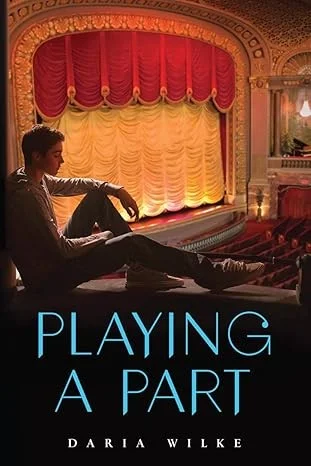
Playing a part
by Daria Wilke
- Publication Date:
- January 1st, 2015
- Publisher:
- Scholastic, Incorporated
- ISBN-13:
- 9780545726085
- ISBN-10:
- 0545726085
Why Playing a part Has Been Challenged
Reviewers have raised concerns that the novel's portrayal of certain characters relies on flattened, stereotyped traits rather than fuller characterization, particularly in how difference is depicted within the theater troupe. See more ↓
Challenged or banned in 1 state across 1 school district.
Overview
Daria Wilke's Playing a Part takes place almost entirely inside a puppet theater in Russia, a self-contained world that has raised Grishka from childhood. The company functions like an extended family, complete with its own rituals, hierarchies, and unspoken rules, and for most of his life Grishka has understood himself only in relation to it.
That stability erodes over the course of the novel. A close friend faces a serious medical procedure, the theater's finances deteriorate to the point of pushing longtime members out, and Sam, the company's jester and one of Grishka's most important confidants, prepares to leave for Holland. Each departure strips away a piece of the structure Grishka has relied on to define himself.
Without the theater to anchor him, Grishka is left uncertain about his own place and identity, both within the troupe and beyond it. The novel follows that unraveling as a quiet, internal reckoning rather than a dramatic crisis, tracking how the loss of a familiar world forces a young person to ask who he is apart from it.
A Coming-of-Age Story Told Through a Vanishing World
Wilke, herself connected to Russian puppet theater, uses the closed, ritualized life of the troupe as a lens for adolescence itself: a space with its own logic and safety that a young person eventually outgrows or loses. The novel's central tension is not a single event but a slow dissolution, mirroring how coming-of-age often means watching the structures of childhood give way rather than confronting one dramatic turning point.
The book also sits within a broader conversation about how young adult literature in translation handles depictions of sexuality and difference. As a Russian-authored novel that reached English-language readers through translation, it has been read partly as a window into how such themes are represented in a specific cultural and literary context, and partly as a text whose portrayals don't always translate comfortably across audiences.
Why Playing a Part Has Been Challenged
Most objections to this novel have been raised in the context of high school reading lists and classroom libraries, with critics arguing that its themes and characterizations require the judgment of an older teen audience rather than younger middle-grade readers. Specifically, challengers have pointed to the character of Sam, whose sexuality is a defining feature of his role in the story, as content some parents and reviewers consider inappropriate for school settings.
A separate line of criticism concerns how certain characters are drawn. Reviewers have described some of the novel's characterizations as leaning on reductive or stereotyped traits rather than fuller, more individualized portrayals, and have argued that this undercuts the book's otherwise sympathetic treatment of its cast. Taken together, these concerns—content involving a gay character and characterizations viewed as stereotypical—have driven the removal or restriction requests recorded for this title, which include challenges tracked in 1 state and 1 district in this catalog.
Where to Buy




Affiliate links may generate a small commission at no extra cost to you, which helps support this site.
Banned in Schools
Banned or challenged in 1 state across 1 school district.
Kentucky 1 district
- Boyle County Schools Banned