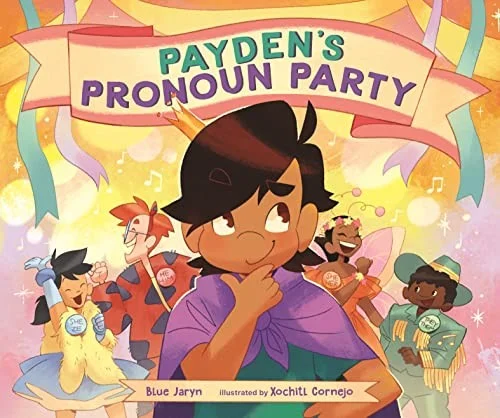
Payden's Pronoun Party
by Blue Jaryn
- Publication Date:
- January 1st, 2022
- Publisher:
- Page Street Publishing Company
- ISBN-13:
- 9781645675587
- ISBN-10:
- 1645675580
- Pages:
- 32
Why Payden's Pronoun Party Has Been Challenged
Objections to this title track closely with those raised against other pronoun- and gender-identity-themed picture books aimed at young children. See more ↓
Challenged or banned in 1 state across 1 school district.
Overview
Payden's Pronoun Party is a picture book by Blue Jaryn built around a simple, celebratory premise: a party where the guest of honor's pronouns are part of the occasion being marked. As the title suggests, the book uses the familiar, low-stakes framework of a birthday party to walk young readers through the idea that people use different words to refer to themselves, and that those words are worth knowing and respecting.
Like much of the picture-book genre it belongs to, the book appears designed less as a plot-driven story than as a gentle teaching tool, pairing an accessible social occasion with vocabulary a young child might not yet have encountered. The "party" conceit gives the material a festive, non-confrontational tone rather than a lecture-like one.
Because no descriptive text accompanies the catalog record for this title, specifics of its narrative arc, illustration style, or supporting cast are not detailed here. What can be said with confidence is the book's evident purpose: introducing pronouns, and by extension gender identity, as an early-childhood literacy topic.
Context and Themes
Picture books that address pronouns directly emerged as a distinct subgenre of children's literature in the early 2020s, alongside broader growth in inclusive and identity-affirming titles for early readers. These books typically sit at the intersection of two aims: building basic literacy skills (naming, labeling, vocabulary) and normalizing conversations about gender for an audience too young for more complex or clinical treatments of the subject.
Payden's Pronoun Party fits within that wave. Its use of a party — a format already legible to small children as something to look forward to — signals an intent to make unfamiliar vocabulary feel welcoming rather than didactic. That approach mirrors a broader trend in early-childhood publishing, where social-emotional concepts (feelings, friendship, difference) are frequently taught through everyday, celebratory scenarios rather than direct instruction.
The book's place in library and classroom collections has made it emblematic of a larger debate over which social concepts belong in early-childhood materials, and who — parents, educators, or publishers — should decide.
Why Payden's Pronoun Party Has Been Challenged
Objections to this title track closely with those raised against other pronoun- and gender-identity-themed picture books aimed at young children. Challengers have generally argued that the subject matter — pronoun choice as an expression of gender identity — is inappropriate for the developmental stage of the book's intended readers, and that introducing the concept in a school or public library setting oversteps decisions they believe belong with parents.
A related line of objection concerns framing rather than content: critics contend that presenting pronoun usage as a celebratory, settled norm (via the "party" device) forecloses discussion rather than opening it, which some parents and community members view as advocacy embedded in what looks like a neutral literacy exercise.
These concerns have led to the book being challenged in 1 state and 1 district tracked in this catalog, consistent with the broader pattern of contestation surrounding gender-identity picture books in recent years.
Where to Buy


Affiliate links may generate a small commission at no extra cost to you, which helps support this site.
Banned in Schools
Banned or challenged in 1 state across 1 school district.