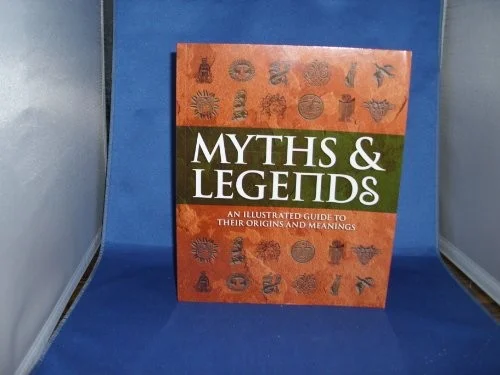
Myths & Legends an Illustrated Guide to Their Origins and Meanings
- Publication Date:
- May 25th, 2011
- Publisher:
- covent garden books
- ISBN-13:
- 9780756674908
- ISBN-10:
- 0756674905
- Pages:
- 352
Why Myths & Legends an Illustrated Guide to Their Origins and Meanings Has Been Challenged
Critics have taken issue with the book's frank illustrations of violence and taboo behavior in ancient myth, and with its practice of describing world religions and folklore side by side without distinguishing one from the other. See more ↓
Challenged or banned in 1 state across 1 school district.
Overview
Myths & Legends: An Illustrated Guide to Their Origins and Meanings is a reference work that surveys the mythological traditions of cultures across the globe, from the pantheons of ancient Greece and Rome to the origin stories of Africa, Asia, the Americas, and the Pacific. Philip Wilkinson organizes the material less as a linear narrative than as a guided tour, moving between creation stories, hero cycles, tricksters, and cosmic battles to show how different societies have used story to explain the natural world and human nature.
The illustrated format is central to the book's approach. Images of sculpture, painting, and ritual objects accompany the text, situating each myth within the visual culture that produced or preserved it. Rather than treating mythology as a fixed body of ancient trivia, the book frames these stories as living systems of symbol and meaning that continue to inform art, language, and belief.
Because the book's scope is comparative, it repeatedly draws connections across traditions, noting where flood narratives, trickster figures, or underworld journeys recur in unrelated cultures. This structure invites readers to see mythology as a shared human vocabulary rather than a set of isolated curiosities belonging to any one civilization.
A Reference Point in the Study of World Mythology
Illustrated mythology guides occupy a particular niche in reference publishing: they are meant to be dipped into rather than read cover to cover, serving students, artists, and general readers who need a quick, visually grounded orientation to unfamiliar belief systems. Wilkinson's book sits within a long tradition of such compendiums, distinguished by its emphasis on pairing narrative summary with visual evidence drawn from the material record.
The book's comparative method also places it within an ongoing conversation about how mythology should be taught and presented. Rather than privileging any single tradition as a default "classical" canon, it treats Norse, Mesoamerican, and East Asian mythologies with the same descriptive attention given to Greco-Roman sources. That even-handedness is part of what makes the book useful as a general reference, but it is also what has occasionally drawn scrutiny when it appears on shelves alongside more narrowly focused mythology titles.
Why Myths & Legends Has Been Challenged
A parent raised the book with a school library committee after finding it shelved in the section browsed by younger students, arguing that its unflinching descriptions of ritual sacrifice, sexual violence among the gods, and graphic accounts of death in various origin stories were inappropriate without an adult guide present to contextualize them. The complaint centered less on any single passage than on the cumulative effect of presenting so many cultures' most violent or taboo stories in one illustrated volume aimed, in the parent's view, at an audience too young to process them critically.
Other objections have focused on the book's treatment of religion itself, with some challengers uneasy about a reference work that discusses gods, creation, and the afterlife across many traditions in the same neutral, descriptive register, without distinguishing living faiths from stories treated as purely legendary. Critics of this framing have argued it can read as either dismissive of religious belief or, conversely, as lending equal credibility to belief systems some parents did not want presented to their children without qualification. This book has been challenged in 1 state and 1 district tracked in this catalog, reflecting a narrower but still notable pattern of concern.
Where to Buy


Affiliate links may generate a small commission at no extra cost to you, which helps support this site.
Banned in Schools
Banned or challenged in 1 state across 1 school district.
Tennessee 1 district
- Oak Ridge Schools Banned