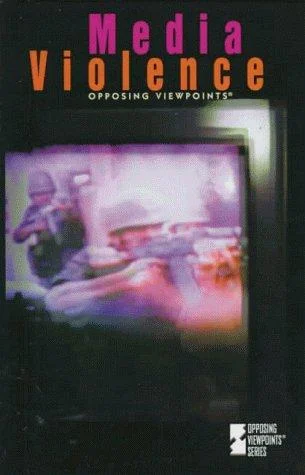
Media violence
- Publication Date:
- January 1st, 1999
- Publisher:
- Greenhaven Press
- ISBN-13:
- 9781565109445
- ISBN-10:
- 1565109457
- Pages:
- 186
Why Media violence Has Been Challenged
Critics have pushed back less on the book's arguments than on the graphic media descriptions it quotes to make them, worrying that presenting both sides so evenly leaves students without guardrails against normalizing violent content. See more ↓
Challenged or banned in 1 state across 1 school district.
Overview
Media Violence, compiled by William Dudley, gathers essays, research summaries, and opinion pieces that argue opposing sides of a long-running public debate: does exposure to violent film, television, and video games make audiences more aggressive, or is the link overstated and misused to justify censorship? Rather than advancing a single thesis, the book is structured as a point-counterpoint reader, pairing selections that draw on psychological studies, industry statements, and cultural criticism.
Readers move through sections that frame the question from different angles: the strength and limits of social-science evidence, the responsibilities of entertainment producers, the role of parents and ratings systems, and the constitutional questions raised whenever regulation of content is proposed. Each piece is attributed to its original author, and the collection's value lies in juxtaposition rather than narrative.
The book belongs to a genre of classroom-oriented anthologies built explicitly for debate, research papers, and critical reading exercises, in which disagreement is the point rather than a flaw.
A Recurring Flashpoint in Media Criticism
The question of whether depicted violence shapes real-world behavior has resurfaced with every new medium, from comic books in the 1950s to television in the 1970s, video games in the 1990s, and streaming and online platforms since. Dudley's compilation sits squarely in that lineage, assembling voices from researchers, advocacy groups, and media professionals who disagree not only on conclusions but on what counts as credible evidence in the first place.
What makes the collection notable is its refusal to resolve the dispute. Some contributors cite experimental studies linking violent content to short-term aggression; others argue that correlation has been mistaken for causation, or that broader social factors are overlooked. By presenting both camps without adjudicating between them, the book positions itself as a tool for developing argumentative literacy as much as a resource on its nominal subject.
Why Media Violence Has Been Challenged
Anthologies like this one are typically assigned for exactly the quality that also draws scrutiny: they place frank, sometimes graphic descriptions of violent media content alongside arguments for and against regulating it, without steering readers toward a conclusion. That evenhandedness, prized by teachers building debate and persuasive-writing units, is the same quality that has unsettled some parents and reviewers, who object less to the book's argument than to the source material it quotes and summarizes in order to make that argument. Challenges have centered on passages describing violent scenes from film, television, and games, concerns that discussing media violence in detail risks normalizing or sensationalizing it, and broader discomfort with assigning students a text that presents arguments for permissive content standards without clear editorial rebuttal. In the catalog tracked here, the book has been challenged in 1 state and 1 district, with objections falling into these categories rather than disputes over factual accuracy.
Where to Buy




Affiliate links may generate a small commission at no extra cost to you, which helps support this site.
Banned in Schools
Banned or challenged in 1 state across 1 school district.
Tennessee 1 district
- Monroe County Schools Banned