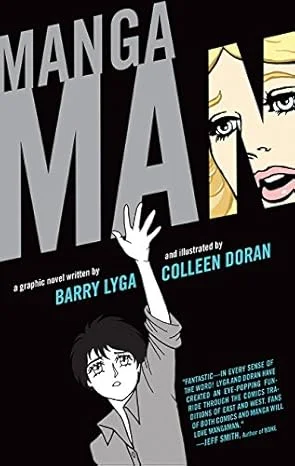
Mangaman
by Barry Lyga
- Publication Date:
- November 6th, 2012
- Publisher:
- Houghton Mifflin Harcourt
- ISBN-13:
- 9780547852133
- ISBN-10:
- 0547852134
- Pages:
- 125
Why Mangaman Has Been Challenged
Mangaman has been removed from Natrona County Schools in Wyoming and Wilson County Schools in Tennessee. See more ↓
Challenged or banned in 2 states across 2 school districts.
About Mangaman
Mangaman is a graphic novel by Barry Lyga, illustrated by Colleen Doran, published by Houghton Mifflin Harcourt in 2011. It operates on a premise that is both visually clever and thematically earnest: Ryoko Kiyama is a character from a Japanese manga who falls through a rip in reality and lands in an American high school. The visual conceit — Ryoko is literally drawn in a manga style while everyone around him is illustrated in a western comics style — is used to explore outsider identity, cultural collision, and the experience of being visibly, irreducibly different.
Ryoko can't help standing out. He doesn't look like anyone else; his very existence is rendered in a different visual language. When he makes contact with real-world objects and people, the styles blur and distort — physics doesn't quite work the same way for him. And yet he is, beneath the foreign lines and shading, a young person trying to figure out where he belongs and how to connect with others across what seems like an unbridgeable distance.
Themes of Otherness and Identity
The cultural commentary in Mangaman is more sophisticated than the premise might suggest. The gap between Japanese and American visual storytelling traditions is real and historically rich, and using it as a literal plot device allows Lyga and Doran to explore ideas about cultural identity, assimilation, and the way we categorize people by the rules of the world they come from rather than who they are.
Ryoko's attempts to navigate an American high school — the social hierarchies, the romantic complications, the baffling customs — are played for both humor and genuine pathos. The love interest subplot gives the story its emotional trajectory: what would it mean to fall for someone whose reality is fundamentally incompatible with yours?
Doran's artwork manages the tonal balancing act with skill. The visual contrast between styles is consistent and inventive, and the moments where the styles bleed into each other are used to signal emotional rather than just physical contact.
Why It Has Been Challenged
Mangaman has been removed from Natrona County Schools in Wyoming and Wilson County Schools in Tennessee. The challenges have cited the book's cartoon depiction of nudity — Ryoko exists in a different physical relationship to clothing than the real-world characters around him, and this is handled with the kind of comic-strip innocence typical of the manga tradition — and its treatment of romantic and physical themes.
The book is a graphic novel aimed at middle grade and young adult readers. Its approach to the human body and to romantic feeling is consistent with mainstream manga conventions and is not salacious. The challenges to Mangaman reflect a broader pattern of discomfort with visual storytelling in school settings, where graphic novels face scrutiny that prose books with equivalent content do not.
Where to Buy


Affiliate links may generate a small commission at no extra cost to you, which helps support this site.
About Barry Lyga

Barry Lyga is an American young adult novelist and short story writer born on September 11, 1971, in New York. A Yale graduate in English, he spent ten years at Diamond Comic Distributors before turning to fiction full-time with his debut novel, The Astonishing Adventures of Fanboy and Goth Girl, in 2006. He is best known for the I Hunt Killers trilogy and for writing unflinchingly about difficult subjects including sexual abuse, violence, and obsession.
Also by Barry Lyga
Banned in Schools
Banned or challenged in 2 states across 2 school districts.
Tennessee 1 district
- Wilson County Schools Banned
Wyoming 1 district
- Natrona County Schools Banned by restriction