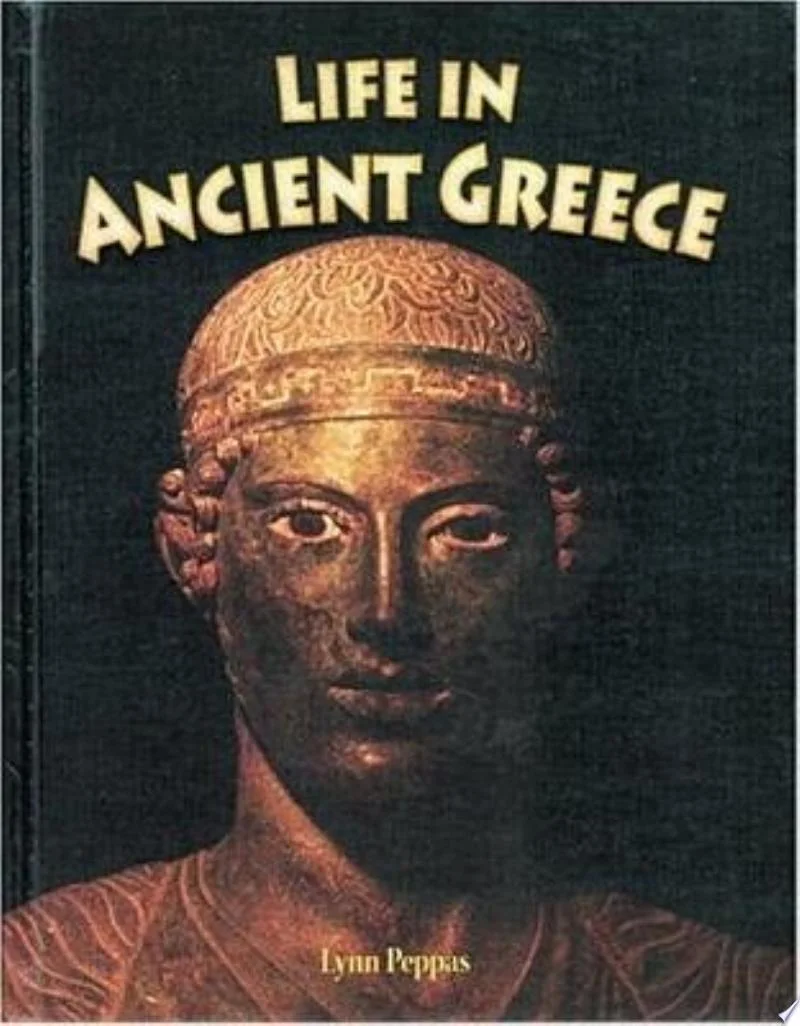
Life in Ancient Greece
by Lynn Peppas
- Publication Date:
- January 1st, 2005
- Publisher:
- Crabtree Publishing Company
- ISBN-13:
- 9780778720355
- ISBN-10:
- 0778720357
- Pages:
- 36
Why Life in Ancient Greece Has Been Challenged
Some readers have questioned whether a young audience should encounter ancient Greek religion and warfare presented as straightforward historical fact rather than softened or contextualized content. See more ↓
Challenged or banned in 1 state across 1 school district.
Overview
Lynn Peppas's Life in Ancient Greece is a nonfiction survey aimed at young readers, organized around the institutions and figures that defined the ancient Greek world. The book moves between large historical forces and specific personalities, introducing readers to the mechanics of early democratic government alongside the military rivalry between Athens and Sparta.
Cultural achievements receive equal attention. Peppas devotes space to Greek poetry and the athletic tradition of the Olympic Games, framing both as contributions that outlasted the civilization that produced them. The pantheon of Greek gods and goddesses appears as a recurring thread, tying together explanations of religious practice, mythology, and everyday belief.
Historical narrative anchors the more thematic material: the Peloponnesian War and the career of Alexander the Great are presented as turning points that reshaped the Greek-speaking world and extended its influence well beyond the Aegean peninsula.
An Ancient World Read Through Its Legacy
The book's organizing idea is continuity rather than distance: it treats ancient Greece not as a closed chapter but as a civilization whose institutions and ideas persist in recognizable form. Democracy, competitive athletics, and literary tradition are each presented as inheritances rather than curiosities, inviting young readers to connect ancient practices to their own civic and cultural surroundings.
That framing situates the book within a broader genre of classroom-oriented world history titles designed to compress a sprawling civilization into an accessible overview. Its structure—moving between government, culture, religion, and war—reflects how ancient Greece is typically taught at the elementary and middle-grade level, balancing the achievements of Athens with the militarism of Sparta and the imperial ambitions that followed both.
Why Life in Ancient Greece Has Been Challenged
Disputes over this title have generally centered on whether its subject matter suits the shelves or classrooms where it was placed, rather than on any single passage. Because the book treats Greek religion as a functioning belief system—describing gods, goddesses, and the rituals surrounding them—some objectors have framed its content as inappropriate exposure to polytheistic mythology for young readers, particularly in educational settings with religiously mixed audiences.
Other concerns have touched on the book's treatment of warfare, including the Peloponnesian War and the conquests of Alexander the Great, which some readers have considered too intense or militaristic for the age group the book otherwise targets. Taken together, the objections reflect unease with how a historically accurate account of an ancient civilization handles religion and violence for a young audience, rather than any dispute over the book's factual content. The catalog currently records a single challenge, spanning one state and one school district.
Where to Buy




Affiliate links may generate a small commission at no extra cost to you, which helps support this site.
Banned in Schools
Banned or challenged in 1 state across 1 school district.
Tennessee 1 district
- Monroe County Schools Banned