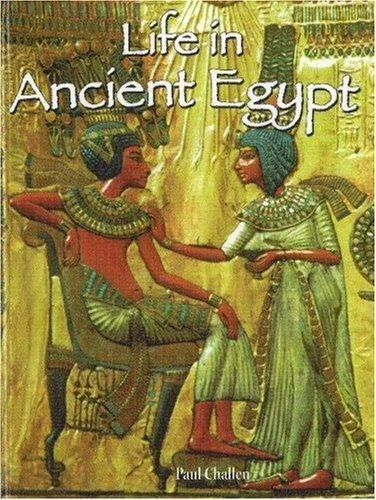
Life in ancient Egypt
by Paul Challen
- Publication Date:
- January 1st, 2005
- Publisher:
- Crabtree Pub. Co.
- ISBN-13:
- 9780778720683
- ISBN-10:
- 0778720381
- Pages:
- 32
Why Life in ancient Egypt Has Been Challenged
Some parents and educators have pushed back on this title's frank, illustrated treatment of mummification and ancient religious ritual, arguing it exposes young readers to death and belief systems before they're ready for them. See more ↓
Challenged or banned in 1 state across 2 school districts.
Overview
Paul Challen's Life in Ancient Egypt belongs to a familiar shelf of classroom nonfiction: a compact survey meant to walk young readers through one of history's most enduring civilizations. Rather than following a single narrative thread, it moves topically, covering how the Nile shaped settlement and agriculture, how Egyptian society was organized from pharaoh to laborer, and how religious belief touched nearly every aspect of daily and civic life.
Books of this kind are built for the classroom and library research shelf as much as for cover-to-cover reading. Chapters are typically short, illustrated with artifacts, maps, and reconstructed scenes, and paired with captions or sidebars meant to anchor a single fact or concept per page. The intent is less to tell a story than to furnish a working vocabulary and visual sense of a civilization students encounter in social studies curricula.
What distinguishes an ancient Egypt title from many other ancient-civilization surveys is the sheer visual and conceptual weight of its subject's relationship to death: tombs, mummification, and the afterlife are not incidental details but central organizing ideas of the culture being described, which shapes how such a book is structured and illustrated.
Ancient Egypt as a Subject for Young Readers
Few ancient civilizations occupy as much space in elementary and middle-grade curricula as Egypt, and few are taught through imagery as distinctive: hieroglyphics, pyramids, and preserved bodies offer a visceral entry point into the idea that people in the distant past lived, worshipped, and died differently than readers do today. That same vividness is what makes Egypt a perennial favorite for publishers producing curriculum-support nonfiction, since the subject essentially supplies its own illustrations.
Books in this genre also sit at an interesting pedagogical crossroads. They are asked to be simultaneously accurate to archaeological and historical scholarship, engaging enough to hold a young reader's attention, and brief enough to function as reference material rather than a full history. That compression means difficult or mature aspects of the civilization, such as its funerary practices or its many gods, often appear stripped of context that an older reader might expect, which can leave the material open to differing interpretations of what is age-appropriate.
Why Life in Ancient Egypt Has Been Challenged
The pages most likely to draw attention in a book like this are the ones devoted to mummification and burial: illustrations or descriptions of embalming, organ removal, and the preparation of a body for the afterlife. Objectors to this kind of content in materials intended for young or elementary-age readers have argued that detailed treatment of death and the handling of corpses is too graphic or unsettling for the age group, regardless of its historical accuracy or educational purpose.
A second recurring concern involves the book's necessary treatment of ancient Egyptian religion, including its polytheistic belief system and depictions of gods and ritual practice. Some challenges to educational texts on ancient civilizations stem from discomfort with presenting non-Christian belief systems to children in a matter-of-fact, descriptive way, even when the material is framed historically rather than devotionally. In the catalog tracked here, Life in Ancient Egypt has been challenged in 1 state and 2 districts, reflecting these kinds of concerns about subject matter rather than any single disputed passage.
Where to Buy



Affiliate links may generate a small commission at no extra cost to you, which helps support this site.
Banned in Schools
Banned or challenged in 1 state across 2 school districts.
Tennessee 2 districts
- Monroe County Schools Banned
- Oak Ridge Schools Banned