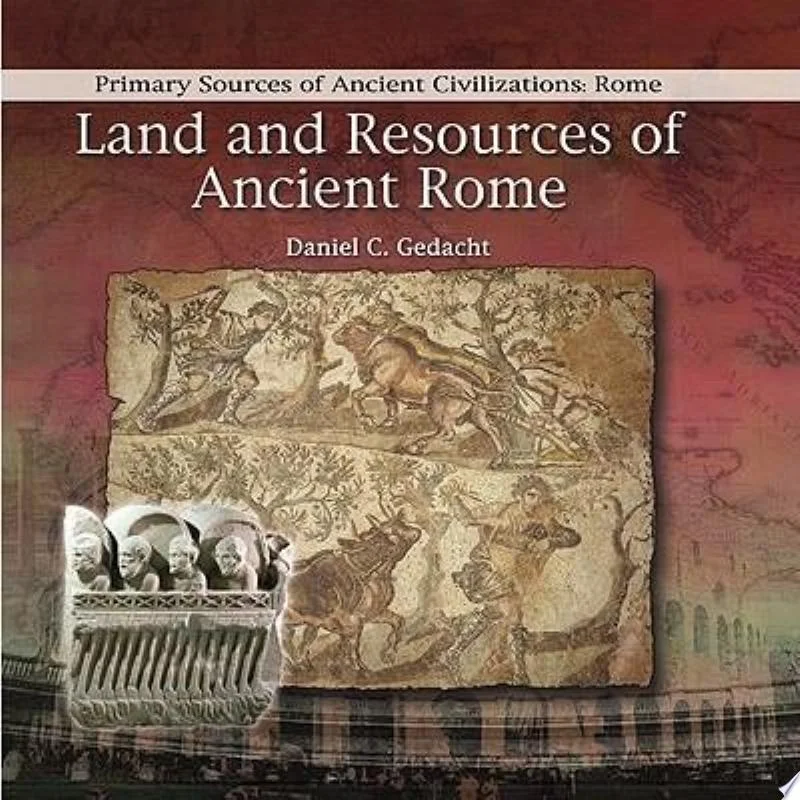
Land and Resources of Ancient Rome
- Publication Date:
- December 15th, 2003
- Publisher:
- The Rosen Publishing Group, Inc
- ISBN-13:
- 9780823967759
- ISBN-10:
- 0823967751
- Pages:
- 28
Why Land and Resources of Ancient Rome Has Been Challenged
Some parents and educators have questioned whether a book cataloging imperial land grabs and extracted resources gives students an unvarnished enough picture of what conquest actually cost the conquered. See more ↓
Challenged or banned in 1 state across 1 school district.
Overview
Land and Resources of Ancient Rome by Daniel C. Gedacht approaches Roman history through geography and material culture rather than emperors and battles. The book opens with the Italian peninsula itself: its fertile soil, temperate growing seasons, and position at the center of Mediterranean shipping routes that let goods, people, and ideas move between Rome and its provinces.
From there the book widens its lens to the empire's diverse climates, from the arid edges of North Africa to the wetter reaches of Gaul and Britain, and the practical challenges those conditions posed for farming, construction, and supply. Building stone receives particular attention, with limestone singled out as a material that shaped how Roman cities, roads, and monuments were physically built.
The final thread follows what Rome took from the territories it conquered: timber, metals, grain, and other raw materials that were absorbed into the imperial economy. Taken together, the book presents Rome less as a story of conquest for its own sake and more as a case study in how a civilization's reach was enabled, and limited, by the land beneath it.
Rome as a Study in Geography and Power
The book sits within a genre of educational nonfiction that reframes familiar history through an environmental or economic lens, asking not just what happened but what made it possible. By centering land, climate, and material resources, it invites young readers to think about ancient Rome the way a geographer or economist might, as a system dependent on soil, sea lanes, and stone, rather than only as a sequence of political events.
This approach places the book in company with resource-focused histories that treat empires as extraction systems, a framing that has become increasingly common in classroom materials as educators look for ways to connect ancient civilizations to modern conversations about trade, sustainability, and the uneven costs of expansion. The book's treatment of conquered territories' resources gestures toward this larger context without dwelling on it, keeping its focus squarely on description rather than argument.
Why Land and Resources of Ancient Rome Has Been Challenged
Much of the concern around this title has centered on where it belongs on a shelf and what reading level it assumes, rather than on any single passage. Because the book is written for younger students, some reviewers have asked whether its brief, matter-of-fact treatment of conquest and resource extraction adequately conveys the human cost behind those historical processes, or whether it risks presenting territorial acquisition as a simple matter of logistics.
Objecting reviewers have generally not disputed the book's factual content but have questioned its framing choices, arguing that a narrative organized around resources and materials can inadvertently soften the reality of conquered peoples losing control of their own land and goods. Records reviewed for this catalog show the book has been the subject of formal challenges in 1 state and 1 school district, reflecting a narrow but notable concern about how imperial history is presented to young readers rather than a broad pattern of objection.
Where to Buy



Affiliate links may generate a small commission at no extra cost to you, which helps support this site.
Banned in Schools
Banned or challenged in 1 state across 1 school district.
Tennessee 1 district
- Monroe County Schools Banned