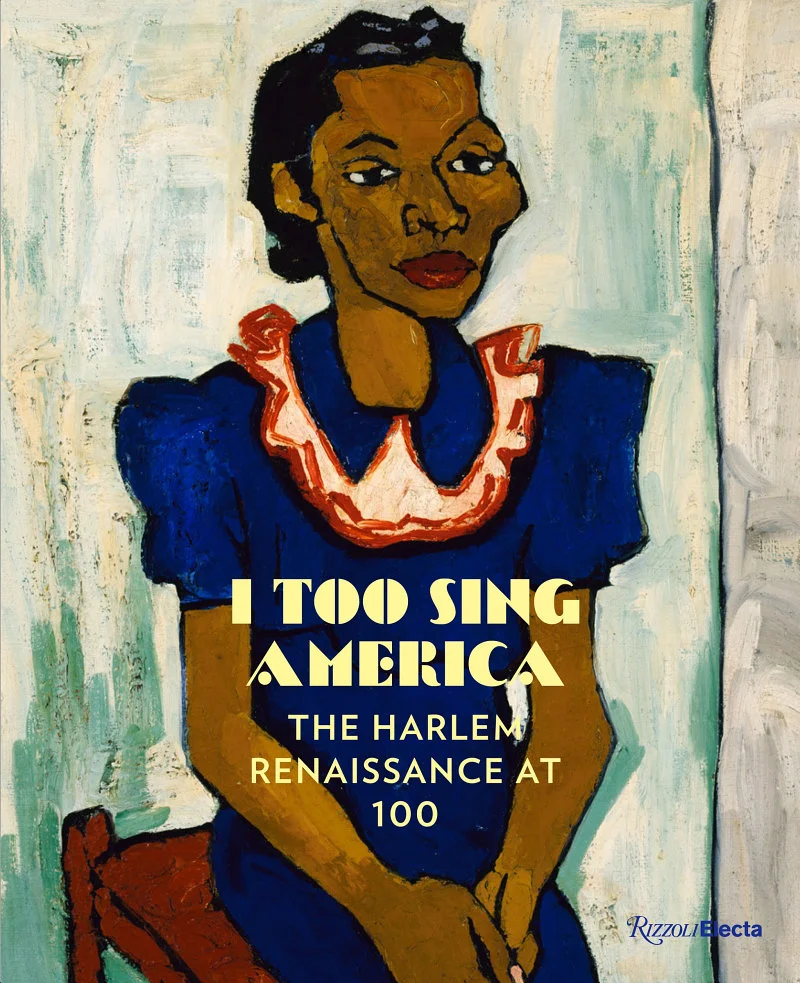
I Too Sing America
by Wil Haygood
- Publication Date:
- October 9th, 2018
- Publisher:
- Rizzoli Publications
- ISBN-13:
- 9780847863129
- ISBN-10:
- 0847863123
- Pages:
- 250
Why I Too Sing America Has Been Challenged
A complaint over this title has questioned whether a museum-style survey of Black artistic history is suitable material for a school setting rather than any specific image or passage within it. See more ↓
Challenged or banned in 1 state across 1 school district.
Overview
Wil Haygood assembles a wide-ranging visual history of the Harlem Renaissance, built around the painters, printmakers, photographers, and sculptors who gave the movement its lasting image. Artists including Romare Bearden, Jacob Lawrence, Archibald Motley, James Van Der Zee, Palmer Hayden, William Johnson, and Allan Rohan Crite appear throughout, their work reproduced alongside period documents and ephemera that root the art in its moment.
Rather than treating the Renaissance as a single style or school, Haygood organizes the material thematically, letting portraiture, street scenes, studio photography, and sculpture speak to different aspects of Black life in the decades following World War I. The visual record is set beside the era's writing and music, so that a painting and a poem or a photograph and a song are understood as part of one continuous cultural outpouring.
The book grew out of Haygood's long study of Harlem and accompanies a major museum exhibition, giving it the scope and physical heft of a catalogue meant to be lingered over rather than read in a single sitting.
A Movement Recovered Through Its Images
Haygood's premise is that the Harlem Renaissance cannot be fully understood through its famous poems and novels alone, and that the painters and photographers working alongside those writers deserve equal billing in the story of how Black American identity was reimagined in the 1920s and 1930s. The thematic structure allows the book to move between the intimate and the public: a studio portrait by Van Der Zee sits near the record of a rent party or a political rally, and a Bearden collage shares space with the social statistics of migration and urban crowding.
That framing places the book in conversation with decades of scholarship arguing that the Renaissance was never confined to Harlem itself, but radiated outward as artists carried its visual language to other cities and later movements. By insisting on the centrality of the visual arts, Haygood's account pushes back against readings of the period that treat painting and sculpture as a secondary accompaniment to its literary achievements.
Why I Too Sing America Has Been Challenged
A challenge to this title has centered on its inclusion in school art and history curricula as source material for discussing race in American life, with the objection framed around whether a survey of this kind belongs in classrooms rather than in a museum or library setting for adult readers. The underlying concern raised in that complaint is less about any single image than about the book's overall project of presenting African American history and culture as a subject worthy of sustained visual study, which some have argued amounts to an unbalanced or politically charged emphasis for students. The book has been challenged or restricted in 1 state and 1 school district tracked in this catalog, reflecting a narrow but notable instance of pushback against its use as educational material.
Because the volume functions as an illustrated history rather than a work of fiction, objections to it tend to engage with the broader question of how African American art and the social history surrounding it should be taught, rather than with any specific passage or image in isolation. That makes the dispute less about content warnings and more about curricular judgment: whether a comprehensive visual record of a formative American art movement is appropriate reading for the age group in question.
Where to Buy




Affiliate links may generate a small commission at no extra cost to you, which helps support this site.
Banned in Schools
Banned or challenged in 1 state across 1 school district.
Tennessee 1 district
- Oak Ridge Schools Banned