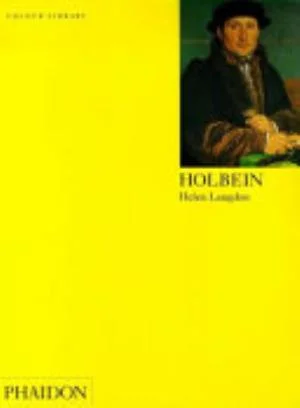
Holbein
- Publication Date:
- August 12th, 1998
- Publisher:
- Phaidon Press
- ISBN-13:
- 9780714828671
- ISBN-10:
- 071482867X
- Pages:
- 128
Why Holbein Has Been Challenged
A reviewer took issue with reproductions of period nudity in the book's religious and court imagery, questioning whether such plates belonged in a general art collection rather than treating them as part of Holbein's documented subject matter. See more ↓
Challenged or banned in 1 state across 1 school district.
Overview
Helen Langdon's study surveys the career of Hans Holbein the Younger, an artist best remembered for the penetrating portraits he made of the scholars, nobles, and officials who moved through the courts of northern Europe in the early sixteenth century. Rather than confining itself to that familiar reputation, the book widens the frame to show an artist working across many forms at once, from devotional paintings to printed illustrations to drawings meant to guide goldsmiths and tailors in their work.
Across its chapters, the book traces how a single sensibility carried through all of these projects: a draftsman's precision applied to surface, texture, and likeness, paired with a genuine curiosity about the people in front of him. Whether rendering the fur trim of a diplomat's robe or the folds of a religious subject's drapery, Holbein's technique served observation rather than flattery.
This edition builds on Langdon's original introduction with new illustrations selected by art historian James Malpas, who also supplies commentary on each color plate, situating individual works within the broader arc of Holbein's output.
An Artist Beyond the Court Portrait
Part of what makes this book useful is its insistence that Holbein cannot be reduced to one genre. The courtier portraits that made his name were only one strand of a working life that also included altarpieces, woodcut designs for printed books, and ornamental sketches for personal objects meant to be worn or carried. Reading these strands together complicates the idea of the Renaissance artist as a specialist, showing instead a figure who moved fluidly between sacred and secular commissions, between public image-making and private craft.
The book also sits within a long tradition of art-historical writing that treats technical mastery and emotional perception as inseparable. Langdon's original text, now supplemented by Malpas's plate-by-plate commentary, asks readers to look closely at how Holbein built a likeness, and to notice that the precision of his hand never crowded out his evident interest in the character of his sitters.
Why Holbein Has Been Challenged
A single district review of this title centered on whether the reproduced religious and courtly artworks, some including unclothed or partially clothed figures typical of Renaissance devotional and allegorical painting, were appropriate for the shelves where the book was placed, arguing that an art book intended for general or younger readers should not carry images of that kind regardless of their historical or scholarly context. The complaint reflects a recurring tension in how illustrated art history is shelved and reviewed: reproductions that scholars read as standard features of the period's religious and portrait traditions can register differently to a parent or reviewer encountering them without that context. This book has been documented as challenged or restricted in 1 state and 1 district within this catalog, a narrow footprint consistent with how infrequently art-history surveys draw formal objections compared to literary fiction.
Where to Buy




Affiliate links may generate a small commission at no extra cost to you, which helps support this site.
Banned in Schools
Banned or challenged in 1 state across 1 school district.
Tennessee 1 district
- Oak Ridge Schools Banned