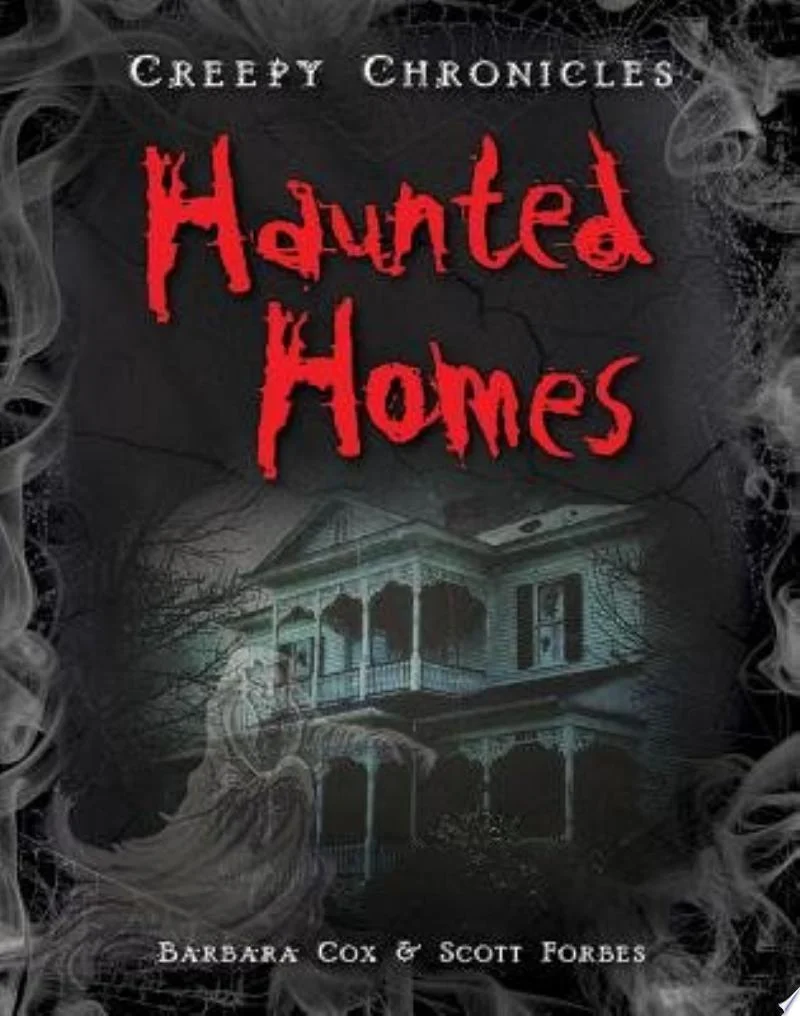
Haunted Homes
by Barbara Cox
- Publication Date:
- January 1st, 2014
- Publisher:
- Gareth Stevens Publishing LLLP
- ISBN-13:
- 9781482402308
- ISBN-10:
- 1482402300
- Pages:
- 34
Why Haunted Homes Has Been Challenged
Parents and reviewers have pushed back against the book less for what it teaches than for how unflinchingly it depicts the demons and undead figures meant to illustrate that lesson. See more ↓
Challenged or banned in 1 state across 1 school district.
Overview
Barbara Cox's Haunted Homes takes young readers room by room through a house that isn't quite empty. Rather than treating hauntings as a single, generic idea, the book sorts its subjects into distinct categories of supernatural visitor: the restless dead, the mischievous or malevolent poltergeist, and the vampire drawn less from folklore footnotes than from the shared cultural imagination of what haunts a home at night.
A recurring move in the book is etymological: it lingers on where a word like "nightmare" actually comes from, tracing it back to old beliefs about a demon that presses on a sleeper's chest. That kind of origin story sets the tone for the whole collection, which treats fear less as something to simply provoke and more as something with a history worth explaining.
Illustrations carry as much of the book's argument as the text does. Rendered with enough detail and shadow to feel unsettling rather than cartoonish, they're positioned as the book's real showcase, giving shape to figures that are otherwise described only in folklore and half-remembered stories.
Folklore as a Gateway to History
Haunted Homes sits within a familiar tradition of children's nonfiction that uses the appeal of the frightening or the strange to smuggle in actual research. Ghost stories and vampire legends are not treated as isolated spooky trivia; they're framed as artifacts of specific cultures and belief systems, with the Norse mythology behind the "night mare" serving as the clearest example of a folk explanation for something universally human: bad dreams.
That framing places the book in conversation with a broader question about how much unsettling material belongs in books aimed at younger readers, and whether the answer changes when the material is presented as cultural history rather than invention. The book's evident interest in etymology and cross-cultural belief suggests an ambition beyond a simple parade of monsters — it wants readers curious about why these figures exist in the first place, not just what they look like.
Why Haunted Homes Has Been Challenged
Reviewers and readers drawn to the book tend to praise exactly what makes some parents uneasy: its willingness to render supernatural threats vividly rather than softening them for a young audience. The same illustrations celebrated for making poltergeists and vampires feel almost real are the ones cited when the book is challenged, and the tension between craft and comfort sits at the center of most objections.
The substance of those objections centers on age-appropriateness rather than factual accuracy. Critics point to the book's frank engagement with demons, death, and predatory undead figures as unsuitable for the elementary-age readers who make up its likely audience, arguing that detailed depictions of frightening supernatural beings can be genuinely disturbing regardless of the folkloric context surrounding them. Some objections also extend to the book's treatment of religious and mythological belief systems, questioning whether presenting demons and spirits as historical fact blurs a line that nonfiction shelving is supposed to keep clear. In the catalog tracked here, that discomfort has translated into a challenge recorded in one state and one district.
Where to Buy



Affiliate links may generate a small commission at no extra cost to you, which helps support this site.
Banned in Schools
Banned or challenged in 1 state across 1 school district.
Tennessee 1 district
- Monroe County Schools Banned