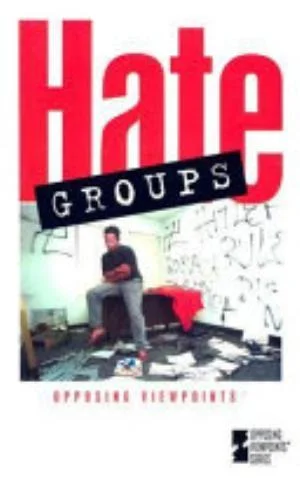
Hate Groups
- Publication Date:
- January 1st, 2004
- Publisher:
- Greenhaven Press, Incorporated
- ISBN-13:
- 9780737722819
- ISBN-10:
- 0737722819
Why Hate Groups Has Been Challenged
Critics have pushed back on a book that lets extremist voices speak for themselves, worried that presenting bigoted arguments without sufficient rebuttal could normalize them for student readers. See more ↓
Challenged or banned in 1 state across 1 school district.
Overview
This volume gathers opposing essays on a question that resists easy consensus: how seriously should a pluralistic society take organized hatred within its own borders? Rather than offering a single narrative or argument, the collection assembles voices from across the ideological spectrum, each making a case about the scale, danger, and proper response to groups organized around racial or religious animus.
The essays split along a few recurring fault lines. Some contributors argue that white supremacist and similar organizations represent a persistent, under-addressed threat to public safety and social cohesion. Others contend that their numbers and influence are routinely overstated, and that treating them as a major crisis can distract from more diffuse forms of prejudice or infringe on unpopular speech.
A second strand of debate concerns hate crime legislation specifically: whether a crime motivated by bigotry warrants a harsher sentence than an otherwise identical act, or whether such laws risk punishing belief rather than conduct. The book does not resolve these disputes; it presents them side by side for the reader to weigh.
Context and Purpose
"Hate Groups" belongs to a genre of classroom-oriented anthologies built explicitly around controversy, where the goal is less to persuade than to model how reasonable people disagree. Its structure assumes a reader capable of holding two incompatible arguments in mind at once and evaluating the evidence behind each, a skill the collection treats as central to civic education.
That format places the book in an unusual position: its content is not a single author's thesis but a curated argument between positions, some of which are deliberately provocative or minimize concerns that other contributors raise. The book's value, and the source of most objections to it, lies precisely in that juxtaposition rather than in any conclusion it reaches.
Why Hate Groups Has Been Challenged
Much of the dispute over this title centers less on whether the subject belongs in a library at all than on where it should sit and at what age students should encounter it unguided. Because the book presents extremist viewpoints in their own words, including arguments that downplay the threat posed by organized bigotry, some reviewers worry that excerpting such material without heavier editorial framing risks lending it undue credibility, particularly for younger or unsupervised readers.
Other objections focus on the book's unflinching engagement with racist and discriminatory ideology as subject matter, regardless of the critical frame surrounding it. Critics in this camp argue that reproducing hate-group rhetoric, even for analysis, exposes readers to language and ideas they find inappropriate for a school setting. The debate over hate crime penalties included in the collection has drawn separate criticism from those who see the topic as inherently political and ill-suited to curricular materials. According to the records this catalog tracks, the book has drawn a formal challenge in one state and one school district.
Where to Buy




Affiliate links may generate a small commission at no extra cost to you, which helps support this site.
Banned in Schools
Banned or challenged in 1 state across 1 school district.
Tennessee 1 district
- Monroe County Schools Banned