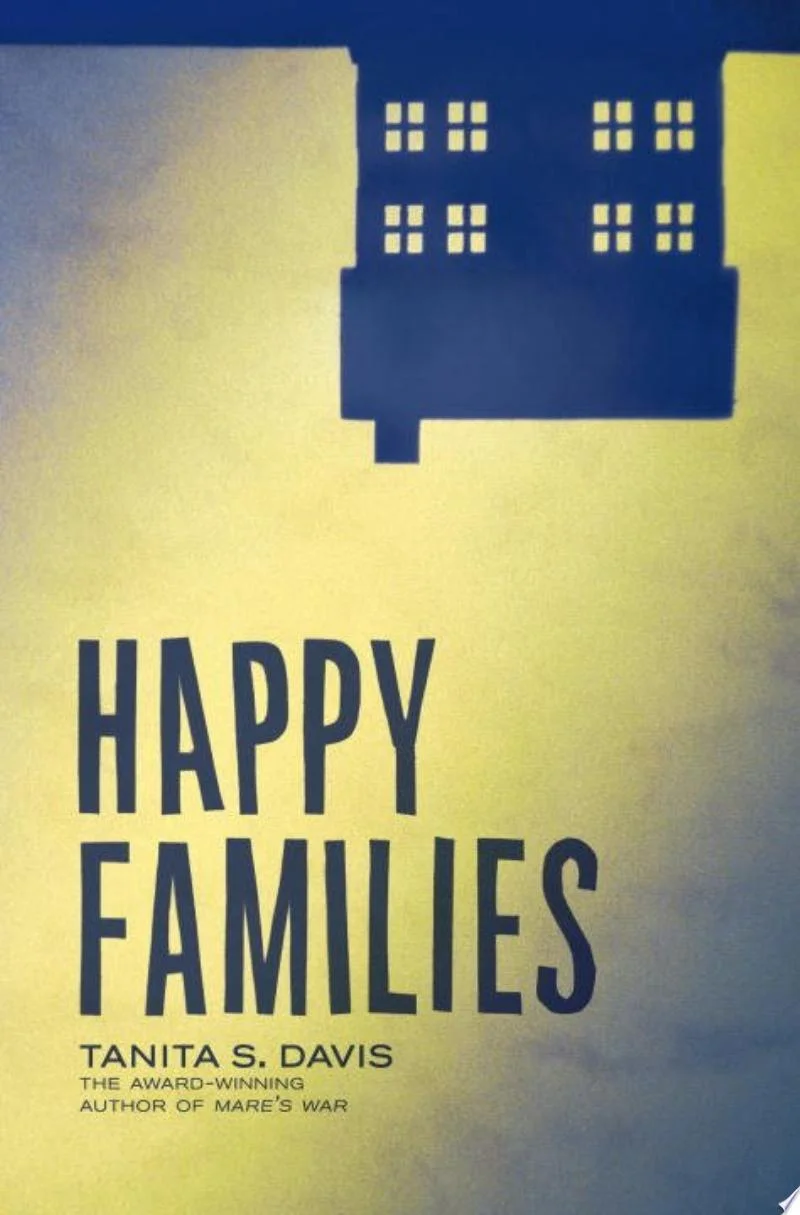
Happy Families
- Publication Date:
- May 8th, 2012
- Publisher:
- Knopf Books for Young Readers
- ISBN-13:
- 9780375984570
- ISBN-10:
- 0375984577
- Pages:
- 242
Why Happy Families Has Been Challenged
This novel has drawn scrutiny for centering a father's gender transition and asking young readers to follow his children through the fallout, a premise some parents feel is unsuited to school shelves. See more ↓
Challenged or banned in 1 state across 1 school district.
Overview
Tanita S. Davis centers her novel on Ysabel and Justin Nicholas, sixteen-year-old twins whose lives seem enviably on track: Ysabel's handcrafted jewelry has drawn real attention, and Justin's academic record points toward an ambitious future. Their household, by their own account, is a stable and affectionate one.
That stability is tested when the twins learn that their father has been keeping something from them, a revelation that unsettles their sense of who he is and what their family will look like going forward. The novel unfolds over a single spring break, compressing the twins' shock, confusion, and eventual reckoning into a short, intense stretch of time.
Told through the alternating perspectives of Ysabel and Justin, the story follows each twin's distinct way of processing the same news, one guarded and withdrawn, the other more openly upset, as they try to decide whether the family they've always known can survive in a new form.
A Story About Identity Within the Family
Davis, known for young adult fiction that treats coming-of-age struggles with restraint rather than melodrama, uses the twins' dual narration to examine how the same disclosure can land completely differently on two people who grew up in the same house. Rather than framing the father's secret as a scandal to be resolved, the novel is more interested in the slower, harder work of redefinition: what the twins owe their father, what they owe each other, and whether "happy family" was ever a fixed thing to begin with.
The book fits within a broader wave of YA literature from the 2010s that took seriously the experience of children whose parents come out later in life, treating it as a family drama rather than a single-issue message book. Its close focus on the twins' interior lives, jealousy, loyalty, and fear of losing status among peers, keeps the story grounded in ordinary adolescent concerns even as it handles unfamiliar territory for its young narrators.
Why Happy Families Has Been Challenged
A parent objection to the novel's presence in a middle or high school library centered on the idea that the father's transition asks students to sympathize with an adult decision that upends his children's lives, arguing that the book normalizes family disruption rather than presenting it as something to be resisted. The complaint framed the twins' distress as evidence that the material was inappropriate for younger readers rather than as the emotional honesty the novel was aiming for.
Beyond that specific concern, most objections to the book track back to its handling of a parent's gender identity and the ripple effects on adolescent children, subject matter some parents and board members have argued belongs to family discussion rather than school shelves. In the catalog tracked here, that concern has resulted in one recorded challenge across a single state and a single school district.
Where to Buy



Affiliate links may generate a small commission at no extra cost to you, which helps support this site.
Banned in Schools
Banned or challenged in 1 state across 1 school district.